
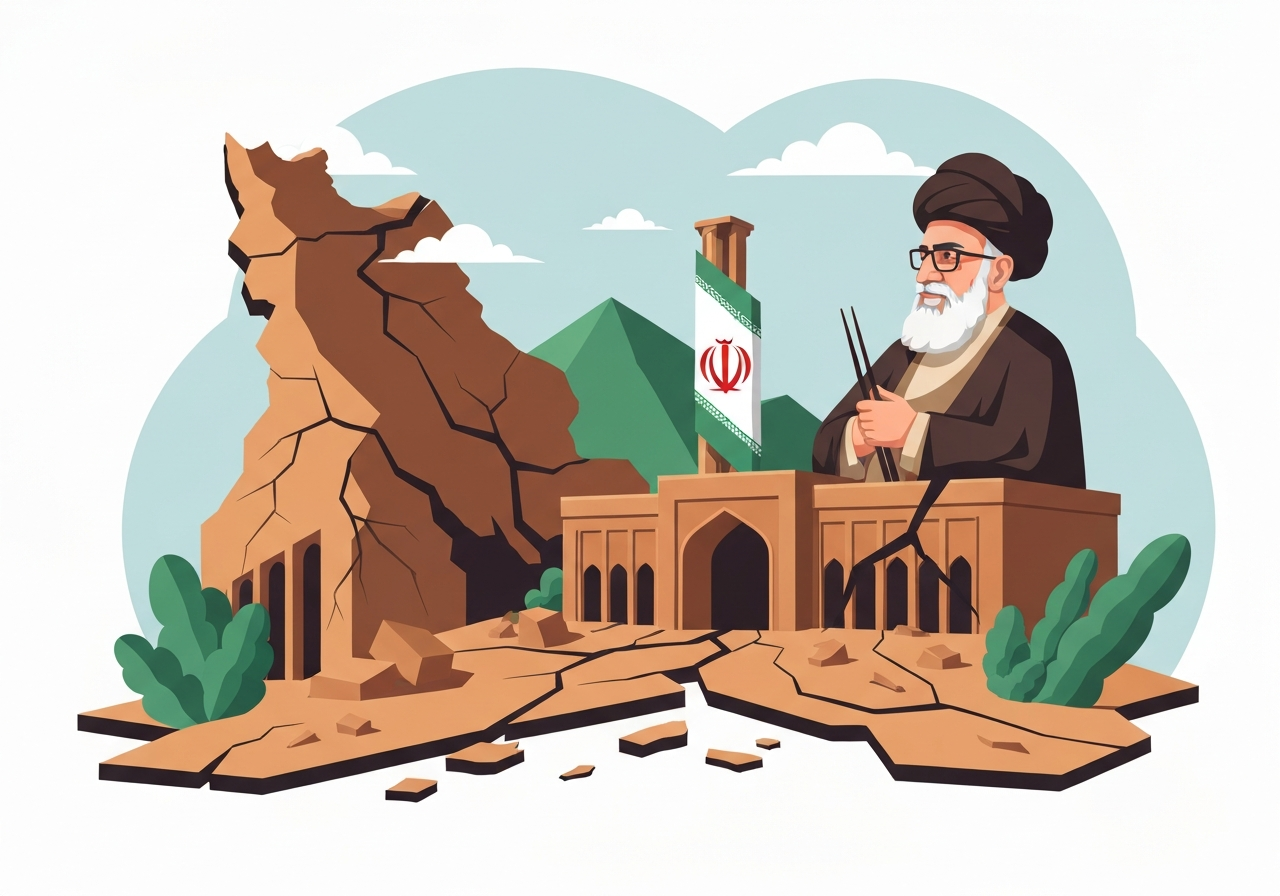
If confirmed, reports that Ali Larijani, 67, the secretary of Iran’s Supreme National Security Council (SNSC), has been killed would constitute a severe disruption to Tehran’s political order, potentially eclipsing the shock of Supreme Leader Ali Khamenei’s death at the outset of the war. Larijani’s removal would eliminate a rare bridging figure who held influence across the Islamic Republic’s civilian institutions, the Islamic Revolutionary Guard Corps (IRGC) and external partners such as China and Russia. The loss would deepen an already acute leadership vacuum and complicate any immediate diplomatic or transitional openings. How Tehran, its security apparatus and regional interlocutors respond in the coming days will determine whether the state stabilizes or fragments further.
Key Takeaways
- Ali Larijani, 67, served as SNSC secretary from August 2025 and previously spent 12 years as speaker of parliament from 2008 to 2020, making him a central figure across multiple political generations.
- The killing, reportedly attributed to Israeli action and possibly involving US collaboration, is not independently verified; if true, analysts compare its strategic effect to the US killing of IRGC commander Qassem Suleimani on 3 January 2020.
- Larijani was viewed as a potential moderating force who could have influenced a post-Khamenei transition; his death removes a candidate many outside Iran had seen as pragmatic and internationally connected.
- He combined ties to the IRGC with working relationships across Iran’s civilian elite and with foreign states, including China and Russia, giving him rare cross-institutional leverage.
- Larijani helped shape Iran’s post-June 2025 stance, including messaging to Gulf states that US bases in their territories would be treated as legitimate targets if Iran were attacked.
- His political comeback in August 2025 followed earlier marginalization: he was barred from presidential ballots in 2021 and 2024 by the Guardian Council and had been out of frontline office after 2020.
- The removal intensifies questions about succession and the prospect of increased IRGC dominance, with Mojtaba Khamenei widely discussed as a possible successor whose ascendancy could sideline moderates.
Background
Iran’s political system is multilayered, combining theocratic institutions, security forces and elected bodies. The Supreme National Security Council sits at the nexus of civilian government and military strategy, coordinating between the presidency, the IRGC and the supreme leader’s office. Over decades, power has shifted among clerical elites, security commanders and pragmatic politicians, producing a fraught balance that can be upset by high-profile losses.
Larijani’s family has been embedded in that system for years: his brother Sadeq led the judiciary and another brother, Mohammad Javad, served as a diplomat and adviser to the supreme leader. Ali Larijani himself held top posts including head of state broadcasting and 12 years as parliament speaker, and he cultivated ties with external powers — a background that helped him re-emerge in August 2025 as SNSC secretary after the June 2025 Israeli and US strikes increased Tehran’s security focus.
Since the US operation that killed Qassem Suleimani in January 2020, Iran’s elite has repeatedly weathered decapitations that reshaped command and strategy. The wartime environment following early 2026 events, including the reported death of Ali Khamenei, intensified succession struggles inside Tehran and heightened the stakes of any further targeted removals.
Main Event
Reports circulating internationally attribute Larijani’s death to an Israeli strike; some outlets have speculated about US involvement or intelligence cooperation, but official confirmation remains pending. If accurate, the strike removed the SNSC secretary who had been charged with reviewing lessons from the 12-day conflict and preparing Iran for potential follow-on attacks. Observers say his role made him central to both military planning and diplomatic outreach.
Larijani had gained renewed prominence after June 2025, when Iran responded to cross-border attacks and reassessed force posture. As SNSC chief he acted as a principal interlocutor for Gulf governments and foreign capitals, warning that US military facilities in regional states could be considered legitimate targets in the event of renewed attacks on Iran. His death would therefore be not only symbolic but operationally consequential.
Domestically, Larijani had been active in efforts to check the acceleration of hardliner control after the supreme leader’s death. He worked with figures such as former president Hassan Rouhani to delay or shape the Assembly of Experts’ process, arguing that a hasty succession could narrow Iran’s postwar options. His sudden absence removes a key actor in those maneuverings.
The immediate operational picture inside Tehran is uncertain: state security organs will seek to reassert control, the IRGC may advance its preferred candidates for senior posts, and the civilian establishment will face a compressed timeframe to respond to both internal unrest and international pressure.
Analysis & Implications
Strategically, eliminating Larijani would deprive Iran of a rare practitioner who could translate between military commanders, pragmatic politicians and foreign capitals. That capacity had practical value: Larijani was seen as someone who could reassure Gulf states, manage crisis messaging and keep diplomatic channels with China and Russia open. Without him, diplomatic backchannels may fray at a moment when external mediation could matter most.
Politically, his death strengthens the hand of hardliners and the IRGC faction that supports a tighter security-first governance model. Mojtaba Khamenei has been discussed as a figure whose rise would consolidate IRGC influence; Larijani had tried to forestall that outcome by delaying the Assembly of Experts or by broadening possible successors. His absence narrows the range of compromise figures inside the system.
Economically and socially, the short-term effects include heightened market instability, capital flight risk and intensified repression of dissent. Larijani had at times advocated for a pragmatic approach to foreign policy, including limited engagement on nuclear issues; his removal reduces the internal constituency for calibrating confrontation versus accommodation and may push policy toward securitized responses.
Regionally, the incident — if confirmed as an Israeli hit — illustrates a willingness by external actors to target Tehran’s senior security machinery. That raises the bar for escalation: Iran may retaliate on multiple fronts or accelerate asymmetric operations through allied militias, complicating de-escalation and raising spillover risks across the Gulf and Levant.
Comparison & Data
| Figure | Date | Role | Immediate Impact |
|---|---|---|---|
| Qassem Suleimani | 3 January 2020 | IRGC Quds Force commander | Sharp reconfiguration of IRGC operations and major retaliatory posture |
| Ali Larijani | Reported March 2026 | SNSC secretary; former parliament speaker (2008–2020) | Potential collapse of cross-faction mediation and succession pathways |
The table underscores differences in role and effect: Suleimani was a military commander whose death directly affected operational chains, while Larijani was a political-technocratic bridge whose removal fractures negotiation channels and moderating influence. Both losses reverberate, but through distinct institutional pathways.
Reactions & Quotes
‘Netanyahu is now focused on blocking Trump’s pathways for a ceasefire and follow-up talks with Iran. Larijani would have been the man to get that job done.’
Ellie Geranmayeh, European Council on Foreign Relations (analysis)
Geranmayeh’s assessment frames the death as part of broader external calculations aimed at constraining diplomatic options. Analysts interpret the remark as signaling that outside actors view Larijani as uniquely capable of negotiating de-escalation.
‘Their martyrdom still feels surreal to me,’
Ali Larijani, November 2024 interview
Larijani’s own words, reflecting on earlier losses such as Suleimani’s, underscore his view of leadership sacrifice and succession dynamics; they also highlight the personal resonance such deaths have within Iran’s ruling circles.
Unconfirmed
- Attribution of Larijani’s killing to Israeli forces and any direct US involvement remains unverified by independent, public evidence.
- The scope and immediacy of planned Iranian retaliation or the IRGC’s next operational moves are not yet confirmed.
- Precise details about whether Larijani was serving in any alternative leadership or succession planning role at the moment of his death are still unclear.
- Reports that the US had a ready internal candidate inside Iran to replace the regime are speculative and lack corroboration.
Bottom Line
Whether or not external partners intended to remove Larijani to prevent diplomatic solutions, his death — if confirmed — represents an extraordinary depletion of Iran’s internal bridging capacity. He was one of the few senior figures able to converse credibly with both the IRGC and pragmatic political currents while maintaining ties to major external powers. That hybridity made him disproportionately valuable at a time when Iran needed interlocutors to manage wartime choices and postwar transitions.
In practical terms, expect a period of intensified maneuvering among hardliners, security elites and surviving civilian figures as they jockey to fill the vacuum. Regional actors and foreign capitals that relied on Larijani’s contacts will face new uncertainty, and any immediate moves toward retaliation or escalation could widen the conflict. Close verification of reports and transparent sourcing will be essential in the coming days to separate confirmed facts from speculation.
Sources
- The Guardian — international news outlet (original report)
- European Council on Foreign Relations — policy institute (analysis and expert comment)
- Haaretz — Israeli news outlet (profile coverage)
- Associated Press — news agency (photo and field reporting)