
Lead
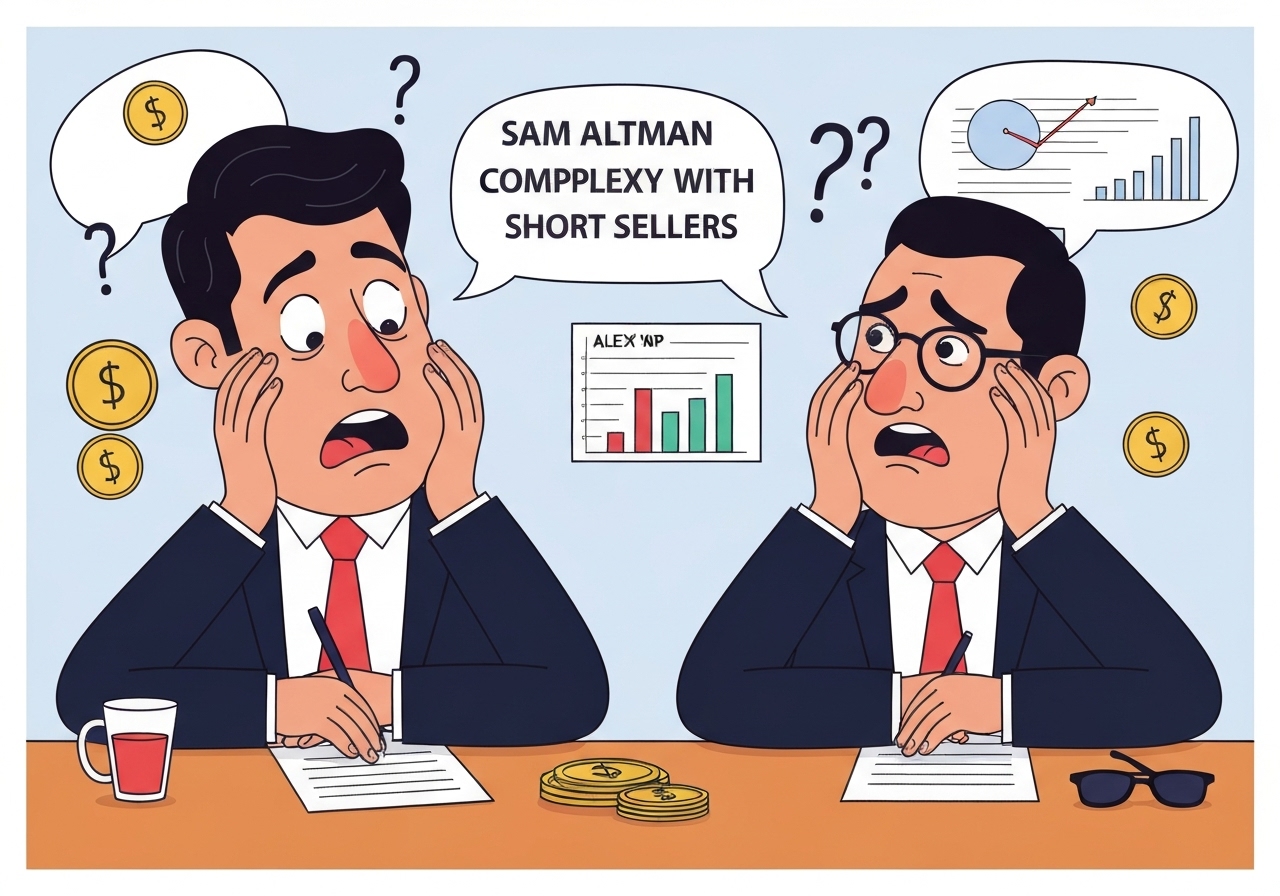
On December 29, 2025, two high-profile tech chiefs — Palantir CEO Alex Karp and OpenAI founder Sam Altman — publicly criticized short sellers who have been betting against their firms. Karp lashed out on CNBC about skeptics targeting Palantir’s stock, while Altman told the Bg2 Pod in October he sometimes wishes OpenAI were public so critics could be forced to put money behind their claims. Their comments come amid heightened scrutiny of AI-related valuations and broader market conversations about the role of bearish investors. The exchanges have reignited a long-running debate over short selling’s place in modern capital markets.
Key Takeaways
- Alex Karp publicly condemned investors shorting Palantir on CNBC in late 2025, arguing critics are attacking a company that has delivered returns to ordinary investors and supported military customers.
- Sam Altman told the Bg2 Pod in October he would welcome short sellers on OpenAI if the firm were public, as a way to test critics’ convictions.
- Palantir’s share price has climbed roughly 1,720% since its October 2020 IPO, a scale that naturally attracts more varied market positions, including shorts.
- Short selling remains risky: theoretic losses for a short position are unlimited, and small-cap stocks can be vulnerable to short squeezes that dramatically lift prices.
- Market participants argue short sellers expose fraud and overvaluation — examples include Valeant in 2015 and other cases where activist short research prompted regulatory scrutiny.
- Derivatives growth around large companies increases the capacity for bearish positions; as firms mature, more instruments let investors bet against them.
- There are bad-actor risks: coordinated misinformation campaigns tied to short positions have occurred, which complicates public perceptions of short sellers.
- Industry voices say shorting provides liquidity, tempers bubbles, and offers a public check on corporate behavior when done transparently.
Background
Short selling — borrowing shares to sell now and buy back later at a lower price — is a long-established market practice that intensifies as companies grow. When a company becomes prominent, more investors, hedge funds and derivative players form opinions that can translate into bearish positions. High-profile conflicts between CEOs and short sellers have become part of corporate lore, from Tesla’s ongoing battles with skeptics to the GameStop episode that spotlighted retail-versus-institution dynamics.
Tech companies at the center of the AI boom have seen valuations and public attention surge, which in turn attracts scrutiny from both longs and shorts. Executives often view short sellers as personal antagonists because bearish bets can coincide with negative publicity and volatile share moves. At the same time, regulators, institutional investors and some academics view short positions as a tool for price discovery and for uncovering misconduct.
Main Event
In late 2025 Alex Karp took sharp aim at short sellers during a CNBC appearance, denouncing investors who he said were targeting Palantir despite the firm’s government contracts and strong historical returns. His remarks framed the shorts as not only wrong about the company’s value but also ethically inconsistent. The exchange followed months of public debate around Palantir’s role in government work, surveillance, and immigration enforcement — issues critics have cited when questioning the company’s outlook.
Sam Altman has voiced similar frustration with skeptical commentary about OpenAI’s valuation. Speaking on the Bg2 Pod in October, he said that if OpenAI were public, he would like critics to short the stock so their beliefs would carry financial consequence. Altman framed the wish as a desire to put skeptics’ convictions to the test rather than as an attack on market norms.
Nvidia CEO Jensen Huang, who spoke during the company’s November earnings call, addressed concerns of an AI bubble more indirectly, rejecting the bubble characterization and arguing the company’s view is of durable demand rather than transient hype. Market participants interpret these comments collectively as a signal that leaders of AI-era companies are increasingly vocal in defending their markets against bearish narratives.
Analysis & Implications
The executives’ ire at short sellers is both emotional and strategic. On a human level, founders and CEOs pour years into building firms and can see public bearishness as a repudiation of that effort. Strategically, vocal criticism can serve to rally employees and supportive investors while attempting to discredit bearish research in the court of public opinion.
From a market-structure perspective, short selling performs several surveillance and price-discovery functions. Short research has a track record of uncovering fraud and accounting irregularities; it can also act as a counterweight when investor enthusiasm detaches prices from fundamentals. That said, the practice contains perverse incentives when actors spread misleading information to move prices in their favor, and regulators have penalized such behavior when proven.
For large, liquid firms the mechanics favor more participants taking bearish positions via derivatives and lending markets. That growth in instruments and counterparties means that attracting short interest is often a sign of maturity rather than imminent collapse. Conversely, in small-cap cases, thin share supply can amplify losses for shorts and fuel squeezes that punish bearish bets — a dynamic that helps explain why executives of sizable companies may view shorting as a backhanded compliment.
Policy and reputation effects also matter. If executives publicly lash out at shorts, they may pressure intermediaries or create a chilling effect on legitimate research. Conversely, transparent, evidence-based short reports can improve market efficiency. The balance between protecting markets from manipulative campaigns and preserving robust, adversarial research is delicate and likely to draw continued attention from regulators and investors.
Comparison & Data
| Metric | Palantir | Example (GameStop) |
|---|---|---|
| IPO date | October 2020 | 2019 (Direct listing) |
| Return since IPO (approx.) | +1,720% | Highly volatile; surged in 2021 |
| Notable short-seller impact | Elevated short interest in 2025 | Short squeeze vs. hedge funds in 2021 |
The table highlights contrasts in scale and market behavior. Palantir’s 1,720% rise since its October 2020 IPO helps explain why more sophisticated instruments and a broader base of opinions now exist about the stock. By contrast, GameStop’s episode exposed how concentrated retail interest and thin lending conditions can produce extreme squeezes. These dynamics show how company size, liquidity and investor composition drive the risks and impacts of short positions.
Reactions & Quotes
“They could pick on any company in the world. They have to pick on the one that actually helps people,”
Alex Karp, CEO of Palantir (CNBC)
Karp’s comments framed short sellers as both unfair critics and morally inconsistent, referencing the firm’s government work and historical returns as justification for his defense.
“I would love to tell them they could just short the stock, and I would love to see them get burned on that,”
Sam Altman, Founder of OpenAI (Bg2 Pod)
Altman’s remark conveyed frustration with what he described as repeated predictions that his company would fail, and expressed a desire to have skeptics back their claims with capital risk.
“There’s been a lot of talk about an AI bubble… from our vantage point, we see something very different,”
Jensen Huang, CEO of Nvidia (Earnings call)
Huang’s comments were more measured, emphasizing durable demand over speculative excess and reflecting how some industry leaders counter bubble narratives without directly attacking short sellers.
Unconfirmed
- Whether specific short positions against Palantir are driven primarily by concerns about government-contract ethics or by purely valuation-based arguments remains mixed and not fully verifiable from public filings alone.
- Claims that short sellers coordinate misinformation campaigns about particular AI companies are occasionally alleged but require case-by-case investigation; broad coordination has not been established in this instance.
- OpenAI’s hypothetical public-market valuation trajectory — and how it would change short-sale dynamics — is speculative because the company remains private.
Bottom Line
Executives’ public frustration with short sellers is understandable but also predictable: as companies grow and attract broader attention, a diversity of market views — including bearish ones — naturally follows. Short selling plays a constructive role when it exposes fraud, improves price discovery, and supplies liquidity, but it also presents risks when paired with disinformation or manipulative tactics.
For leaders such as Karp and Altman, the most productive response may be evidence-based engagement rather than personal attacks: address factual criticisms, improve disclosure where warranted, and let the market judge long-term performance. Regulators and investors will continue to weigh the trade-offs between policing manipulative conduct and preserving an environment where adversarial research can help markets function efficiently.