
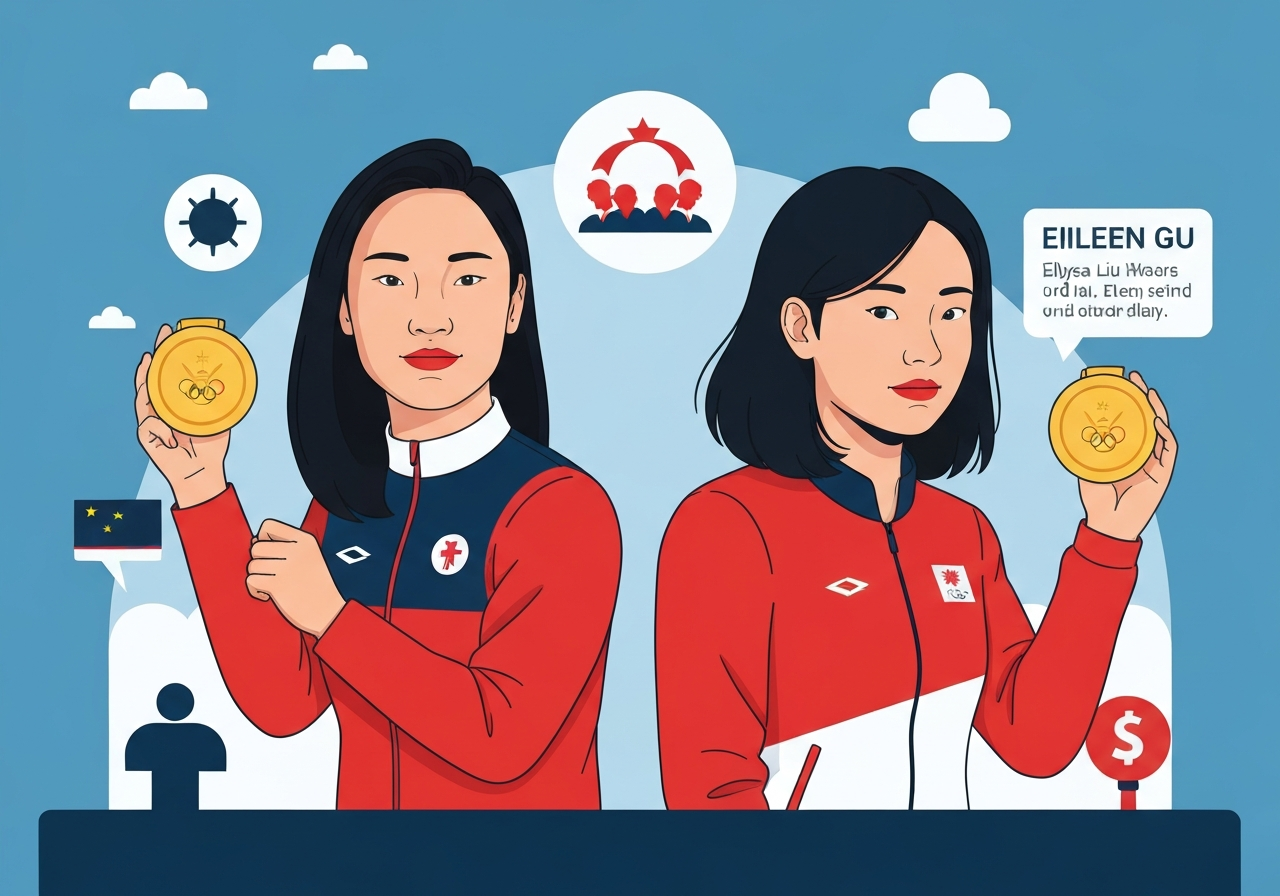
When Alysa Liu won the United States’ first Olympic women’s figure skating gold in 24 years on Thursday, she celebrated a personal triumph — but woke Friday to an instant, uncomfortable juxtaposition with fellow California native Eileen Gu, who competes for China. The contrast unfolded across social media and political commentary, turning two elite athletes into symbols in a debate they did not choose. The moment blurred sport and geopolitics: Liu’s victory became a flashpoint in wider arguments about national allegiance, identity and how Asian American athletes are perceived. Both athletes’ backgrounds and choices have now been parsed in public and political arenas.
Key Takeaways
- Alysa Liu won the U.S. women’s Olympic figure skating gold on Thursday, the first American to do so in 24 years.
- Eileen Gu, a California-born skier who competes for China, has five Olympic medals referenced across two Games: two golds and a silver previously, and two additional silvers in Italy.
- Social and political actors quickly framed the two skiers as contrasting symbols; a viral post urging “Be an Alysa Liu” accumulated over 1.4 million views.
- Lawmakers and commentators weighed in publicly, including Rep. Andy Ogles and Rep. Michael Baumgartner, intensifying the politicized response.
- Scholars warn these comparisons reflect a racialized double standard for Asian American athletes, not differences in sporting disciplines.
- Gu has defended her choices, saying she feels targeted by a strain of American politics and arguing that athlete nationality choices are common.
- Alysa Liu’s family history includes her father’s exile after the 1989 Tiananmen crackdown; she and her family have reported harassment tied to that history.
Background
Elite athletes with multinational backgrounds have long raised questions about nationality, funding and representation at the Olympics. In recent decades, cross-national training, dual citizenship and sport federations’ recruitment have blurred simple categories of national allegiance. The Olympic movement allows athletes to represent countries for a variety of personal, cultural and financial reasons; that reality has collided with heightened geopolitical tensions between the United States and China.
Eileen Gu, born and raised in Northern California to a Chinese mother and American father, chose to compete for China and has been a prominent, sometimes polarizing, figure for two Olympic cycles. Alysa Liu, also from Northern California, has a different family narrative: her father, Arthur Liu, was a pro-democracy activist who fled China after the 1989 Tiananmen Square crackdown. Those contrasting biographies — one athlete competing under China’s flag, the other with a family history of dissidence — have been emphasized in recent commentary.
Main Event
On Thursday, Liu delivered a free skate that clinched the gold and ended a 24-year U.S. drought in Olympic women’s figure skating. The performance was widely praised for its technical polish and competitive composure. Within hours, political actors and social posts began juxtaposing Liu’s win with Gu’s presence on the Chinese team, treating two separate sporting stories as a single narrative about loyalty and identity.
Conservative commentators amplified the contrast. Rep. Michael Baumgartner’s social cues and other posts in right-leaning circles framed the athletes as opposites; Rep. Andy Ogles reposted imagery of Gu with a medal and suggested consequences for athletes who “support our adversaries.” Vice President JD Vance, when asked about Gu, said he would root for athletes who identify as American.
Gu has faced sustained scrutiny over her decision to represent China, and that scrutiny intensified after Liu’s gold. Gu defended herself publicly, saying she feels like “a bit of a punching bag for a certain strand of American politics” and noting that many athletes represent countries other than their birth nation. Liu, in interviews after her win, described the result as dreamlike and said she was still processing the arena atmosphere.
Analysis & Implications
The rapid politicization of Liu’s victory illustrates how elite sport can be co-opted into geopolitical narratives. Athletes’ personal decisions — about training location, sponsorship, and national representation — are now interpreted through the prism of interstate rivalry, particularly between the U.S. and China. That dynamic risks reducing complex individual motivations to simple binaries of loyalty or betrayal.
Scholars of race and sport note that Asian American athletes often face distinct standards. Comparing two athletes from similar ethnic backgrounds but different national affiliations highlights how race can shape public judgments independently of sport-specific criteria. These judgments can have reputational and financial consequences for the athletes involved, and they can shape young athletes’ sense of belonging.
For policymakers and sports bodies, the episode raises practical questions about athlete recruitment, transparency in payments and the role of national federations. Reports that athletes have received sizable payments to compete for other countries add a financial layer to public reactions, even where motivations are mixed and not solely monetary. Sports organizations may need clearer guidance on transfers, disclosures and athlete protections to limit politically driven backlash.
Comparison & Data
| Athlete | Birthplace | Represents | Recent Olympic medals |
|---|---|---|---|
| Alysa Liu | Oakland, California | United States | Gold (women’s singles, current Games) |
| Eileen Gu | Northern California | China (PRC) | Two golds & one silver (previous Games); two silvers (Italy) |
The table clarifies that both athletes share California roots but represent different national delegations. Medal counts and representation are public records; the table is intended to separate athletic facts from political interpretation. Financial claims, sponsor arrangements and private motivations require separate documentation and are discussed elsewhere in this article.
Reactions & Quotes
“I’m still in yesterday, to be honest… it was a dream.”
Alysa Liu, post-victory interview
This comment captured Liu’s immediate emotional response after winning gold and was widely reported in post-event interviews.
“I feel like a bit of a punching bag for a certain strand of American politics… People only have a problem with me doing it because they kind of lump China into this monolithic entity.”
Eileen Gu, public statement
Gu’s remark framed her view that criticism is politically motivated and not solely about sporting choices. Her defense has been echoed in media appearances and social posts.
“There’s a tendency that if there’s two of them, then we must compare, we must make a racial comparison.”
Christina Chin, Professor of Sociology, California State University, Fullerton
Professor Chin’s analysis places the episode in a broader scholarly context about racialization in sports coverage.
Unconfirmed
- The precise motivation and breakdown of reported payments to athletes tied to competing for other countries remain incompletely documented in public records.
- Claims of targeted harassment and spying tied to athletes’ families have been made publicly but are not comprehensively verified in open-source reporting.
- The extent to which political actors coordinated social media messaging around these athletes has not been independently confirmed.
Bottom Line
The episode around Alysa Liu and Eileen Gu shows how high-profile sports moments can quickly be reframed as political theater. Both athletes are elite competitors with distinct personal histories; public debate that flattens those differences into a simple good-versus-bad binary reflects broader societal tensions rather than clear-cut athletic issues.
For observers, separating verified facts — medals, representation, direct quotes — from political inference matters. Sports federations, commentators and policymakers should aim for transparency on payments and eligibility while avoiding rhetoric that racializes or politicizes athletes’ identities. For both Liu and Gu, the coming days on and off the slopes and the ice will reveal how these narratives evolve and whether sports institutions respond to limit collateral politicization.
Sources
- NBC News — news report covering the event and public reactions (news)
- Olympics.com (Eileen Gu profile) — official Olympic athlete profile and medal records (official)