
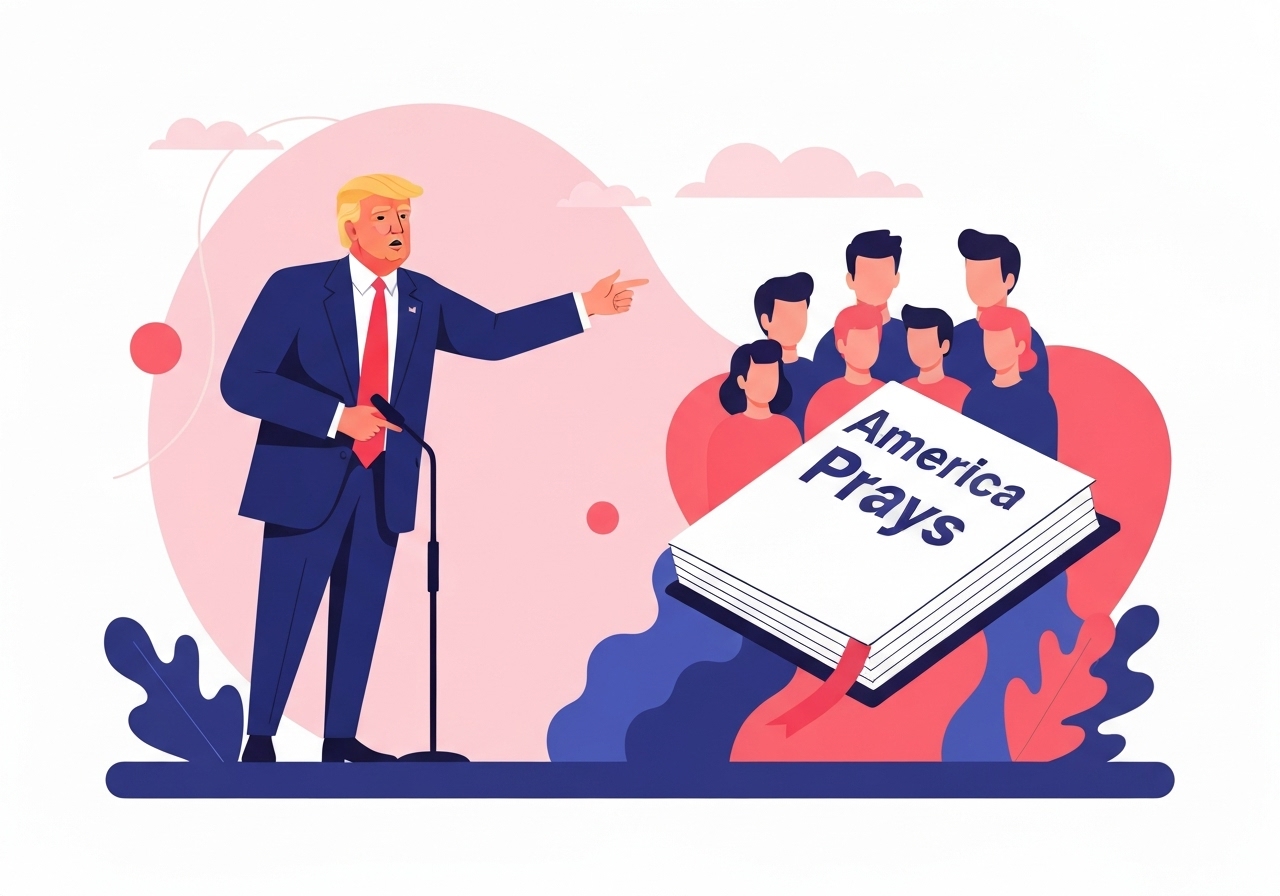
Lead: On September 8, 2025, at the Museum of the Bible in Washington, President Donald J. Trump unveiled an initiative called “America Prays,” urging Americans of diverse faiths to unite in prayer ahead of the 250th anniversary of the Declaration of Independence. He framed the initiative as part of his administration’s broader effort to defend religious liberty and previewed forthcoming Department of Education guidance intended to protect students’ ability to pray in public schools. The president also highlighted the participation of more than 70 faith organizations and recounted an elementary-school case he said illustrates tensions between religious belief and school materials.
Key Takeaways
- Announcement date and venue: President Trump announced America Prays at the Museum of the Bible on September 8, 2025.
- Participation: Secretary of Housing and Urban Development Scott Turner said 70+ faith organizations and churches had signed on to the initiative.
- Policy preview: The president said the Department of Education will issue new guidance to safeguard students’ right to pray in public schools; the guidance was described as forthcoming, not yet published.
- Personal example cited: The president referenced a 12-year-old California student, identified as Shay, who he said was required to read material he found inconsistent with his religious beliefs.
- Rhetorical emphasis: The address linked national renewal to the role of religion and invoked the Declaration of Independence’s reference to a Creator when discussing rights.
- Political flashpoint: The speech included criticism of Senator Tim Kaine for disputing the phrasing that rights come from a Creator, a point the president said underscores the need for the initiative.
Background
The United States has a long, contested history of balancing religious expression and secular public life. Since the National Day of Prayer was codified by Congress in 1952, public calls for collective prayer have been part of national life, while courts have repeatedly clarified the limits of religious activity in government-run institutions such as public schools. Debates over curriculum content, student expression, and the role of faith-based groups in public programs have intensified in recent years as cultural and political polarization has grown.
The Trump administration has previously pursued policies favoring religious organizations’ access to federal programs and legal measures intended to expand religious-liberty claims. Advocacy groups on the right welcomed the President’s remarks as reinforcement of those priorities; civil liberties organizations and some education advocates expressed concern that new federal guidance could blur church-state lines and prompt legal challenges. The Museum of the Bible, the speech venue, is a private institution that frequently hosts faith-related events and was an intentional setting to underscore the religious framing of the announcement.
Main Event
In his address, President Trump rolled out “America Prays,” describing it as a nationwide appeal for prayer and interfaith participation in the lead-up to the 250th anniversary of the Declaration of Independence. He cast the initiative as both symbolic and practical, saying it would mobilize congregations and faith leaders to focus on national unity, community recovery, and moral renewal. Organizers, according to the administration, have already secured pledges from more than 70 religious groups to host or promote prayer events over the coming year.
The president also announced that the Department of Education would soon issue guidance to protect students’ ability to pray in public schools, portraying the step as restoring religious rights for young people. Administration officials characterized the guidance as clarifying existing First Amendment protections for individual student expression rather than mandating school-endorsed prayer. Legal observers noted that how the guidance is worded will determine its practical impact and whether it triggers litigation.
Trump recounted an incident involving a 12-year-old California student he said had been required to read material opposing his religious beliefs. He used the anecdote to argue that federal attention to school practices is necessary to prevent what he described as ideological coercion. The speech included direct criticisms of political opponents who questioned the religious foundations of American rights, which the president used to reinforce the administration’s policy direction and to energize supporters ahead of the 2026 commemoration year.
Analysis & Implications
Policy-wise, a presidential announcement and administrative guidance are distinct: a public initiative like America Prays mobilizes communities, while Department of Education guidance—if issued—would steer how schools interpret existing constitutional protections. Guidance can influence district policies and enforcement priorities but does not override Supreme Court precedent; any significant expansion of religious expression in schools could invite legal review from state or federal courts. Observers will closely examine the forthcoming text to see whether it recommends district-level policy changes or merely re-states settled law.
Politically, the initiative consolidates a base that prioritizes public expressions of faith and positions the administration as a defender of religious conservatives ahead of the 2026 semi-centennial celebrations. For opponents, linking federal action to religious concerns is likely to energize mobilization around separation-of-church-and-state issues. The announcement thus acts both as policy signaling and campaign messaging, with immediate rhetorical benefits and potential long-term legal and administrative consequences.
Socially, calls for national prayer can foster community engagement and voluntary charitable activity, particularly when faith groups coordinate relief or civic programs. However, critics warn such initiatives risk marginalizing nonreligious Americans or religious minorities if public institutions appear to favor specific faith expressions. Schools, where students come from pluralistic backgrounds, are a particularly sensitive arena; administrators and teachers may face new pressure to interpret and apply any guidance amid divergent local expectations and legal constraints.
Comparison & Data
| Initiative | Year | Scope / Notable detail |
|---|---|---|
| National Day of Prayer | 1952 | Annual, federally recognized day encouraging voluntary prayer across faiths |
| America Prays | 2025 | Launched Sept 8; 70+ faith groups reported as participants |
| DOE school-prayer guidance (announced) | 2025 (forthcoming) | Administration previewed guidance; content pending |
The table contextualizes America Prays alongside long-standing public traditions and the administration’s stated policy action. While the National Day of Prayer has a fixed statutory pedigree, the new initiative couples voluntary religious mobilization with a prospective federal policy document; that combination will determine the initiative’s lasting administrative and legal footprint.
Reactions & Quotes
“We have invited faith communities nationwide to pray for our people and our peace,” the president said, framing the effort as a broad call to spiritual unity.
President Donald J. Trump, remarks at Museum of the Bible
“More than 70 organizations have pledged participation,” HUD Secretary Scott Turner said, characterizing the effort as a grassroots mobilization among houses of worship.
Secretary Scott Turner, U.S. Department of Housing and Urban Development
Advocates for church-state separation warned that federal guidance could reshape school practices and increase litigation risks if it is perceived to endorse particular religious activities.
Civil liberties advocate (public statement)
Unconfirmed
- The exact text and legal effect of the Department of Education guidance have not been released; specifics about enforcement and remedies remain unconfirmed.
- The administration’s characterization of the elementary-school incident involving “Shay” is based on the president’s account and has not been independently verified in public records made available at the time of this report.
- Claims that the initiative will produce measurable “miracles” or specific nationwide social transformations are aspirational and not substantiated by empirical evidence.
Bottom Line
President Trump’s America Prays is both a symbolic mobilization of faith-based communities and a policy signal ahead of a major national anniversary. The initiative ties community-level religious outreach to an anticipated Department of Education guidance that could affect how schools handle student prayer, but the policy’s actual content and legal consequences remain to be seen. Stakeholders on multiple sides should watch for the DOE text: its wording will determine whether the announcement reshapes school practices or primarily serves as political messaging.
For the public and policymakers, the key questions are procedural and legal: will guidance clarify individual student rights without endorsing school-sponsored prayer, and how will courts respond if local implementation prompts challenges? In the short term, America Prays is likely to energize supporters and critics alike; in the longer term, its impact will hinge on administrative detail and judicial review.