
Lead
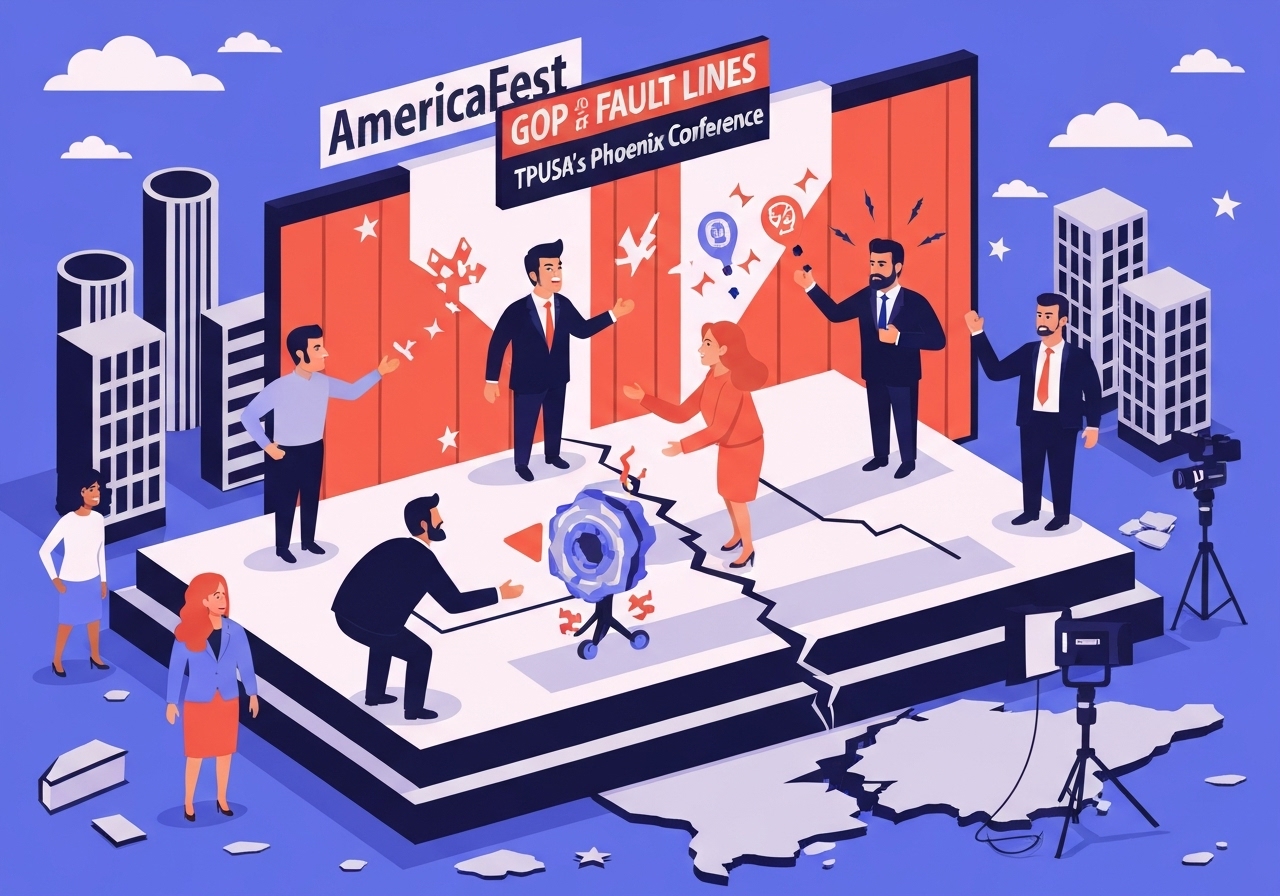
In late December 2025, Turning Point USA’s four-day AmericaFest in Phoenix gathered Republican officials, conservative media figures and activists — the first major TPUSA summit since founder Charlie Kirk was killed in September. The sessions focused on Israel, free speech, accusations of bigotry and who counts as ‘conservative’ in the post-2024 Republican alignment. Onstage confrontations between high-profile commentators laid bare sharper ideological splits inside the party and within the MAGA base. The conference closed without a clear consensus, highlighting an unsettled coalition ahead of 2026 political fights.
Key Takeaways
- AmericaFest ran four days in Phoenix and was TPUSA’s first major conference after Charlie Kirk’s death in September 2025; Erika Kirk now leads the organisation.
- High-profile speakers included Ben Shapiro, Tucker Carlson, Megyn Kelly, VP JD Vance, Steve Bannon and Erika Kirk, producing on-stage clashes over bigotry, platforming and US policy toward Israel.
- Ben Shapiro publicly denounced colleagues who platform extremist figures, calling Carlson’s invite to Nick Fuentes “an act of moral imbecility,” while Carlson rejected ostracism of dissenting voices.
- Debate over US support for Israel recurred, with Steve Bannon criticising unconditional backing and Carlson denouncing targeting of Muslim Americans; divisions map onto wider GOP tensions over ‘America First’ vs. traditional pro-Israel stances.
- Vivek Ramaswamy condemned ethnic or heritage-based definitions of American identity, contrasting with JD Vance’s emphasis on a shared people and history; Vance declined to blacklist controversial figures.
- TPUSA’s campus network — more than 850 chapters — remains a recruiting ground for younger conservatives, but leadership transition to Erika Kirk raises organisational questions.
- The conference showcased an intensified media-driven rivalry inside the conservative movement, where personalities often substitute for coherent policy platforms.
Background
Turning Point USA (TPUSA) was founded in 2012 to organise and train young conservatives on college campuses; it now reports more than 850 chapters across high schools and universities, advocating free-market principles and limited government. Charlie Kirk, the founder, was killed in September 2025; his widow, Erika Kirk, succeeded him as CEO and chair of the board, taking the organisation into its latest annual summit. AmericaFest has been held annually since 2021 and combines policy panels, networking and cultural programming aimed mainly at younger activists and media influencers.
The conservative movement in the United States is simultaneously a media ecosystem and a political coalition; personalities such as Ben Shapiro, Tucker Carlson and Megyn Kelly have platforms that often shape what activists and donors prioritise. Since Donald Trump’s 2016 rise and the subsequent MAGA realignment, factions inside the Republican coalition have competed over foreign policy (notably Israel), cultural issues and whether to prioritise ideological purity or broad electoral appeal. That competition intensified after 2024 as the party navigates governance, media strategy and grassroots organising ahead of midterm and 2026 contests.
Main Event
The conference’s panels and keynote stages became arenas for direct confrontation. Ben Shapiro, speaking early in the program, called out fellow conservatives for amplifying what he described as conspiratorial and extremist figures, specifically criticising Tucker Carlson for hosting Nick Fuentes. Shapiro framed his remarks as a defence of normative conservatism and staunch support for Israel, and he singled out critics of Israel’s conduct in Gaza as entering morally dangerous territory.
Tucker Carlson responded on the same platform, dismissing attempts to ostracise dissenters and mocking the push to deplatform controversial commentators. Carlson also condemned bigotry targeting Muslims and argued that punitive social censorship weakens the coalition’s ability to debate ideas. The exchange illustrated a broader media-fueled split: one side pushing to restrict perimeter figures, the other warning that exclusion will fracture the movement.
Other speakers broadened the arguments. Megyn Kelly ran a live “prove me wrong” session and faced questions about what voices should be hosted in conservative spaces. JD Vance, speaking at the conference close, avoided naming individuals to blacklist and urged inclusivity for those who “love America,” while noting policy shifts such as rolling back diversity, equity and inclusion programs. Steve Bannon attacked what he called the “Israel First” element within the party, arguing that an America First posture should limit military entanglement abroad.
Analysis & Implications
AmericaFest’s public disputes reflect an underlying realignment within the Republican coalition: media figures now play gatekeeping roles that once were held primarily by elected officials and party institutions. That shift amplifies personality-driven controversies, making discipline and message coherence harder to achieve. When commentators feud publicly, donors and activists receive mixed signals about priorities — from foreign policy to standards of acceptable rhetoric.
On Israel, the conference displayed a transactional tension: historically strong GOP support for Israel is colliding with an emergent isolationist strain that prioritises domestic over foreign entanglements. If the latter grows, Republican foreign-policy consensus could fracture, complicating congressional votes on aid and shaping 2026 candidate platforms. The presence of influential podcasters and cable-aligned hosts ensures these debates will spill into the wider conservative news cycle.
The contest over who counts as ‘conservative’ also has organisational consequences for TPUSA at the campus level. With Erika Kirk now at the helm, the group must balance its role as a recruitment engine for college activists against reputational risks tied to platforming extreme voices. How TPUSA navigates these choices will influence its fundraising, partnerships with donors and relationships with electorally focused Republican officials.
Comparison & Data
| Figure | Position on Israel | Stance on Platforming/Bigotry |
|---|---|---|
| Ben Shapiro | Strong pro-Israel | Opposes platforming extremists |
| Tucker Carlson | Critical of dragging US into foreign wars | Defends broad platforming, condemns censorship |
| JD Vance | Supportive of traditional GOP policies, cautious on conflicts | Declined to de-platform; emphasises broad inclusion |
| Vivek Ramaswamy | Supports sovereignty, frames America by ideas | Rejects heritage-based exclusion; condemns bigotry |
The table summarises public positions voiced at AmericaFest and reported during the conference. These distinctions are important because they map onto likely legislative and rhetorical priorities: hardline pro-Israel actors will press for continued aid and firm rhetoric, while isolationists and ‘America First’ advocates will emphasise restraint. Media platforming decisions will determine which views gain traction among younger activists and donor networks.
Reactions & Quotes
Speakers’ remarks were followed quickly by commentary from across the conservative ecosystem and beyond, with reactions ranging from endorsement to alarm about internal divisions.
“An act of moral imbecility.”
Ben Shapiro (on hosting Nick Fuentes)
Shapiro used the phrase to condemn what he described as reckless platforming of extremist figures; his critique was framed as both a moral rebuke and a strategic warning that legitimising fringe actors damages the broader conservative cause.
“I laughed”
Tucker Carlson (on calls to ostracise voices)
Carlson’s brief comment was part of a longer rebuke of deplatforming efforts; he characterised attempts to police conservative speech as divisive and said exclusion risks shrinking the movement’s influence rather than protecting it.
“We don’t care if you’re white or Black, rich or poor…”
VP JD Vance (closing remarks)
Vance used inclusive phrasing to argue against rolling lists of disfavoured conservatives, emphasising instead a broad, patriotic yardstick for participation in the movement while reiterating policies from the Trump administration such as curbing DEI programs.
Unconfirmed
- Allegations linking any US or Israeli government actors to Charlie Kirk’s killing remain unsubstantiated and have not been verified by independent investigators.
- Claims that a broad Republican consensus supports categorising Israel’s actions in Gaza as “genocide” reflect contesting viewpoints and are legally and politically disputed.
- Reports that specific donors will change funding commitments to TPUSA as a direct result of AmericaFest debates were not independently confirmed at the conference and require follow-up.
Bottom Line
AmericaFest made two things clear: the conservative movement remains influential but fragmented, and media personalities now play an outsized role in defining acceptable boundaries of debate. The on-stage clashes over platforming, Israel and definitions of American identity are not merely theatrical; they indicate real strategic choices that will shape messaging, fundraising and candidate positioning heading into 2026.
TPUSA, under Erika Kirk’s leadership, faces a test in balancing its campus mobilisation mission with reputational risks tied to controversial guests and rhetoric. How the group and leading Republican figures manage these internal differences will affect whether the party coalesces around a shared platform or remains a loose coalition of competing factions.
Sources
- Al Jazeera (news report on AmericaFest, 22 December 2025)
- Turning Point USA (official organisation site)