
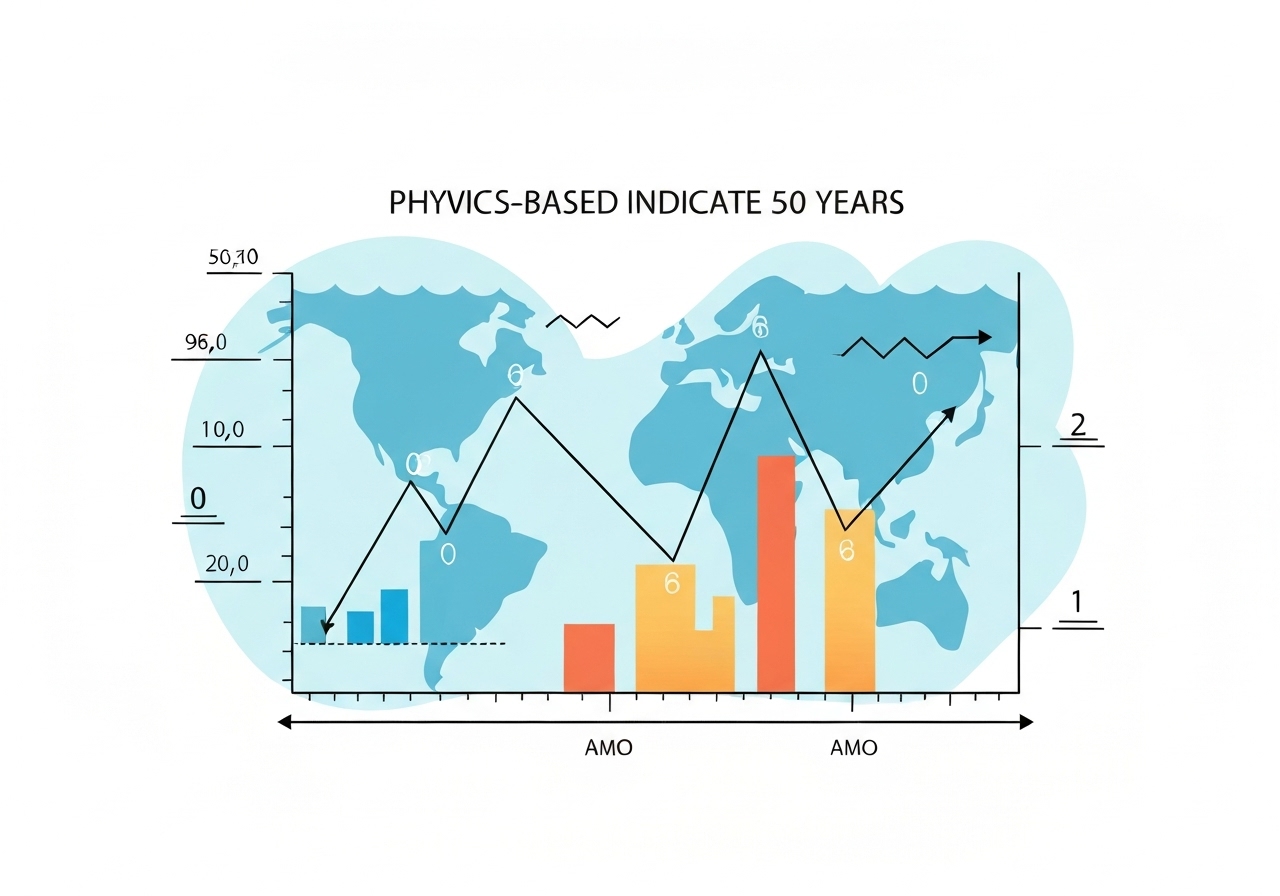
— Researchers using the Community Earth System Model (CESM) report a physics-based indicator that signals a likely tipping point for the Atlantic Meridional Overturning Circulation (AMOC) within the next 50 years. The study, published in Journal of Geophysical Research: Oceans (DOI: 10.1029/2025JC022651) and led by René M. van Westen and colleagues, identifies a sign change in surface buoyancy flux across the North Atlantic (40°N–65°N) as the indicator and places median tipping dates in the mid-21st century under high and intermediate emissions scenarios.
Key Takeaways
- The study applies a physics-based buoyancy-flux (Bflux) indicator to CESM and 25 climate model simulations.
- Model results show the AMOC was relatively stable up to about 2020, with increasing signs of weakening since then.
- Under high-emission scenarios the tipping-point window spanned 2023–2076, with a median of 2055.
- Under intermediate scenarios the window was 2026–2095, with a median of 2063.
- If collapse begins, models indicate it can take over 100 years to reach a substantially weaker circulation state.
- Projected regional impacts include colder winters, reduced summer rainfall, and more severe winter storms in Northwestern Europe.
- Most models did not include enhanced Greenland ice melt, a factor that could accelerate weakening.
Verified Facts
The research tests the new indicator across 25 different climate model experiments using CESM and related setups. The indicator tracks a change in surface buoyancy flux (Bflux) across a key North Atlantic band (40°N–65°N). A sign reversal of Bflux in this region marks the proposed onset of AMOC collapse in the simulations.
Model diagnostics and comparisons to historical observations suggest the AMOC remained fairly stable through about 2020, after which multiple simulations show increasing weakness. The authors report scenario-dependent ranges for when the indicator first flips: 2023–2076 (median 2055) for a high-emissions pathway and 2026–2095 (median 2063) for an intermediate pathway.
Once the indicator signals the start of collapse, the models typically require more than a century for the circulation to settle into a substantially weaker state. During that long transition, regional climate shifts are projected, especially across Northwestern Europe, with colder winters, lower precipitation in some seasons and heightened storminess in winter months.
| Scenario | Tipping Window | Median |
|---|---|---|
| High emissions | 2023–2076 | 2055 |
| Intermediate emissions | 2026–2095 | 2063 |
Context & Impact
The AMOC is a major Atlantic current system that transports warm surface water northward and returns cold, deep waters southward. It influences European climates, Atlantic hurricane activity, and broader ocean heat and carbon distributions. A substantial slowdown or collapse would therefore have wide-ranging climatic and socio-economic consequences.
Regional effects are expected to be non-uniform: Northwestern Europe could experience colder and stormier winters, while other regions may see altered precipitation patterns and shifts in marine ecosystems. The protracted timescale of collapse—decades to centuries—means impacts unfold over generations, complicating adaptation planning.
Modeling choices matter: many previous projections ended near 2100, but the authors argue that extending simulations toward 2200 improves the ability to detect long-term transitions and to estimate timelines for slow processes in the ocean–climate system.
Official Statements
“If the AMOC starts to collapse, it takes more than 100 years to reach a substantially weaker state,” the authors write, emphasizing long transition times and regional climate shifts.
René M. van Westen et al., Journal of Geophysical Research: Oceans (2025)
Unconfirmed
- Most models in the set did not include enhanced Greenland ice-sheet melt; its omission could delay or underestimate the timing and speed of weakening.
- In some model configurations, background circulation can partially offset surface buoyancy changes, producing rare false positives in the indicator.
- Exact regional climate outcomes and socioeconomic impacts depend on local forcings and adaptation measures and remain subject to further study.
Bottom Line
The study introduces a physics-based, buoyancy-flux indicator that, when applied across multiple CESM experiments, points to a plausible AMOC tipping point in the mid-21st century under higher-emission trajectories. Because collapse unfolds over long timescales, communities and policymakers have a window to reduce emissions, refine long-duration climate modeling (into 2200), and develop adaptation strategies—actions the authors urge to lower the risk of a large-scale circulation change.