
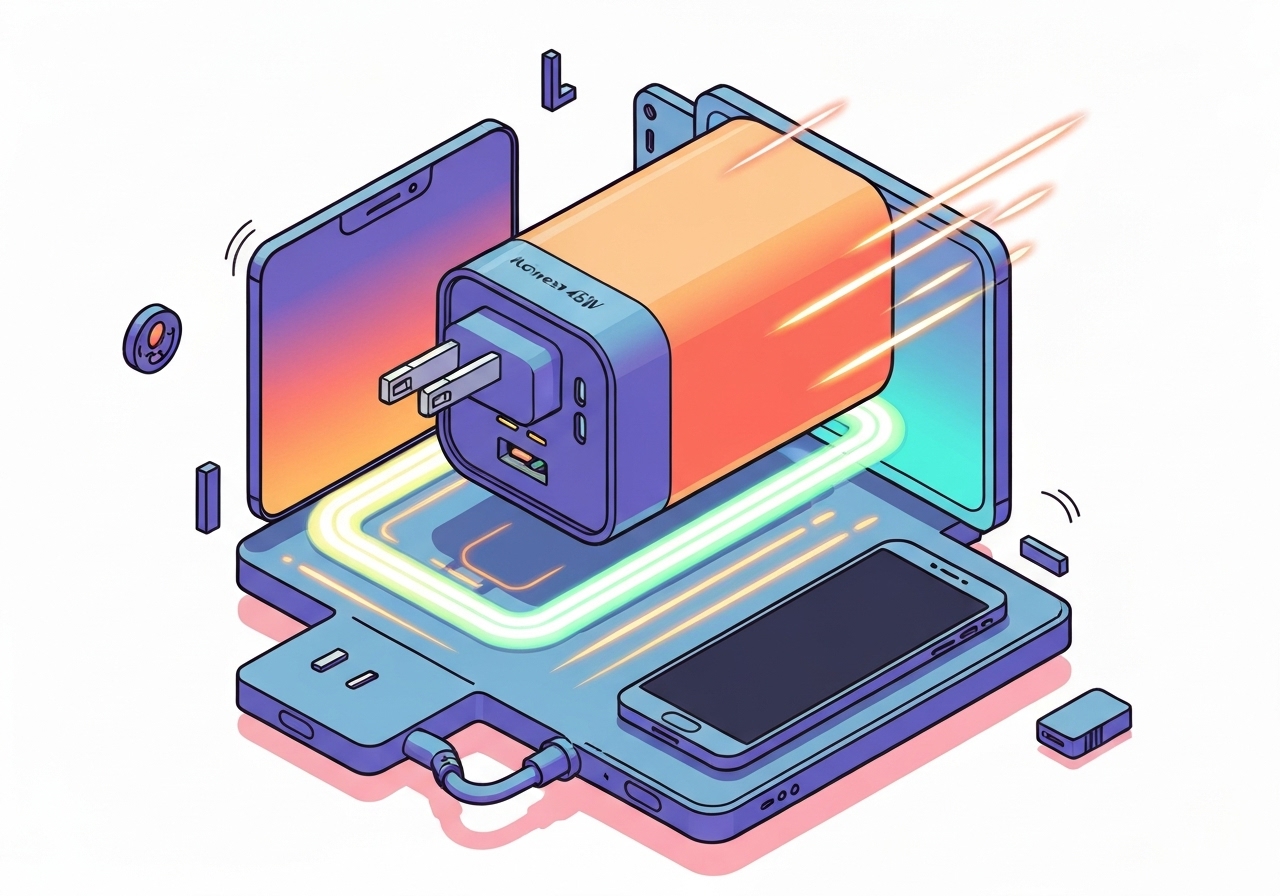
Lead: Anker unveiled a refreshed 45W Nano charger at CES 2026 and it is already available for pre-order at $30, $10 below the advertised MSRP, with shipments slated to begin on January 20. The compact unit adds a smart display that reports live power flow, temperature and charging status and is designed to auto-recognize attached devices to adjust charging behavior. The accessory is intended to work across phones, earbuds and wearables including iPhone, Apple Watch, AirPods and Samsung devices. The company also highlighted folding prongs and a small footprint intended for travel and tight outlets.
Key Takeaways
- Anker’s 45W Nano charger is on pre-order for $30, delivering a $10 discount off the regular MSRP; shipments start January 20, 2026.
- The charger includes a smart display that shows real-time power flow, temperature and charging status and includes ‘fun animations’ per the manufacturer.
- Anker says the unit can recognize the connected device and automatically adjust metrics to help extend battery lifespan.
- Compatibility advertised covers iPhone, Apple Watch, AirPods, Samsung phones and most USB-C devices.
- The charger uses dual folding prongs to keep overall size small and to fit a wide range of wall outlets.
- The $10 discount is applied via an auto-applied coupon at checkout or with code WS24D5XT3DV9 if needed.
Background
Anker has positioned itself for years as a leading third-party charger and accessory maker, frequently iterating on compact ‘Nano’ designs that prioritize portability and higher power densities. The market since 2020 has trended toward GaN-enabled compact chargers (higher wattage in smaller housings) and increased feature sets such as multiple ports and thermal management. As mobile devices demand faster charging but also better battery health, manufacturers have started to add telemetry or adaptive charging logic to balance speed and longevity.
Compact chargers are a crowded segment with price competition and incremental feature differentiation. Features like folding prongs, small casings and added functionality such as displays or multiple ports are typical ways vendors try to stand out. For consumers, the trade-off is often between size, cost and whether extra features deliver measurable benefits over a basic USB-C PD charger.
Main Event
At CES 2026 Anker introduced several new chargers and peripherals; among them is the new 45W Nano charger positioned as an upgrade to its existing Nano line. The company opened pre-orders immediately with a $30 introductory price and an advertised $10 savings off MSRP, while confirming shipments will begin January 20, 2026. The listing and early marketing emphasize a built-in smart display that provides live feedback on power draw, temperature and charging progress, plus small animated visuals described as ‘fun animations’ by the maker.
Anker’s product page and CES materials state the charger will auto-recognize connected devices and adjust certain metrics to favor battery longevity, though the company does not publish independent lab data in the initial announcement. The product’s physical design includes dual folding prongs to minimize bulk and to rotate into outlet-friendly positions, a feature that aims to improve daily usability for travelers. The company advertises the unit as broadly compatible with iPhone, Apple Watch, AirPods, and a range of Samsung and other USB-C devices.
The advertised discount is applied automatically at checkout on Anker’s storefront; an alternate coupon code WS24D5XT3DV9 is provided for cases where auto-apply does not function. Engadget’s coverage notes the device is available for pre-order and that the outlet has not yet run hands-on testing. As with many CES product rollouts, wider availability and third-party reviews are expected after the initial shipping date.
Analysis & Implications
At a $30 pre-order price point, the 45W Nano sits in a competitive segment where consumers often weigh portability against maximum output and brand trust. If the smart display and adaptive charging logic deliver as advertised, the product could appeal to buyers who want immediate feedback and perceived safeguards for battery health. However, claims about extending battery lifespan depend on how the charging algorithms are implemented and whether they lower peak stress on lithium-ion cells during daily use.
For Anker, adding a visible display can be a differentiator in retail listings and unboxing-driven social media. The ability to show real-time metrics may help users diagnose issues—such as cable limitations or device-side throttling—without resorting to external tools. That said, telemetry alone does not guarantee superior long-term outcomes unless the charger applies well-tested charge profiles and thermal protections.
From a regulatory and safety perspective, the inclusion of temperature readouts could help detect abnormal conditions, but consumers and reviewers will likely look for independent test results on efficiency, heat dissipation and compliance with regional safety standards. Competitors may respond with similar feature sets or undercutting prices, making the post-shipment review period crucial to determine whether the product’s extra features justify the premium over basic chargers.
Comparison & Data
| Attribute | This 45W Nano (Anker) | Typical compact USB-C PD charger |
|---|---|---|
| Maximum output | 45W | 18–30W |
| Display | Smart real-time display (power, temperature, status) | No |
| Form factor | Small housing, dual folding prongs | Small to mid-size |
| Intro price (pre-order) | $30 (ships Jan 20, 2026) | Varies, often $20–40 |
The table above highlights the core differentiators: higher peak power and a real-time display at a $30 introductory price. While many compact chargers reach 30W, 45W output enables faster charging for some laptops and tablets while still serving phones. Reviewers should verify thermal performance and efficiency once units ship on January 20.
Reactions & Quotes
Below are short excerpts from the manufacturer and media coverage, with context for each.
‘It can recognize what’s being charged and automatically adjust certain metrics to ensure a longer battery lifespan.’
Anker (manufacturer statement)
This quote reflects Anker’s core claim about adaptive charging logic; the company frames the feature as protective of battery health but has not released independent test data in the initial announcement.
‘We haven’t gotten a chance to try this one yet, but it looks promising.’
Engadget (technology outlet)
Engadget’s early coverage expresses cautious interest, emphasizing that hands-on verification is pending once pre-orders ship and reviewers receive units.
‘Real-time readouts can help users identify charging bottlenecks or overheating, but they do not replace standardized performance testing.’
Independent industry observer (analysis)
This perspective underscores that while a display adds user-facing utility, it should be paired with lab-based assessments of efficiency, safety and longevity claims.
Unconfirmed
- Whether Anker’s adaptive adjustments materially extend battery lifespan under typical daily use remains unverified by independent testing.
- No third-party efficiency, thermal or safety test results were provided in the initial announcement; those data will be necessary to confirm performance claims.
- Customer experiences with the auto-applied coupon or the backup code WS24D5XT3DV9 may vary until broader sales have been processed.
Bottom Line
The 45W Nano from Anker is a clear attempt to marry compact form factor with visible telemetry, offering a $30 pre-order price and a $10 discount ahead of shipments on January 20, 2026. For buyers who value a compact charger with an informative display and broad device compatibility, the product is worth watching once independent reviews are available. For consumers prioritizing raw value, the market already contains many capable 18–30W chargers at similar or lower prices, so the display and adaptive charging claims must be validated to justify choosing this unit over cheaper alternatives.
We recommend waiting for hands-on reviews and lab data that confirm thermal behavior, efficiency and any measurable effect on battery longevity before making a purchase decision based solely on the manufacturer’s claims. The pre-order price is attractive, but the decisiveness of this product in the market will depend on how it performs in third-party testing and how competitors respond in the weeks after shipments begin.