
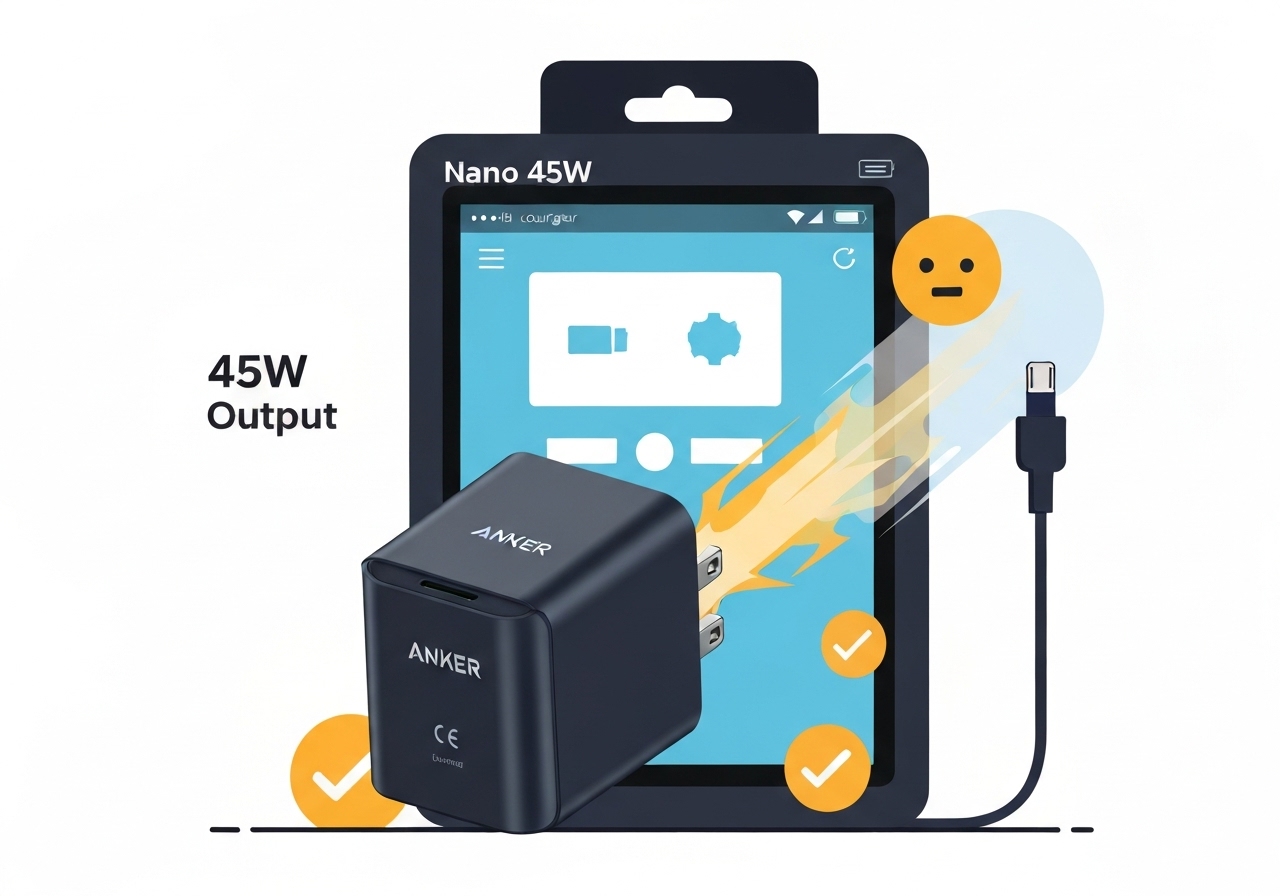
Lead: At CES 2026, Anker unveiled three new power accessories led by an upgraded Nano Charger that packs a small front-facing screen into a compact 45W USB-C brick. The device identifies many connected Apple devices and reports charge level and power-delivery status on the display. Anker says the charger uses a three-stage power-delivery scheme to manage temperature and prolong battery life. The company plans a late-January 2026 release for the Nano at $39.99, alongside two other new products.
Key Takeaways
- The updated Nano Charger is a 45W single-port USB-C charger with a front-facing display that shows power-delivery metrics and the connected device’s battery percentage.
- It can recognize iPhone models starting with the iPhone 15 series and iPad Pro models released from 2020 onward, and shows more detail for those devices than for non-Apple hardware.
- The charger uses a three-stage power-delivery system designed to regulate temperature to help prolong battery health; Anker reports this information on the screen.
- Design changes move the USB-C port to the top and give the folding prongs a 180-degree rotation so the port can face two orientations when plugged in.
- The Nano is priced at $39.99 and is expected in late January 2026.
- Anker also announced a Prime Wireless Charging Station (Qi2.2, 25W phone charging only) with an airflow cooling system, priced at $149.99 and arriving in Q1 2026.
- The Nano Power Strip clamps to a desk edge, offers six easy-access top outlets (including two 70W USB-C ports) and four underside AC outlets; it costs $69.99 and launches in late January 2026.
Background
Compact, higher-wattage single-port chargers have become common as laptops and phones demand faster charging. Anker has long sold small 45W bricks that prioritize size and convenience; this update aims to add telemetry and device-aware features without increasing the charger’s footprint substantially. The move echoes a broader industry trend of embedding basic status displays and smarter power management into peripherals to differentiate commoditized chargers.
Apple’s adoption of higher-wattage fast charging for iPhones and iPads has encouraged accessory makers to implement device-identification handshakes that deliver tailored power profiles. Meanwhile, temperature management and battery-health messaging are becoming selling points as consumers worry about long-term battery degradation. At CES 2026, vendors emphasized cooling and efficiency across multiple product categories, and Anker positioned the new Nano and its other launches to fit that narrative.
Main Event
During its CES announcement, Anker highlighted the Nano Charger’s front display as the focal upgrade. The screen provides instant feedback on the power being delivered and the connected device’s charge percentage when recognized; Anker says recognition is most complete for iPhone 15-series models and iPad Pros from 2020 onward. For non-Apple devices the Nano will charge normally but may not present as many details on the screen.
To integrate the display without compromising accessibility, Anker relocated the USB-C port to the top face of the brick. The charger’s folding prongs can now rotate 180 degrees, allowing users to orient the USB-C port in two directions so the display and connector remain reachable when the charger shares a crowded strip or outlet.
Pricing and timing were announced alongside two companion products. The Prime Wireless Charging Station is a folding 3-in-1 stand supporting Qi2.2 with a 25W wireless pad for smartphones, while earbuds and an Apple Watch can charge simultaneously at lower rates. Anker added an internal airflow cooling system that it says improves thermal performance and charging efficiency; the stand is priced at $149.99 and arrives in Q1 2026.
The Nano Power Strip is designed as a clamp-on desk accessory that brings two AC outlets, two USB-A, and two 70W USB-C ports to the top surface, plus four AC outlets underneath. Anker confirms each USB-C port can deliver up to 70W but only when used singly; using both USB-C ports simultaneously will split or limit available wattage, which may affect users charging multiple laptops at once. The strip is set for late-January availability at $69.99.
Analysis & Implications
Adding a status display to a compact 45W charger is an incremental but meaningful product differentiation. For many users, simple, glanceable information about charge level and power delivery reduces uncertainty and can influence purchase decisions, especially for people who regularly top up phones and tablets at desks or in travel scenarios. At $39.99, Anker positions the Nano as an affordable upgrade relative to more elaborate smart chargers.
The device-aware features that surface richer detail for recent Apple devices point to continued vendor reliance on manufacturer identification protocols. That can create a more seamless experience for Apple owners, but it risks fragmenting functionality across ecosystems: non-Apple devices may not show the same telemetry, which could frustrate users expecting parity. Accessory makers must balance the benefit of deep integration with one ecosystem against the need to support broad compatibility.
Thermal management and staged power-delivery profiles matter for perceived battery longevity. Anker’s three-stage system and the Prime stand’s airflow cooling both reflect growing attention to heat as a limiting factor in charging speed and battery health. If these systems materially reduce peak temperatures during charging, they could deliver a real long-term value proposition despite modest price premiums.
The Nano Power Strip emphasizes convenience over raw simultaneous output. Clamping multiple accessible outlets to a desk edge addresses a common ergonomic pain point in home and office setups, but the 70W-per-port limitation when both USB-C ports are used may reduce appeal for users needing concurrent high-wattage charging for two laptops. Buyers weighing the strip should consider whether easy access to outlets matters more than sustained multi-device high-watt charging.
Comparison & Data
| Product | Release | Price | Key spec |
|---|---|---|---|
| Nano Charger | Late Jan 2026 | $39.99 | 45W single USB-C, front display, Apple device ID |
| Prime Wireless Charging Station | Q1 2026 | $149.99 | Qi2.2 25W phone pad, 3-in-1, airflow cooling |
| Nano Power Strip | Late Jan 2026 | $69.99 | 2 AC top, 4 AC underside, 2×70W USB-C |
The table summarizes announced timing, cost, and headline specifications. While the Nano Charger’s display and Apple-device recognition stand out, the Prime’s 25W wireless number applies only to the phone pad; other positioned chargers on the stand will charge at lower rates. The Nano Power Strip’s advertised 70W per USB-C port applies when a single port is used at a time, which is important for users expecting sustained multi-laptop output.
Reactions & Quotes
Official messaging from the company framed the display and thermal approach as usability and longevity improvements. Below are concise excerpts representing that framing and early coverage.
“A compact brick that surfaces device charge and power-delivery status for easier, informed charging.”
Anker (official announcement)
Press coverage immediately highlighted the Nano’s shorthand for providing battery and PD feedback in a pocket-sized charger.
“Adds a small but useful status display to a familiar 45W form factor.”
Andrew Liszewski / The Verge (media report)
Early community response on social platforms mixed approval for the display and convenience against questions about cross-device parity and the limitations of multi-port power delivery.
“Useful desk convenience, but check simultaneous wattage if you need to charge two laptops.”
Community responses summarized from CES social posts
Unconfirmed
- Exact non-Apple device telemetry: Anker has not published a full list of non-Apple models that will show detailed information on the Nano’s display.
- Real-world thermal gains: While Anker describes staged PD and airflow cooling, independent lab measurements confirming improved long-term battery health or reduced charging times are not yet public.
- Simultaneous USB-C behavior under heavy load: The Nano Power Strip’s behavior when powering two high-draw laptops at once requires hands-on testing to measure real-world wattage distribution.
Bottom Line
Anker’s updated Nano Charger is a pragmatic refinement: it keeps the compact 45W format while adding a small display and device-aware feedback that will appeal to users who frequent desks or travel and want quick visibility into charging behavior. The $39.99 price places it within reach for most buyers who already favor pocket-size chargers but want smarter status readouts.
The Prime Wireless Charging Station and Nano Power Strip expand the company’s focus on thermal management and desk-centric convenience, though both introduce trade-offs—higher price for the Prime and limited simultaneous USB-C wattage for the strip. Prospective buyers should weigh those trade-offs against their device mix and whether the added telemetry and cooling justify the cost.