
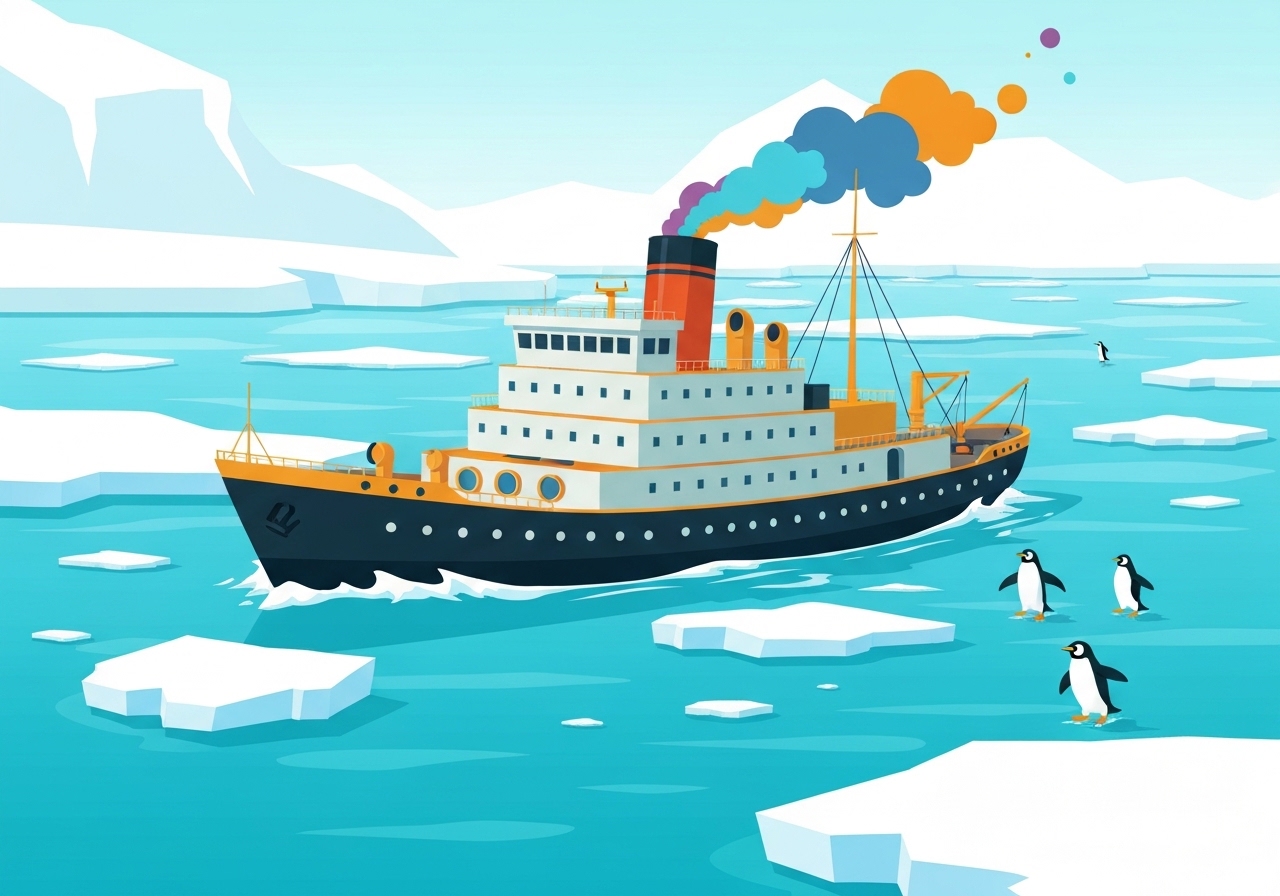
On Jan. 16, 2026, scientists aboard the South Korean icebreaker Araon navigated into the rear of a 20-mile-long inlet at Pine Island Glacier in Pine Island Bay, Antarctica, a channel formed when a large portion of the glacier’s floating front broke away several years ago. The voyage marked the first documented transit to the back of that inlet, according to chief scientist Won Sang Lee, and it exposed researchers to narrow passages and continuously calving icebergs that can rapidly block exits. Expedition members described the inlet’s hazards as a potential “death trap” for ships, underscoring the operational risk of studying Antarctica’s fastest-deteriorating ice. The trip gave scientists a rare opportunity to collect conductivity, temperature and depth data inside a landscape reshaped by warm ocean currents.
Key Takeaways
- Araon reached the inner end of a 20-mile-long inlet at Pine Island Glacier on Jan. 16, 2026, the first recorded ship transit according to the expedition’s chief scientist.
- Pine Island and neighboring Thwaites glaciers are both eroding from below by warm ocean currents; Pine Island has lost more ice over the past 50 years, though Thwaites would contribute more to sea-level rise if it melted entirely.
- The inlet formed when a large section of the glacier’s floating terminus calved several years ago, creating narrow entrances where drifting icebergs can strand vessels.
- Researchers aboard Araon took conductivity, temperature and depth (CTD) measurements within the inlet to assess ocean-driven melting near the glacier front.
- Scientists aboard expressed acute concern about operational safety because icebergs continuously peel away from nearby ice and can block the channel, potentially trapping ships.
Background
Pine Island Glacier sits on West Antarctica’s Amundsen Sea coast and has been one of the continent’s fastest-changing ice streams. Over the last half-century it has lost more ice mass than nearby Thwaites Glacier, largely because warm circumpolar deep water has intruded onto the continental shelf and contacted the glaciers’ floating ice margins. Those subsurface currents increase basal melt rates and can undercut ice shelves, making them more prone to calving and disintegration.
The glacier’s floating front fractured several years ago, sending a large slab of ice out to sea and leaving a long inlet where solid ice once connected the shelf to land. That geometry produces a confined channel that can be safe or deadly depending on iceberg activity at the entrance. Stakeholders include multinational research teams aboard vessels like Araon, national polar programs that fund Antarctic logistics, and climate scientists tracking implications for global sea level.
Main Event
The Araon spent several days away from Thwaites Glacier to work at Pine Island and used a narrow window of calmer ice conditions to push into the inlet. Chief scientist Won Sang Lee reported that the ship reached the inlet’s rear after careful route-finding and repeated hazard assessments. On approach, the team observed frequent calving and icebergs of varied sizes shearing off the channel’s walls, then drifting outward toward the ocean.
Inside the inlet the crew deployed CTD casts to measure water column properties directly adjacent to the glacier front. Those measurements are intended to quantify how warm water mixes beneath the floating ice and to map gradients in temperature and salinity that drive basal melting. Scientists also visually documented the ice walls’ morphology, noting undercuts and rills carved by meltwater and tidal motion.
Several expedition members voiced concern about the narrow exit: as icebergs drift seaward they can pile up at the mouth of the inlet and effectively seal it. The team rehearsed contingency plans and maintained continuous communications with support vessels and shore authorities. Despite the hazards, the successful sampling run provided otherwise unavailable in situ observations of water-ice interactions inside a recently opened inlet.
Analysis & Implications
The transit into Pine Island’s inlet demonstrates both scientific opportunity and elevated operational risk. Direct measurements in such confined basins are scarce, yet they are critical for validating ocean–ice models that forecast future ice loss. Data collected in this inlet will help constrain how much heat is delivered to the glacier’s base and improve estimates of melt rates that drive grounding-line retreat.
From a sea-level perspective, the distinction between Pine Island and Thwaites is important. Although Pine Island has lost more ice mass over the past 50 years, Thwaites holds a larger potential contribution to sea-level rise if it were to collapse entirely. Both glaciers, however, are dynamically linked to regional ocean warming, so accelerated melt at one site can influence stress and flow patterns farther inland and potentially hasten broader instability.
Operationally, the episode highlights how changing ice geometry can create transient hazards for research platforms. Narrow inlets bounded by unstable ice increase the likelihood of entrapment, which raises costs for insurance and logistics and may restrict the timing and scope of future field campaigns. Policymakers and funders will need to weigh scientific value against safety and environmental risk when planning Antarctic operations.
Comparison & Data
| Feature | Pine Island Glacier | Thwaites Glacier |
|---|---|---|
| Recent net ice loss (past ~50 years) | Greater | Smaller |
| Potential sea-level contribution if fully melted | Substantial | Greater than Pine Island |
| Recent major calving events | Created a 20-mile inlet (several years ago) | Rapid retreat and thinning documented |
The table summarizes relative behavior between the two glaciers using the facts established by recent observations: Pine Island’s cumulative loss over the past half-century outpaces Thwaites, while Thwaites contains a larger total volume that would yield more sea-level rise if it were to disintegrate completely. These distinctions influence model sensitivity and regional hazard assessments.
Reactions & Quotes
“We became the first people to sail to the back of a 20-mile-long inlet,”
Won Sang Lee, Chief Scientist (onboard Araon)
Lee’s statement framed the transit as a first-of-its-kind sampling opportunity and as an operational milestone for the expedition.
“Some scientists described the channel as a ‘death trap’ given how icebergs can block the exit,”
Researchers aboard Araon
The phrase captures onboard concerns about entrapment and the need for constant situational awareness when operating in recently opened glacier inlets.
“In situ ocean measurements in such confined spaces are rare but essential for improving melt-rate estimates,”
Polar oceanography researcher (external expert, paraphrased)
Independent experts emphasized that direct casts of temperature and salinity near glacier fronts are indispensable for validating remote-sensing and model-based inferences.
Unconfirmed
- Precise timelines for large-scale collapse of Pine Island or Thwaites remain uncertain; model projections vary and depend on future ocean warming scenarios.
- The frequency and exact likelihood that the inlet’s entrance will seal and trap ships on future transits are not yet quantified and will depend on short-term iceberg production and drift patterns.
Bottom Line
The Araon’s transit into Pine Island Glacier’s inlet provided rare direct observations of ocean conditions adjacent to a rapidly changing glacier and demonstrated both scientific value and operational peril. Measurements taken inside the inlet will strengthen understanding of how warm water drives basal melt and inform models that project future ice loss and sea-level rise.
At the same time, the voyage is a reminder that Antarctica’s evolving ice geometry is creating hazardous environments for research platforms. Continued monitoring, improved forecasting of iceberg calving and cautious expedition planning will be necessary to balance knowledge gains against safety risks as polar conditions continue to change.
Sources
- The New York Times — Media reporting from the Araon expedition (Jan. 16, 2026)
- Korean Polar Research Institute (KOPRI) — Official national polar program and Araon operator information
- National Snow and Ice Data Center (NSIDC) — Scientific data and analysis on Antarctic ice change