
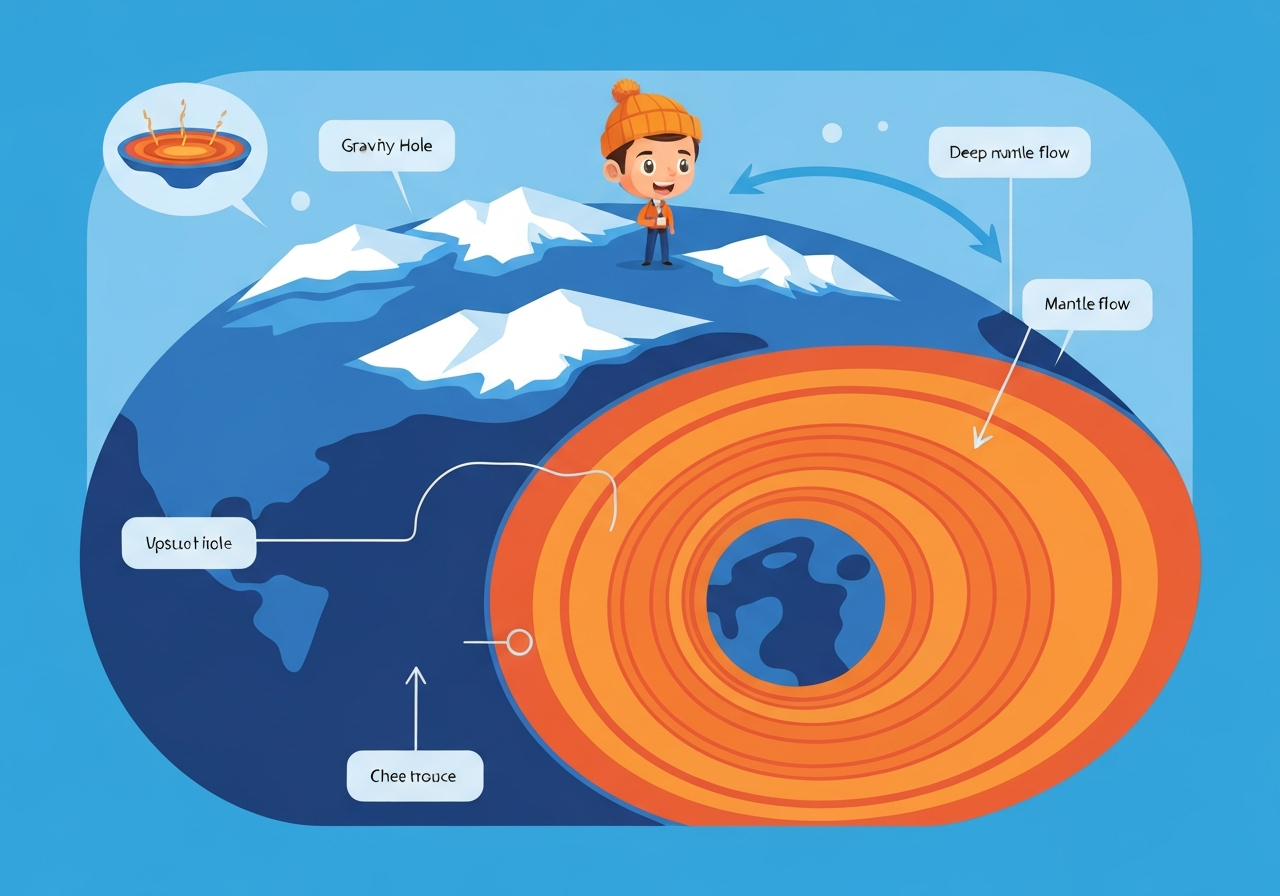
Lead: A new study in Scientific Reports reports that the region of weakest gravity on Earth lies beneath Antarctica and that extremely slow rock motions deep in the planet’s mantle largely produced this “gravity hole.” Researchers led by Alessandro Forte and Petar Glišović used global earthquake recordings and physics-based models to map the anomaly and rewind its evolution back about 70 million years. Their reconstructions show the gravity low strengthened between roughly 50 and 30 million years ago, overlapping the interval when Antarctica moved toward large-scale glaciation. The team notes the gravity anomaly also affects local sea-surface height, lowering ocean waters around the continent.
Key Takeaways
- The study was published in Scientific Reports and led by Alessandro Forte (University of Florida) and Petar Glišović (Paris Institute of Earth Physics).
- Gravity on Earth is not uniform; after removing rotational effects, the weakest gravity is found beneath Antarctica.
- Researchers used global seismic recordings and physics-based models to create a three-dimensional map of density variations inside Earth that produce the Antarctic gravity low.
- Reconstruction of mantle flow reversed about 70 million years shows the gravity anomaly grew stronger mainly between ~50 and ~30 million years ago.
- Weaker gravity around Antarctica pulls less strongly on seawater, so sea-surface height is measurably lower in that region, changing local ocean mass distribution.
- Model results align closely with satellite gravity measurements, lending confidence to the tomographic and geodynamic approach.
- Authors highlight an unresolved question: whether changes in deep Earth and the gravity field influenced the timing or pattern of Antarctic ice-sheet growth.
Background
Gravity on Earth varies because rock density is not uniform. Denser material exerts a stronger pull; regions with relatively low-density mantle or crust produce local gravity lows. Scientists map these variations using satellite gravimetry (which measures the external gravity field) and seismic tomography (which uses earthquake waves to infer internal structure).
Past work has shown Antarctica sits above an anomalous deep structure that reduces gravitational pull, but the new study is among the first to combine global seismic data with geodynamical models to rewind mantle motion and track how that anomaly evolved through deep time. Understanding these slow interior processes matters because they adjust the geoid and therefore relative sea-level patterns, which in turn interact with ice sheets and coastal environments. Stakeholders include geophysicists, paleoclimatologists, sea-level scientists, and modelers of ice-sheet dynamics.
Main Event
The research team collected seismic records from earthquake waves worldwide to constrain a three-dimensional picture of density differences inside Earth beneath Antarctica. By treating seismic imaging like a planetary CT scan, they inferred lateral and vertical variations in mantle density that are responsible for the gravity low. Those seismic-derived density models were then used as inputs to physics-based geodynamic simulations.
Using those models, the researchers reversed the slow, viscous flow of mantle rock to produce snapshots of how mass distribution and the gravity field beneath Antarctica changed over the past ~70 million years. The reversal is not an instantaneous replay but a time-dependent reconstruction based on accepted rheologies and mantle circulation physics. The model outputs matched high-precision satellite gravity measurements, improving confidence that the simulated interior changes are realistic.
The reconstructed history shows the Antarctic gravity hole was relatively weak about 70 million years ago and intensified between roughly 50 and 30 million years ago. That interval overlaps with major shifts in Antarctica’s climate system and the emergence of widespread glaciation, raising the possibility of a link between deep Earth evolution and surface climate/ice dynamics. The study additionally emphasizes that regions of weaker gravity cause the sea surface to sit lower there, redistributing ocean mass toward stronger-gravity areas.
Authors caution that while the timing of gravity-anomaly growth and the onset of glaciation coincide, the models do not yet prove a causal chain from mantle evolution to ice-sheet initiation; further coupled Earth system modeling is required to test such influence quantitatively.
Analysis & Implications
The finding that deep mantle flow shaped a persistent Antarctic gravity low has several implications for geophysics and paleoclimate. First, it changes how scientists should interpret past sea-level indicators near Antarctica: a gravity low depresses the local sea surface, so past sea-level reconstructions that ignore geoid changes may misestimate water distribution and ice-volume inferences. Integrating geoid evolution is therefore essential for robust paleoglaciological reconstructions.
Second, the temporal overlap between anomaly strengthening (50–30 Ma) and Antarctic glaciation suggests a possible feedback. If a strengthening gravity hole lowered local sea level, that could alter grounding-line positions and the stability thresholds of emerging ice sheets. Conversely, growth of large ice sheets loads the crust and can modify mantle flow patterns, producing a two-way interaction that coupled models must capture.
Third, the close match between the geodynamic reconstructions and satellite gravity measurements demonstrates that combining seismic tomography with forward and backward mantle-flow modeling is a productive path for linking deep Earth processes to surface observables. For practical forecasting, this approach implies that long-term predictions of ice-sheet behavior and regional sea-level change should incorporate evolving deep-Earth mass redistribution as a boundary condition.
Comparison & Data
| Time slice | Relative gravity anomaly beneath Antarctica | Climate context |
|---|---|---|
| ~70 million years ago | Relatively weak | Pre-major Antarctic glaciation |
| ~50–30 million years ago | Strengthening gravity low | Transition to large-scale glaciation |
| Present | Distinct gravity hole (weakest globally after rotation) | Large Antarctic ice sheets |
The table summarizes the study’s qualitative timeline: the gravity anomaly was weaker in deep time, intensified mainly between ~50 and ~30 million years ago, and today corresponds with a clearly measurable sea-surface depression around Antarctica. The authors avoid giving a single scalar magnitude for the anomaly in this summary, instead relying on model-to-satellite comparisons to quantify the field in their original paper.
Reactions & Quotes
The lead author framed the seismic approach in plain terms to explain how earthquake data illuminate deep structure.
“Imagine doing a CT scan of the whole Earth, but we don’t have X-rays like we do in a medical office. We have earthquakes.”
Alessandro Forte, University of Florida (study co-author)
Forte also highlighted the broader scientific motivation for linking deep Earth and climate processes.
“If we can better understand how Earth’s interior shapes gravity and sea levels, we gain insight into factors that may matter for the growth and stability of large ice sheets.”
Alessandro Forte, University of Florida (study co-author)
Unconfirmed
- Whether the strengthening of the Antarctic gravity hole directly triggered or significantly accelerated Antarctic glaciation remains unproven and requires coupled geodynamic–climate experiments.
- The precise magnitude and spatial detail of past geoid changes depend on model assumptions about mantle viscosity and density; local uncertainties remain in reconstruction resolution.
- Potential feedbacks from ice-sheet growth back onto mantle flow are plausible but not yet quantified for the time windows identified in this study.
Bottom Line
The study provides robust evidence that very slow mantle motions shaped a persistent gravity low beneath Antarctica and that the anomaly intensified primarily between about 50 and 30 million years ago. Because gravity anomalies change the local sea surface, these deep-Earth shifts could have influenced coastal and grounding-line conditions as Antarctic glaciation emerged, though causation has not been demonstrated.
Going forward, integrating geodynamic reconstructions with ice-sheet and climate models will be essential to test whether and how interior Earth processes helped set the stage for Antarctica’s ice sheets. For researchers and policymakers concerned with past and future sea-level change, recognizing the role of deep mass redistribution improves the fidelity of regional sea-level and ice-volume estimates.