
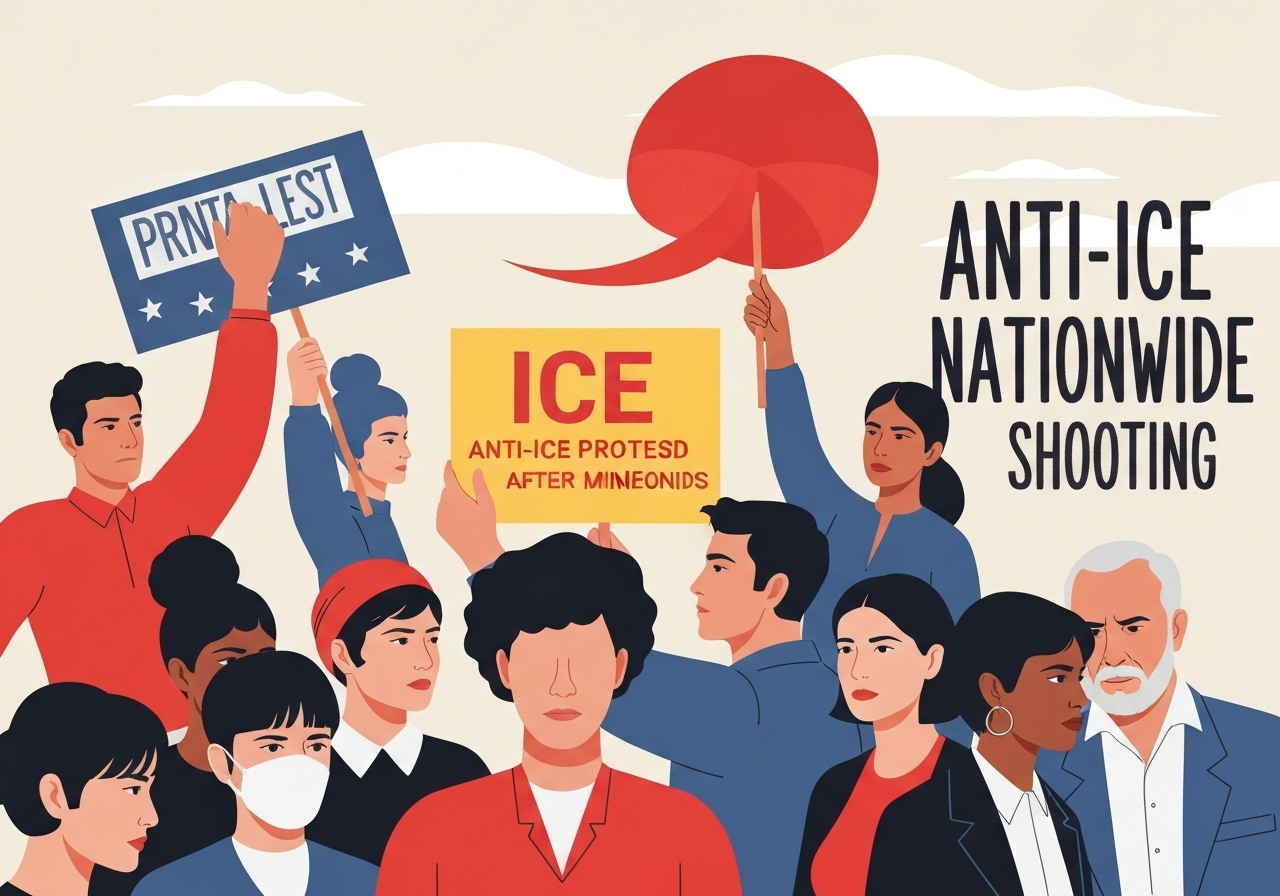
On Jan. 10, 2026, demonstrations organized under the “Ice Out for Good” banner swept through small towns and major cities after an Immigration and Customs Enforcement (ICE) agent shot and killed Renée Nicole Good in South Minneapolis three days earlier. Protesters mobilized to condemn what they described as an escalation in federal immigration enforcement tied to the Trump administration’s deportation campaign. The demonstrations followed a Jan. 8 incident in Portland, Ore., in which Border Patrol agents shot and wounded two people in a vehicle, and organizers linked the two cases in calls for nationwide action. Authorities and federal officials offered sharply different accounts of the Minneapolis shooting, and videos of the encounter circulated widely, fueling both outrage and debate.
Key Takeaways
- Renée Nicole Good, identified by state officials as a U.S. citizen, was shot and killed by an ICE agent in South Minneapolis on Jan. 7, 2026; video of the encounter exists from multiple angles.
- Protests under the “Ice Out for Good” campaign occurred across the country on Jan. 10, 2026, including gatherings in Portland, Ore., small towns and other cities targeted by recent enforcement operations.
- On Jan. 8, 2026, Border Patrol agents in Portland shot and wounded two people in a car; activists linked that incident to the Minneapolis killing in weekend mobilization calls.
- The 50501 movement and organizers of last year’s “No Kings” and “Hands Off” demonstrations issued statements calling the incidents part of a pattern of accelerated violence by ICE under the Trump administration.
- State leaders in Minnesota described the Minneapolis shooting as an unjustifiable use of lethal force; Trump administration officials characterized Ms. Good as a left-wing domestic terrorist and said the agent acted in self-defense.
- Protesters frequently carried cameras, whistles and other recording devices at demonstrations; local scenes ranged from peaceful marches to tense standoffs near enforcement actions.
Background
Federal immigration enforcement has intensified in recent years, with the Trump administration launching coordinated operations in multiple cities. Those campaigns have singled out neighborhoods with immigrant populations, and Minneapolis has been identified by federal officials as a focus for operations targeting Somali residents. That emphasis has deepened long-running strains between immigrant communities and federal enforcement agencies, producing recurring street responses and local political pushback.
Organized activist networks that coalesced around protests last year — groups behind demonstrations labeled “No Kings” and “Hands Off” — have remained active and coordinated. The 50501 movement, one of the groups that issued a news release after the Minneapolis and Portland shootings, framed the incidents as evidence of a pattern of systemic brutality that activists say has accelerated under current federal policies. Law enforcement agencies, local officials and immigrant-rights groups have frequently disputed each other’s narratives in high-profile enforcement episodes, amplifying polarization.
Main Event
According to state statements and video circulated by witnesses, on Jan. 7 an ICE agent encountered Renée Nicole Good in South Minneapolis and fatally shot her while she was in a car. The episode was recorded from several vantage points; footage shared online shows parts of the encounter but has been interpreted differently by advocates, officials and bystanders. Minnesota state leaders publicly criticized the agent’s use of force, calling it unjustified; at the same time, federal officials asserted that the agent confronted a violent threat and defended the shooting as self-defense.
Three days later, on Jan. 10, demonstrators assembled in multiple cities to protest. In Portland, a crowd gathered along the downtown waterfront on Saturday morning; other demonstrations took place in towns and cities that have recently been targeted by federal immigration enforcement operations. Organizers framed the weekend mobilization as a coordinated national response to two recent incidents they say illustrate a pattern of excessive force by federal agents.
Activists and organizers said the demonstrations were meant both to mourn victims and to pressure elected officials for accountability and policy change. Protesters reported encountering law enforcement at several sites; many carried cameras and used whistles and other tactics that have become common in recent anti-enforcement demonstrations. Local law enforcement agencies monitored rallies and, in some places, sought to keep demonstrations and ongoing enforcement activity physically separated.
Analysis & Implications
The Minneapolis killing and the Portland shooting together underline how immigration enforcement operations have become flashpoints that can quickly escalate into national political controversies. For the Trump administration, intensified enforcement is a policy priority, but high-profile uses of force raise legal and political risks that can reverberate through communities and courtrooms. Investigations, civil lawsuits and calls for federal oversight are likely outcomes when deaths or serious injuries occur during enforcement actions.
For immigrant communities and their advocates, these incidents reinforce perceptions of disproportionate targeting and the need for new safeguards. Community trust in federal agents has long been fragile; fatal encounters are likely to deepen mistrust, hinder cooperation with authorities on unrelated public-safety matters and mobilize further protest activity. Elected officials at the state and local level face pressure to demand transparency and to pursue independent inquiries.
There are also operational implications for agencies: heightened scrutiny may lead to changes in rules of engagement, reporting protocols, body-camera policies and interagency coordination. If federal investigators or prosecutors open formal inquiries, that process could take months and shape both local enforcement practices and broader policy debates about deportation priorities and oversight mechanisms.
Comparison & Data
| Date | Location | Agency | Fatalities | Injuries | Notes |
|---|---|---|---|---|---|
| Jan. 7, 2026 | South Minneapolis, Minn. | ICE | 1 (Renée Nicole Good) | 0 reported | Video from multiple angles; dispute over use of force |
| Jan. 8, 2026 | Portland, Ore. | U.S. Border Patrol | 0 | 2 wounded | Agents shot occupants of a car; details under review |
The table above summarizes the two linked incidents that organizers cited in calls for nationwide demonstrations. Both events occurred within days of one another and involve federal immigration agents, but they differ in outcome, with one fatality in Minneapolis and two people wounded in Portland. Public video and official statements exist in both cases, yet interpretations diverge sharply; that divergence has been a central driver of public mobilization.
Reactions & Quotes
“Renée Nicole Good and the Portland victims are just the most recent victims of ICE’s reign of terror.”
50501 movement (activist group statement)
The 50501 movement used this language in a news release that framed the two incidents as part of an escalating pattern of force by federal immigration agencies, and called for a coordinated, nationwide response.
“An unjustifiable use of lethal force against a civilian who was trying to leave the scene,”
Minnesota state leaders (official statement)
State officials in Minnesota characterized the shooting in these terms when criticizing the ICE agent’s actions; their statement prompted calls for an independent review. The exact legal and administrative outcomes will depend on forthcoming investigations and any criminal or civil proceedings.
“The agent acted in self-defense; the subject attempted to run over the officer and was affiliated with a left-wing domestic terrorist ideology,”
Trump administration officials (federal statement)
Federal spokespeople offered a markedly different account, portraying the agent as having faced an immediate threat. That assertion remains contested by state officials and independent observers who point to video discrepancies and witness testimony.
Unconfirmed
- Whether Renée Nicole Good intentionally attempted to run over the ICE agent remains disputed; available video has been interpreted in contrasting ways and investigators have not publicly announced a definitive conclusion.
- Claims that Ms. Good was a left-wing domestic terrorist are made by federal officials but lack public corroboration in available reporting and remain allegations pending verification.
- The full operational context for the agents involved (tasking, local coordination, prior warnings) has not been publicly released and is subject to investigation.
Bottom Line
The Minneapolis fatality and the Portland shootings have catalyzed nationwide protests and sharpened public debate over federal immigration enforcement. These events illustrate how enforcement actions that result in death or injury immediately become political flashpoints, prompting calls for oversight, demands for accountability and intensified community activism.
What to watch next: whether state or federal prosecutors open formal criminal investigations, whether independent or federal reviews change agency practices, and how elected officials respond to renewed pressure from both immigrant-rights groups and law-and-order constituencies. The coming weeks are likely to determine whether the incidents produce policy changes, sustained protest cycles or a prolonged legal process.