
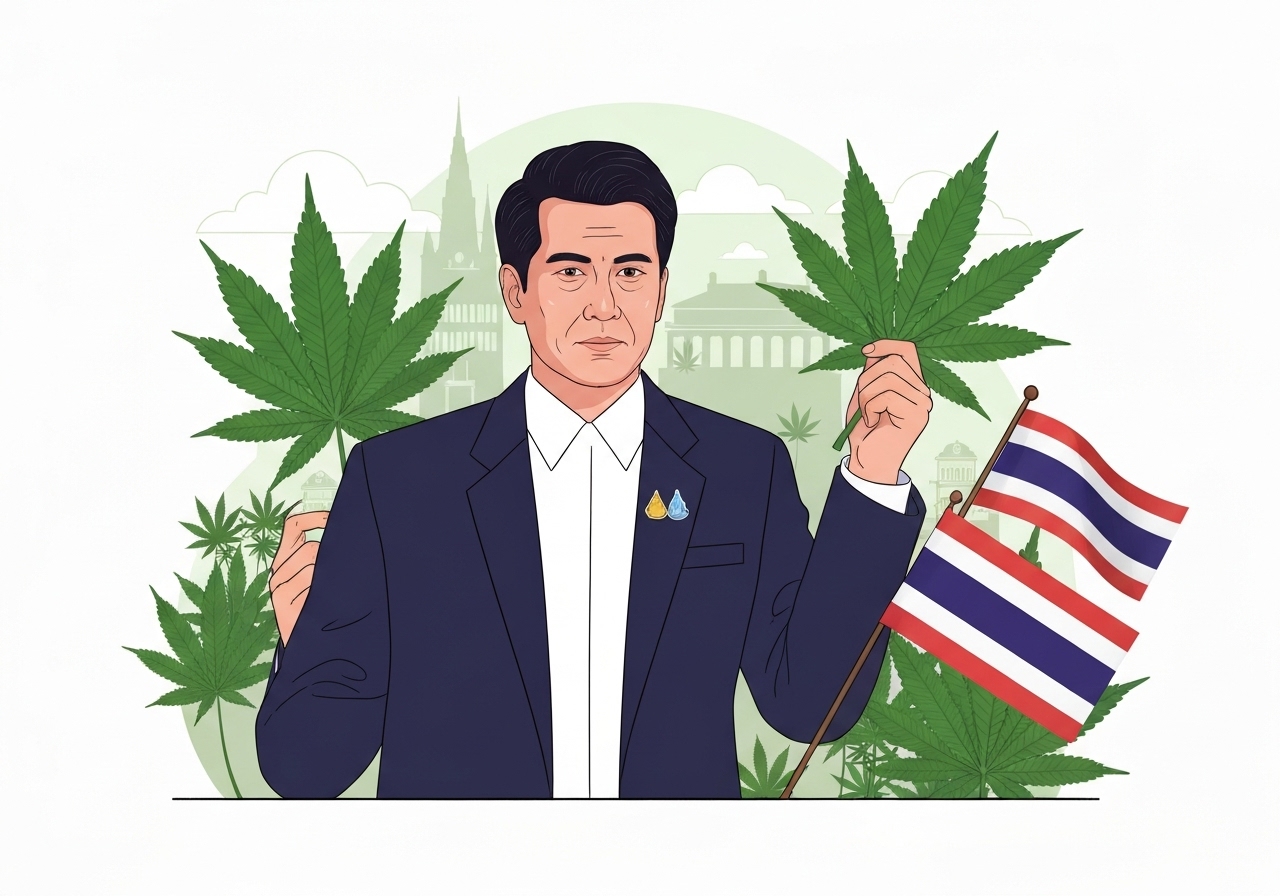
— Anutin Charnvirakul was elected Thailand’s prime minister by parliament on Friday after a court removed Paetongtarn Shinawatra from office; the 58-year-old, long known for championing cannabis reform and for his role in health and coalition politics, secured broad legislative backing while abstaining from the vote.
Key Takeaways
- Anutin won a parliamentary vote on Sept. 5, 2025, after Paetongtarn was dismissed by the Constitutional Court.
- He abstained from the floor vote and celebrated with his lawmakers after a decisive outcome.
- Leader of the Bhumjaithai party, Anutin built his appeal bridging conservative elites and regional constituencies.
- He rose to national prominence as health minister during COVID-19 and led Thailand’s 2022 cannabis liberalisation.
- Bhumjaithai holds 70 of 500 parliamentary seats but secured broader coalition support, including outside backing from the People’s Party successor to Move Forward.
- His background spans private-sector leadership at Sino-Thai and long-standing ties to Thaksin-era politics.
- Immediate challenges include economic headwinds, tense Cambodia border relations, and the need to manage coalition stability.
Verified Facts
Parliament voted to elect Anutin on Sept. 5, 2025, after the Constitutional Court dismissed Paetongtarn Shinawatra from the premiership for an ethics violation. Observers described the weeks preceding the vote as turbulent, after a June leak of a phone call set in motion political manoeuvres that reshaped coalition alignments.
Anutin, 58, has been a national figure for more than two decades. He entered politics with the Thai Rak Thai movement and later led Bhumjaithai, a party rooted in the farming communities of the lower northeast. Bhumjaithai won 70 seats in the 500-member lower house at the last election but has often acted as a pivotal junior partner in coalitions.
In government roles, Anutin served as health minister during the COVID-19 pandemic and pursued high-profile policy changes, most notably championing cannabis legalisation in 2022. He also held the interior ministry in administrations formed since 2023. He abstained from the prime ministerial ballot and accepted the result after his coalition achieved a commanding vote tally.
His private-sector career includes leadership at Sino-Thai, the construction firm founded by his family, and a return to politics after a 2007 court-mandated party dissolution and a five-year political ban; he became Bhumjaithai leader in 2012. Analysts note that Anutin has cultivated links both with provincial power brokers and parts of the conservative establishment.
Context & Impact
Anutin’s elevation reflects a pragmatic strand in Thai politics that can reconcile conservative royalist interests with populist provincial networks. Commentators view him as politically flexible, able to negotiate across factions that have historically clashed — a dynamic that has produced multiple coups and court interventions over 25 years.
Domestically, his premiership comes at a sensitive moment: Thailand’s economy faces headwinds and social expectations for stable governance remain high. Regionally, relations with Cambodia are fragile after a violent border confrontation earlier this year, presenting an early foreign-policy test for the new government.
The support arrangement with the People’s Party (the successor aligned with Move Forward’s progressive base) is structured as outside backing rather than formal coalition membership. That posture may reduce immediate friction but also leaves the government exposed to shifting parliamentary calculations.
Policy-wise, Anutin’s track record suggests continuity on health and regulatory reform, with potential emphasis on agricultural constituencies that underpin Bhumjaithai’s support. Observers will watch appointments to key ministries and any pledges on economic stimulus or border security.
“We know that the People’s Party has cooperated and made sacrifices in finding a solution for Thailand during a period of crises,”
Anutin Charnvirakul, after securing endorsement
Unconfirmed
- Precise motives and actors behind the June phone-call leak remain under investigation and are not fully verified in public records.
- Long-term stability of the current coalition and the scope of formal agreements with outside supporters are subject to negotiation and may change.
Bottom Line
Anutin’s rise to prime minister signals a pragmatic pivot in Thai governance: a leader with provincial roots, business experience and a reformist record on issues like cannabis now heads a fragile coalition. His immediate priority will be to demonstrate steady economic management and to defuse regional tensions while maintaining fragile parliamentary alliances.