
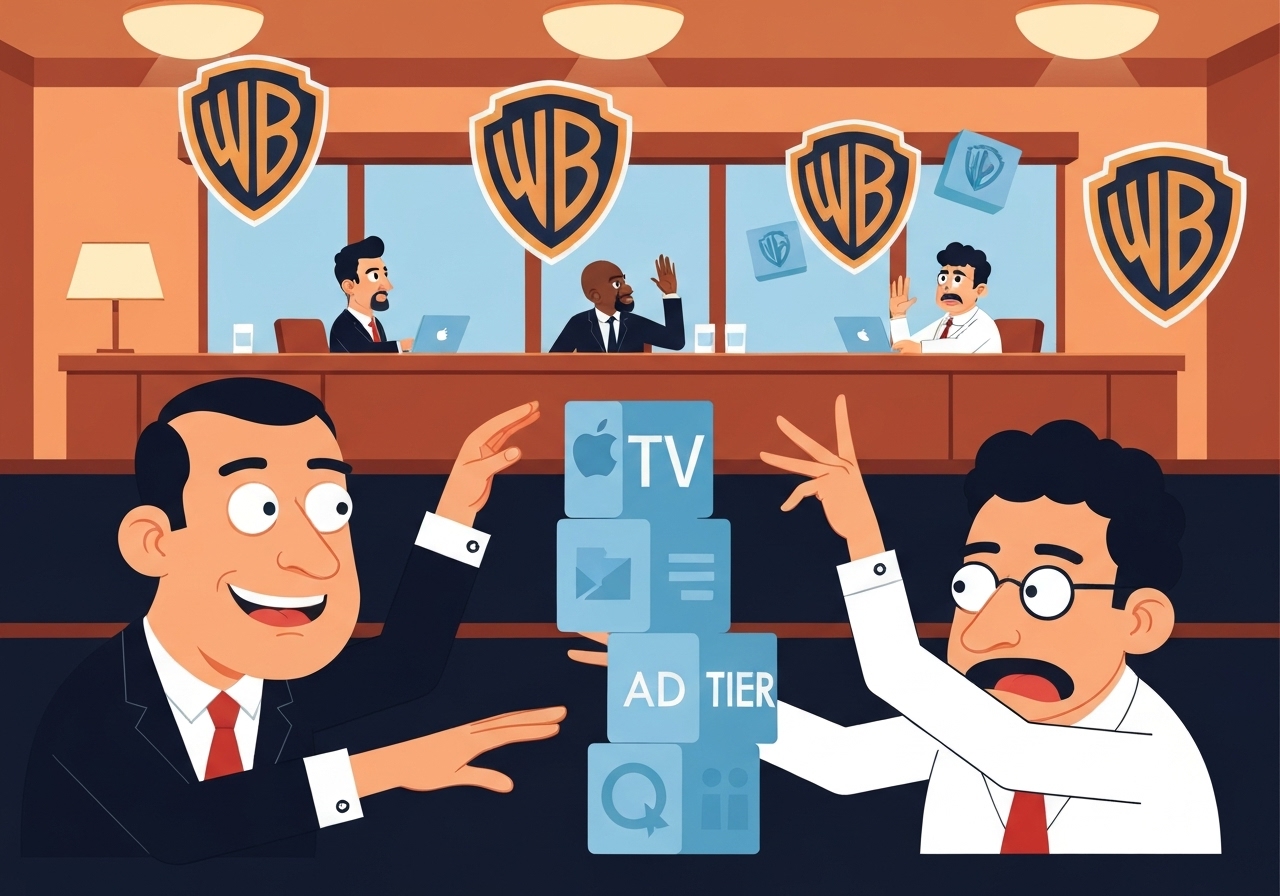
Apple TV executives told a Screen International interview, as reported by Ars Technica in November 2025, that the company has no plans to add an ad-supported tier or to pursue a major acquisition such as Warner Bros. Discovery. The leadership emphasized a strategy centered on original programming rather than licensing or buying large legacy libraries. Executives said Apple prefers small, targeted acquisitions unrelated to Apple TV and that the current focus is on building distinctive, emotionally driven shows and films. The remarks aim to settle recent speculation about Apple changing course to scale its streaming footprint quickly.
Key Takeaways
- Apple TV+ launched in 2019 and the company reiterated in November 2025 that it remains focused on original content rather than building a large licensed library.
- Jamie Erlicht stated the service is ‘all-original’ and that Apple is not planning to add pre-existing IP or library content to Apple TV+.
- Eddy Cue (referred to as Cue) noted Apple historically pursues very small acquisitions and said he does not expect major studio buyouts tied to Apple TV.
- Zack Van Amburg emphasized storytelling that centers on human emotional experience as the creative pillar for Apple TV’s commissions.
- Media speculation in 2025 about Warner Bros. Discovery being for sale prompted questions about acquisition, but Apple executives explicitly downplayed that route.
- Apple’s strategy implies foregoing short-term scale gains that come from legacy libraries or ad revenue in favor of curated premium originals.
Background
Apple entered the streaming market with Apple TV+ in 2019 as a subscription video-on-demand service emphasizing high-profile original series and films rather than a large back catalog of licensed content. The streaming landscape since then has been shaped by consolidation, large-scale library purchases, and the emergence of ad-supported tiers as a revenue lever for some competitors. Companies such as Disney and Warner Bros. Discovery control extensive legacy IP that can rapidly scale subscriber growth when bundled, while pure-originals strategies rely on critical hits and brand prestige.
In 2025, trade coverage and investor commentary rekindled questions about whether Apple might use acquisitions to expand Apple TV+ more quickly, particularly amid reports that Warner Bros. Discovery was a potential asset in play. That speculation intersected with industry debate over whether ad-supported pricing or acquiring entrenched libraries is necessary to compete with incumbents like Netflix, Disney+, and Max. Apple executives were interviewed by Screen International and summarized in an Ars Technica report that captured their public-facing rationale for sticking to originals-first development.
Main Event
The Screen International interview, relayed by Ars Technica in November 2025, put Apple TV leaders on record rejecting both an ad tier and large studio acquisitions as growth plans. Jamie Erlicht, one of Apple’s heads of worldwide video, said the company is ‘building an all-original service’ and is not looking to augment the platform with pre-existing IP or licensed libraries. When asked directly about targets mentioned in public speculation—Warner Bros., A24, or Disney—Eddy Cue highlighted Apple’s historical pattern of small purchases and expressed skepticism that a large buy would fit Apple TV’s approach.
Executives framed the decision as deliberate rather than reactive: they argued Apple TV+ prioritizes creative control and premium positioning over rapid scale. Zack Van Amburg described the creative thread of Apple programming as placing humanity and emotional stakes at the center of storytelling, a guiding principle for commissioning shows and films. The leadership said these choices reflect long-term brand and product strategy rather than short-term subscriber accumulation tactics.
The statements came amid industry chatter about consolidation and asset sales, but the executives presented a consistent message: Apple TV’s growth will come from original slate-building, not licensing bulk catalogs or deploying a lower-cost ad-supported product. The public comments sought to manage expectations among investors, talent partners, and potential subscribers about what Apple intends for its streaming business.
Analysis & Implications
Apple’s insistence on an originals-first model narrows the immediate playbook for subscriber growth compared with peers that combine originals with vast licensed libraries. Originals can generate awards, cultural buzz, and higher per-subscriber revenue, but they are costlier per hour of viewer engagement than leaning on an existing IP catalog. By rejecting an ad tier, Apple forgoes an incremental revenue stream and a low-price entry point that competitors have used to broaden reach.
Choosing not to pursue large-scale acquisitions constrains rapid expansion into library-driven audiences but reduces exposure to high transaction costs, complex integrations, and antitrust scrutiny. Apple historically makes small, strategic acquisitions—often for technology or talent—that align with long-term product roadmaps. That approach preserves cultural and operational control but may make Apple TV+ a slower riser in market share versus conglomerates that bought scale through mergers and legacy IP.
For talent and production partners, Apple’s stated priorities send a clear signal about commissioning criteria: projects that offer distinct creative voice and emotional resonance are likelier to receive backing. For investors and competitors, the statements suggest Apple accepts trade-offs between scale and curation. International expansion, bundling with hardware, and cross-promotion inside the Apple ecosystem could remain the main levers for customer acquisition unless strategy shifts in the future.
Comparison & Data
| Service | Launch Year | Primary Strategy (2025) |
|---|---|---|
| Apple TV+ | 2019 | Premium originals; no ad tier (per executives), limited small acquisitions |
| Disney+ | 2019 | Large legacy library bolstered by acquisitions (e.g., 21st Century Fox); offers ad tiers |
| Warner Bros. Discovery | Consolidated 2022 | Extensive legacy IP and linear assets; subject to 2025 sale speculation |
The table highlights strategic contrasts: Apple TV+ leans on original content and curated commissioning, while several rivals combine originals with large back catalogs and ad-supported options. This means Apple must rely on hit-driven economics and ecosystem tie-ins rather than the immediate subscriber lift that a library or ad tier can produce.
Reactions & Quotes
‘We’re building an all-original service; we’re not building on the back of pre-existing IP or library.’
Jamie Erlicht, Apple head of worldwide video (as quoted in Screen International)
The remark succinctly captures Apple TV’s positioning against an industry that often prizes scale from existing catalogs.
‘We do very small acquisitions in general, not related to Apple TV, so I don’t see that happening because we like what we’re doing.’
Eddy Cue, Apple executive
Cue’s comment underlines Apple’s broader historic acquisition pattern and the company’s current lack of appetite for a transformational studio purchase tied to its streaming service.
‘A core tenet of everything Apple does is the notion that humanity needs to be at the center of it… Our shows and our movies tend to be about the emotional experience, the stakes involved, even when we’re doing a comedy.’
Zack Van Amburg, Apple head of worldwide video
Van Amburg’s framing explains the creative rationale guiding commissioning decisions and what Apple expects from originals it finances.
Unconfirmed
- Reports that Apple is actively pursuing a purchase of Warner Bros. Discovery remain unconfirmed and lack direct evidence from Apple corporate filings or formal bids.
- While executives denied plans for an ad tier at the time of the interview, future strategic pivots by Apple cannot be ruled out and have not been publicly committed in long-term legal filings.
Bottom Line
Apple TV’s leadership has clearly signaled that the service will double down on original programming rather than chase quick scale through large studio acquisitions or a lower-cost ad-supported product. That choice preserves Apple TV+’s premium positioning but may slow subscriber growth relative to rivals that exploit legacy libraries or ad tiers to widen audiences rapidly.
For stakeholders—viewers, creators, and investors—the practical implication is predictability: Apple TV+ will continue to prioritize selective, emotionally driven projects and incremental, small acquisitions when necessary. Observers should watch for changes in messaging from Apple or market conditions that could prompt a re-evaluation of this approach, but as of November 2025, the company appears committed to curation over consolidation.
Sources
- Ars Technica — technology news report (citing a Screen International interview, November 2025)