
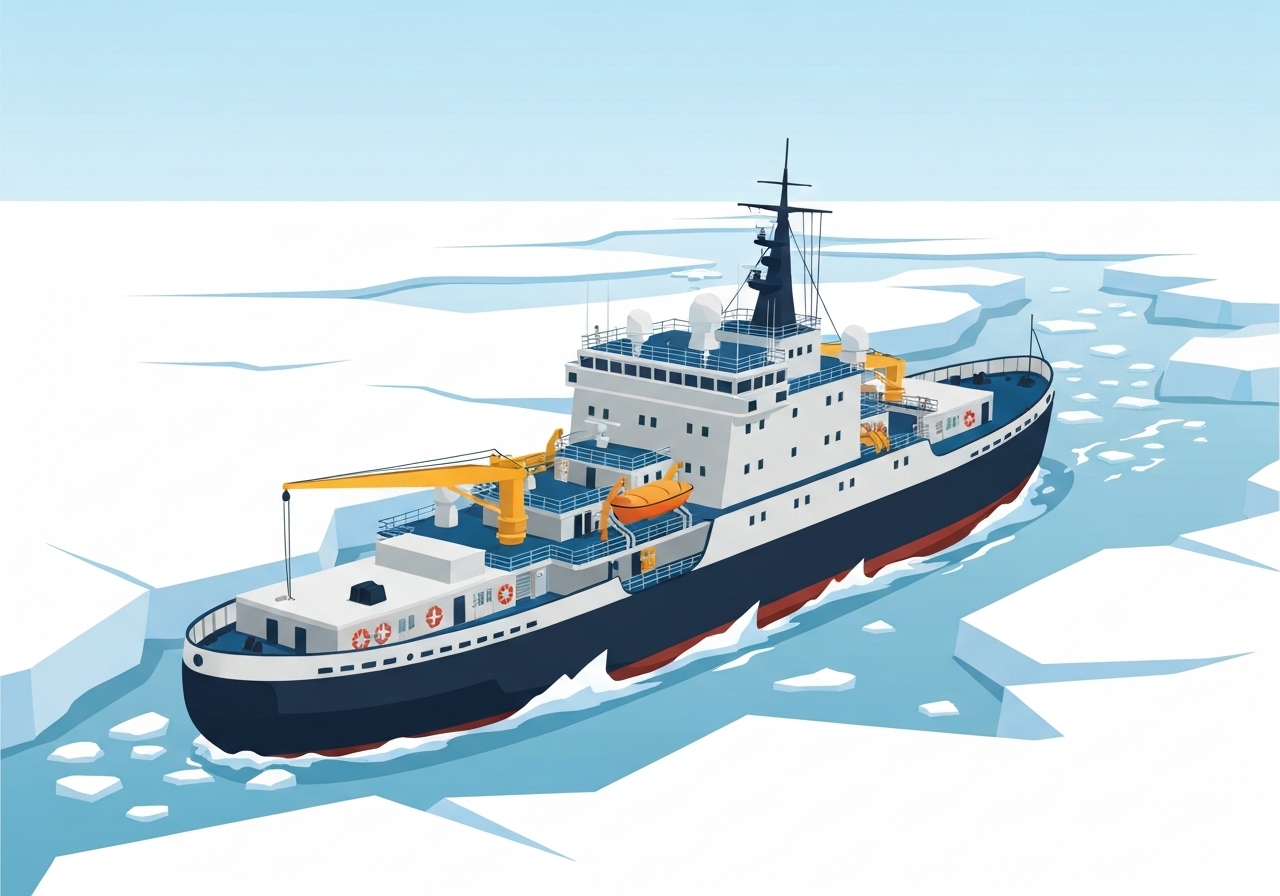
On Jan. 6, 2026, South Korea’s icebreaker Araon encountered a rapid and dramatic change in sea-ice conditions while operating in the Amundsen Sea: open, movable floes that the vessel had been traversing gave way within hours to a continuous, snow-covered ice plain and whiteout conditions that severely restricted navigation and scientific operations. Chief scientist Won Sang Lee and the ship’s crew, led by Captain Kim Gwang-heon, described a shift from dynamic, colliding floes to expansive, immobile sheets that trapped even large icebergs. The transformation forced the expedition to slow, reassess sampling plans and prioritize safety amid limited visibility. The episode highlights immediate operational risks for polar research ships and adds a real-time example to debates about changing Antarctic sea-ice behavior.
Key Takeaways
- On Jan. 6, 2026, the icebreaker Araon was operating in the Amundsen Sea when sea ice shifted from broken floes to an unbroken snow-covered plain within a few hours.
- Chief scientist Won Sang Lee and Captain Kim Gwang-heon reported whiteout conditions and a near-total loss of a visible horizon, complicating navigation and deck operations.
- The change rendered previously navigable routes effectively impassable, forcing the ship to slow and alter planned sampling and transit schedules.
- Observers noted that large tabular icebergs appeared immobilized by the denser sea ice surrounding them, suggesting rapid consolidation of pack ice.
- Photographer Chang W. Lee documented the event, including the moment a storm obscured the horizon, limiting visual cues for the bridge crew.
- The incident underscores immediate safety challenges and potential impacts on seasonal fieldwork timelines for Antarctic expeditions.
Background
The Araon is a South Korean research icebreaker regularly deployed to the Amundsen Sea to support oceanographic and glaciological studies. The Amundsen Sea region is a focal point for Antarctic research because of its connections to West Antarctic ice-shelf dynamics and accelerating glacier discharge. Sea-ice conditions there can be highly variable: wind, currents and temperature shifts produce episodes of mobile floes and, occasionally, rapid consolidation into extensive pack ice. Researchers plan operations around forecasted windows of navigability, but sudden transitions remain a known risk for both science missions and resupply voyages.
Historically, polar crews have adapted by altering course, waiting for respite, or using ice-strengthened hulls to push through thinner areas; but thick, continuous sea ice presents limits even for reinforced vessels. Previous decades have seen instances where research schedules were truncated or equipment deployments canceled because of unexpected ice growth or storms. Multiple stakeholders are involved in these missions: ship officers responsible for safety, scientists aiming to collect time-sensitive measurements, and logistics teams coordinating port connections. The balance among safety, science objectives and operational constraints is central to how such events are managed.
Main Event
The vessel spent much of Monday making steady progress through a zone of broken floes—loose plates of sea ice that shifted and bumped under wind stress—allowing the crew to maintain planned sampling work. By midafternoon, conditions began to change: observers on the bridge reported the floes drawing together, the sea surface becoming increasingly uniform and the wind carrying snow that began to erase distant visual references. Within hours that surface had become an almost seamless, snow-covered plain extending to the visible horizon.
By evening, a storm-driven whiteout removed the horizon entirely, leaving crews to rely on instruments rather than visual cues for navigation. Captain Kim Gwang-heon ordered the ship to reduce speed and shift to heightened watch routines while the bridge team evaluated options for safe transit. The consolidated sea ice was firm enough that even sizable icebergs appeared embedded, no longer free to move with currents or wind as they had been earlier in the day.
Onboard scientists, led by Won Sang Lee, paused deployments of near-surface samplers and acoustic instruments until safer conditions returned. The abruptness of the transition forced a reassessment of immediate research priorities: maintaining crew safety and preserving instrument integrity took precedence over further sampling in the affected sector. Communication between the bridge and the science party intensified as forecasts and ice-observation data were rechecked for signs of imminent change.
Analysis & Implications
Operationally, the episode is a clear illustration of how quickly polar conditions can shift from manageable to hazardous, even for purpose-built research vessels. For mission planners, the event underscores the value of conservative routing, flexible sampling schedules and contingency plans that allow rapid suspension of fieldwork when ice conditions consolidate. Dependence on visual navigation diminishes in whiteout scenarios, meaning instrument redundancy and experienced bridge teams are essential to maintain safety margins.
Scientifically, sudden consolidation of sea ice affects the interpretation of short-term measurements of ocean-atmosphere exchange, sea-ice thickness and biological sampling windows. Data collected before and after such rapid changes can show stark contrasts in surface forcing, light penetration and heat fluxes, complicating short-term time series but offering a natural experiment on system response. Understanding how frequent and extensive these consolidation events are will matter for regional models of ice–ocean interaction around the Amundsen Sea.
At a broader level, incidents like this feed into policy and logistical discussions about Antarctic operations amid variability linked to climate trends. If rapid transitions between navigable floes and dense pack ice become more common or occur at different seasonal timings, research seasons could shorten and costs rise as missions require more fuel, time and contingency resources. National program managers and international partners will need to weigh these risks when scheduling and funding field campaigns.
Comparison & Data
| Condition | Before (hours) | After (hours) |
|---|---|---|
| Surface type | Discrete, mobile floes | Continuous snow-covered plain |
| Visibility | Horizon visible | Whiteout, horizon obscured |
| Navigation | Normal transit speed | Reduced speed, caution |
The table above summarizes the qualitative shift observed aboard Araon over a matter of hours. While precise thickness or concentration measurements were not released publicly at the time of reporting, the operational indicators—reduced speed, halted deployments and reports of immobilized icebergs—are consistent with a rapid increase in sea-ice concentration and surface compaction. Follow-up measurements (ice thickness profilers, satellite ice-concentration products and shipborne radar) would provide quantitative confirmation and are recommended to contextualize the event within seasonal norms.
Reactions & Quotes
Bridge and science teams described the moment of change and immediate responses in succinct terms.
“We appear to be entering the real test for this leg—conditions tightened far faster than expected,”
Won Sang Lee, chief scientist
Dr. Lee framed the shift as an operational pivot point: planned sampling had to be suspended while safety assessments took priority. The comment captures the thin margin between research ambition and the pragmatic demands of shipboard safety.
“Visibility vanished and we had to slow the ship and rely on instruments rather than sight,”
Kim Gwang-heon, captain
Captain Kim’s remark emphasized navigational constraints: with the horizon gone, the bridge relied on radar and navigation systems and adopted heightened lookout procedures until the situation stabilized.
“Images show how the surface changed from fragmented plates to a broad snowfield in hours,”
Chang W. Lee, photographer
Photographic documentation supplied visual confirmation of the transition and will be useful for post-cruise analysis and public communication about the event.
Unconfirmed
- Any precise measurements of ice thickness or concentration aboard Araon at the moment of transition have not been publicly released and are not confirmed here.
- At this time there is no confirmed evidence linking this single consolidation event to long-term trends in Amundsen Sea ice behavior; broader datasets will be needed to assess frequency changes.
Bottom Line
The Araon episode on Jan. 6, 2026, is a clear operational reminder that Antarctic sea-ice conditions can change rapidly, turning manageable floe fields into continuous, hard-to-navigate pack within hours. For ship teams and scientists, the practical consequence is to plan conservatively, maintain flexible sampling schedules and prioritize redundant navigation aids for whiteout scenarios.
From a scientific and policy perspective, the event underscores the need for systematic, high-frequency observations—satellite and in situ—to determine whether such rapid consolidations are becoming more common and to quantify their impacts on research access and regional ice–ocean processes. Until more quantitative data are published, this incident stands as a well-documented example of the operational challenges facing modern Antarctic science.
Sources
- The New York Times — News media report from aboard the icebreaker Araon (Jan. 6, 2026).