
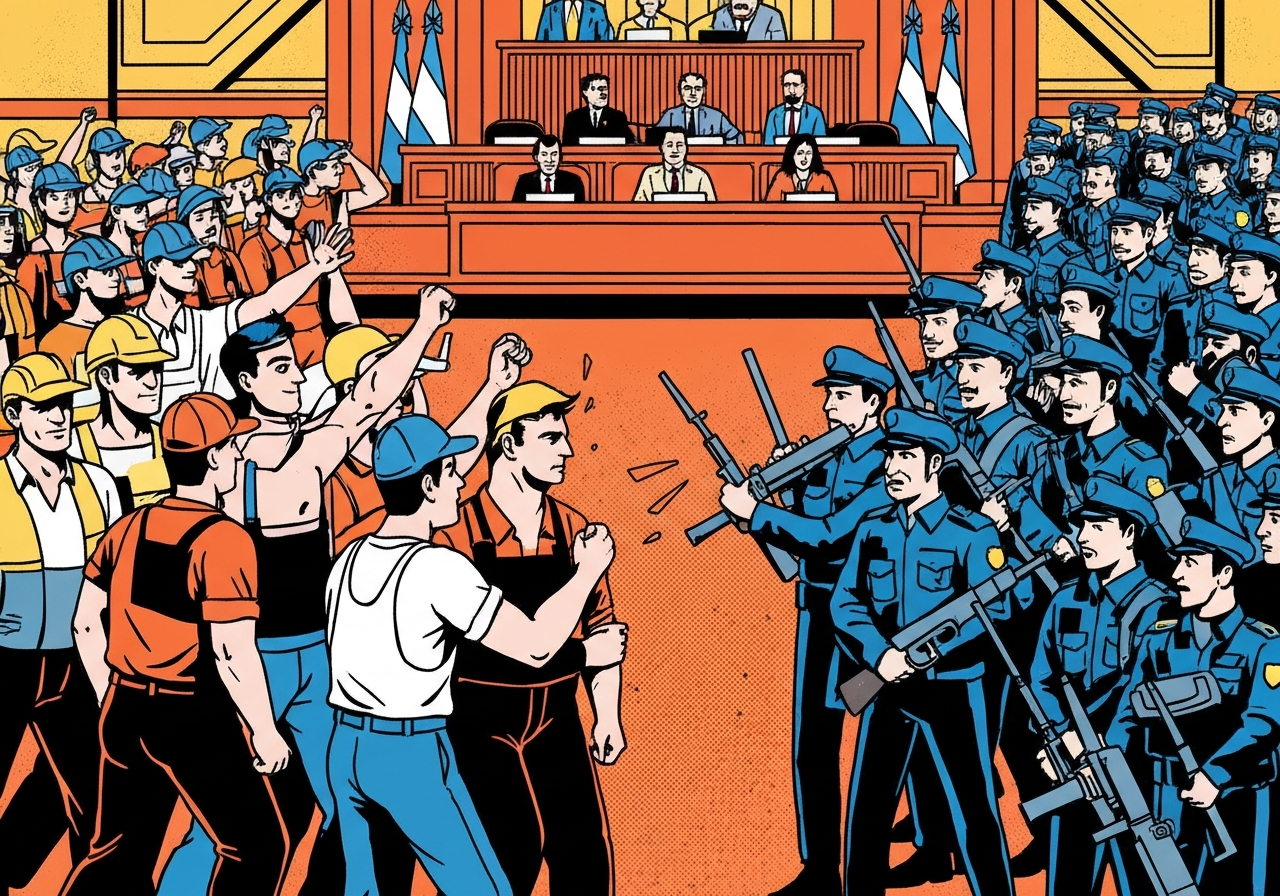
Lead: On Thursday, Feb. 12, 2026, thousands of unionized workers gathered outside Argentina’s Congress in Buenos Aires as senators opened debate on a proposed overhaul of the country’s labor laws. The demonstration, organized by major trade unions, blocked traffic and devolved into clashes with security forces. Police deployed water cannons and fired rubber bullets to disperse parts of the crowd while some protesters threw rocks and Molotov cocktails. The confrontation unfolded as lawmakers began formal discussion of a broad reform package intended to loosen longstanding labor protections.
Key Takeaways
- Thousands mobilized: Large union-organized contingents converged on Congress in Buenos Aires on Feb. 12, 2026, creating major street blockages around the legislative precinct.
- Senate action: Senators opened formal debate that day on a sweeping revision of Argentina’s rigid labor framework, marking a high-stakes parliamentary moment.
- Security response: Security forces used water cannons and rubber bullets to control crowds near the Palace of the National Congress.
- Protester tactics: Reporters and officials said some demonstrators threw rocks and Molotov cocktails at police lines, contributing to escalations on site.
- Public disruption: The mobilization disrupted traffic and commuter routes in central Buenos Aires for several hours during peak daytime activity.
- Photo coverage: The confrontation was documented in a curated photo gallery by AP editors capturing both clashes and legislative scenes.
Background
The proposed legislation aims to revise elements of Argentina’s longstanding labor code that many business groups describe as rigid and costly for employers. Argentina’s labor system has been shaped by strong union influence and statutory protections built over decades, which supporters of reform say constrain hiring and investment.
Trade unions, in turn, view labor protections as core to social stability and worker livelihoods; large federations retain substantial mobilizing capacity across sectors. Previous attempts to modify labor rules have repeatedly triggered nationwide strikes and political confrontations, making labor reform a perennial flashpoint in Argentine politics.
Main Event
Demonstrators began assembling near Congress in the morning, concentrating along the avenues that feed into the legislative precinct. Union marshals and banners marked organized contingents; the crowd steadily grew as senators convened to start debate on the reform package.
Authorities erected temporary barricades and a visible security perimeter around the Congressional complex. As some protesters sought to push past cordons, security forces employed water cannon discharges and used rubber projectiles to disperse concentrated clashes at several points.
Journalists on the scene and official statements reported that a segment of the crowd responded with thrown projectiles, including rocks and incendiary devices described as Molotov cocktails. Police actions and protester responses produced chaotic scenes captured in a photo gallery curated by AP editors.
Analysis & Implications
Politically, the clash underscores the sensitivity of labor reform in Argentina, where unions remain key actors in electoral coalitions and street politics. The Senate debate turns on balancing policymakers’ desire to increase labor market flexibility with unions’ determination to protect job security and collective bargaining gains.
Economically, proponents argue that loosening rigidities could encourage hiring and foreign investment over the medium term; opponents caution that weakened protections could depress wages and boost social tensions. Any enacted changes will be closely watched by businesses, investors, and labor organizations for their impact on employment and social stability.
In the short term, the protests increase the political risk for legislators endorsing controversial elements of the bill. Sustained street mobilization could force last-minute amendments, bargaining with union leaders, or potential judicial challenges if opponents pursue legal routes.
Comparison & Data
| Item | Details |
|---|---|
| Date | Feb. 12, 2026 |
| Location | National Congress, Buenos Aires |
| Organizers | Major trade unions (federations) |
| Senate action | Opening of debate on labor reform |
| Security response | Water cannons, rubber bullets |
| Protester actions | Blockades, rocks, Molotov cocktails reported |
This table summarizes verifiable facts reported from the scene and the parliamentary timeline. It is not a comprehensive legislative reading of the reform text, which remains under debate in the Senate at the time of reporting.
Reactions & Quotes
Union leaders described the proposed changes as an unacceptable rollback of worker protections and called for continued mobilization.
Union federation (statement to press)
A government spokesperson framed the legislation as necessary modernization to boost employment and competitiveness while affirming a willingness to negotiate technical points.
Government spokesperson (official statement)
AP editors compiled the photograph gallery documenting the day’s scenes, emphasizing the scale of mobilization and the intensity of confrontations around the legislature.
Associated Press (photo editors)
Unconfirmed
- Exact casualty and arrest figures were not confirmed at the time of reporting; official tallies had not been released.
- The proportion of protesters who engaged in violent tactics versus peaceful demonstrators remains unclear pending further investigation.
- Specific links between any organized groups and the reported incendiary devices have not been independently corroborated.
Bottom Line
The Feb. 12, 2026 confrontations outside Argentina’s Congress highlight how labor reform proposals continue to provoke street-level resistance and heighten political stakes for lawmakers. While the Senate has begun formal debate, the combination of large union mobilization and confrontational episodes raises the likelihood of intense negotiations, possible amendments, and ongoing public demonstrations.
Observers should watch for official votes, union bargaining moves, and any government attempts to mediate concessions; the final form of legislation will determine whether tensions abate or escalate further, with significant implications for Argentina’s labor market and political landscape.