
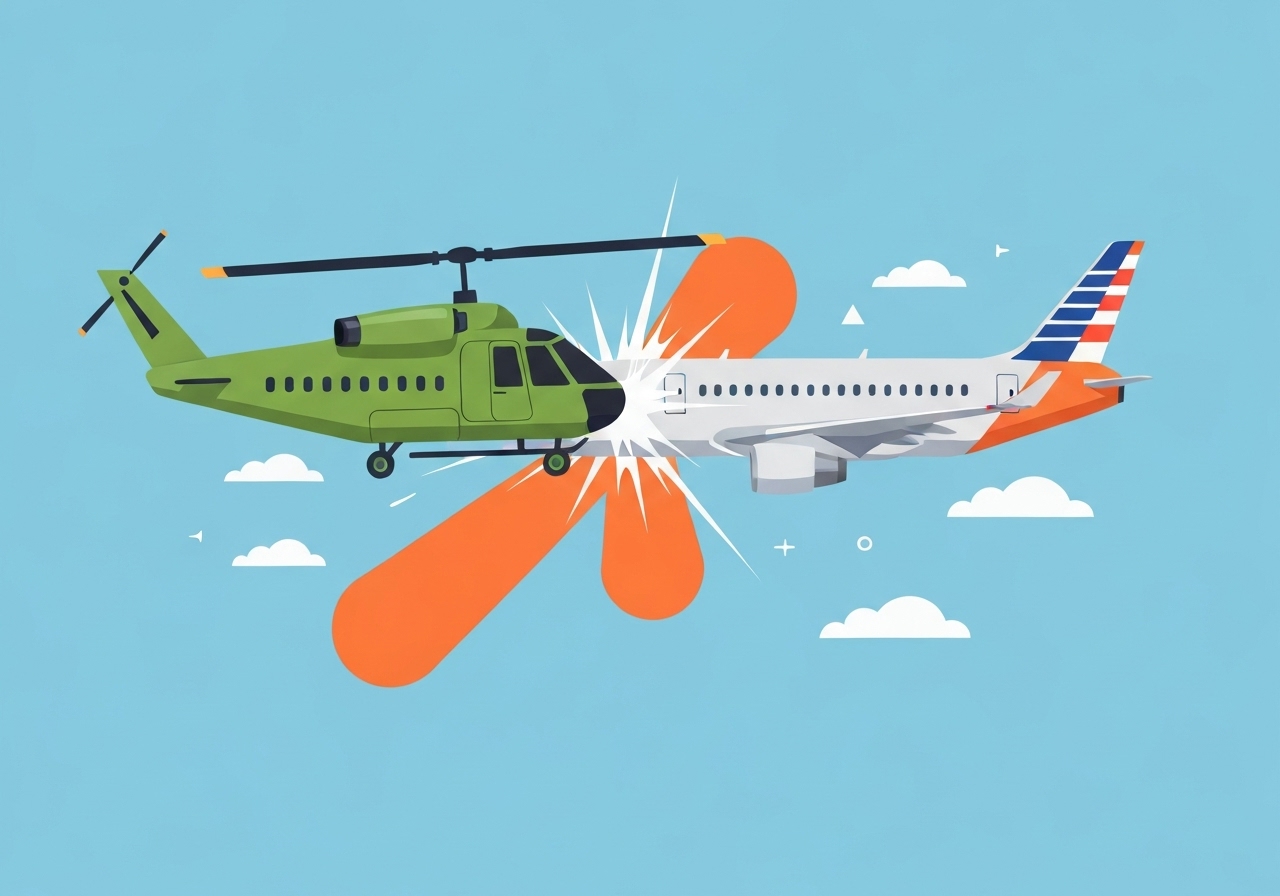
Lead: On January 29, 2025, the U.S. government formally admitted liability in the midair collision above the Potomac River that killed all 67 people aboard an Army Black Hawk and American Eagle Flight 5342. The Justice Department’s court filing said the government breached a duty of care, citing failures by Army aircrew and Federal Aviation Administration controllers. The collision occurred as the regional jet approached Ronald Reagan Washington National Airport at roughly 300 feet altitude. Families of victims have filed lawsuits in U.S. District Court in Washington while the National Transportation Safety Board continues its investigation.
Key Takeaways
- The crash on Jan. 29, 2025, involved American Eagle Flight 5342 from Wichita and a U.S. Army Black Hawk; all 67 people on both aircraft died.
- The Justice Department admitted the United States breached a duty of care in a court filing dated Dec. 17, 2025, and named FAA controllers and Army crew errors as proximate causes.
- The Army helicopter reportedly violated altitude restrictions and failed to avoid the airliner; the FAA did not issue required separation alerts, according to the filing.
- The NTSB is leading the official probe and had earlier criticized the FAA for not addressing safety risks and for chronic staffing shortages in the airspace around Reagan National.
- The collision prompted new restrictions on helicopter operations near Ronald Reagan Washington National Airport, one of the nation’s busiest and most constrained terminal areas.
- American Airlines (PSA Airlines subsidiary operator) is a named defendant in at least one wrongful-death suit filed by a victim’s family in federal court.
Background
The Potomac midair collision came against a backdrop of densely packed terminal airspace at Ronald Reagan Washington National Airport, where military and civilian flights share constrained corridors. For years the National Transportation Safety Board and aviation safety advocates have warned about the complexity of arrival and departure paths in the Washington area and the risks introduced by mixed military and civilian traffic. The region’s airspace frequently requires low-altitude transitions and close sequencing, increasing reliance on air traffic control and strict adherence to published altitude corridors.
Historically, the U.S. air system has handled mixed operations through procedures, NOTAMs and temporary flight restrictions, but staffing shortfalls at the Federal Aviation Administration have been cited as a recurring problem during congressional hearings and agency reviews. The Jan. 29 collision is now the deadliest U.S. aviation accident since 2001, renewing scrutiny of coordination between the military, FAA, and airports. Families of victims and public officials have demanded clearer accountability and faster remedial action.
Main Event
On the evening of January 29, 2025, American Eagle Flight 5342 was on final approach to runway 1 at Ronald Reagan Washington National Airport, descending to about 300 feet when a U.S. Army Black Hawk helicopter carrying three people entered the aircraft’s path over the Potomac River. The two aircraft collided, broke apart, and came down into the river. Emergency response teams recovered wreckage and remains; there were no survivors among the 67 people aboard both aircraft.
In its December court filing, the Justice Department said the Army crew failed to maintain required altitudes and did not take evasive action to avoid the jet. The filing also cites FAA air traffic control failures to separate the aircraft and to issue timely traffic alerts. The FAA and the Department of Defense have declined immediate on-the-record comment following the filing; American Airlines also did not respond to requests for comment when contacted by reporters.
The National Transportation Safety Board has conducted on-scene work and multiple investigative activities since January, collecting flight data recorders, radar tracks, and communications transcripts. Over the summer, NTSB members publicly criticized the FAA at a hearing for not adequately addressing known safety risks in the Reagan National terminal area and for chronic controller staffing issues. The multiagency investigation remains open as the NTSB examines procedures, human factors, and system performance leading up to the collision.
Analysis & Implications
The Justice Department’s admission of liability is uncommon and signals a substantial legal and policy ripple effect. Legally, an admission narrows factual disputes in civil litigation and may accelerate settlement talks; it also lays a foundation for families seeking compensation. Politically and administratively, it raises questions about interagency coordination—particularly how military flight operations are integrated with civilian air traffic in constrained terminal areas.
From a safety-management perspective, the filing highlights two failure nodes: aircraft operator adherence to altitude constraints and centralized air traffic control. If investigations confirm procedural noncompliance by the Army crew, the Defense Department will face pressure to revise training, oversight, and mission planning for flights in civilian terminal airspace. Simultaneously, the FAA will confront renewed demands to fix controller staffing shortfalls, improve procedures for mixed-use corridors, and deploy technological aids to reduce loss-of-separation risk.
Economically, the accident and subsequent operational curbs could produce modest short-term impacts on flight planning and helicopter missions in the region, while litigation costs and potential settlements could reach tens or hundreds of millions of dollars depending on outcomes. Internationally, the U.S. handling of accountability and corrective measures will be watched by other countries managing mixed military-civilian terminal environments.
Comparison & Data
| Event | Date | Fatalities |
|---|---|---|
| Potomac midair collision (this crash) | Jan 29, 2025 | 67 |
| Colgan Air Flight 3407 | Feb 12, 2009 | 50 |
| September 11 attacks (U.S.) | Sep 11, 2001 | 2,977 |
The table above places the Potomac collision in recent historical context: with 67 fatalities it is the deadliest U.S. civil aviation accident since 2001. The NTSB’s mandate is to determine probable cause and recommend safety improvements; comparisons to earlier accidents underscore how catastrophic results can follow layered operational or organizational failures.
Reactions & Quotes
Officials and observers reacted swiftly after the Justice Department filing and over the course of the investigation. Below are representative statements and the surrounding context.
“The United States admits that it owed a duty of care to Plaintiffs, which it breached, thereby proximately causing the tragic accident on January 29, 2025.”
U.S. Department of Justice (court filing)
This excerpt from the DOJ filing crystallizes the government’s legal position that failures by both military aircrew and FAA controllers contributed to the crash. The admission will figure prominently in ongoing civil suits and could shape settlement dynamics and congressional oversight.
“NTSB investigators have repeatedly warned about known safety risks and controller shortages in the Reagan National terminal area.”
National Transportation Safety Board (public hearing summary)
The NTSB has previously pointed to systemic vulnerabilities in the Washington terminal area. Its public critiques prompted hearings this summer where the FAA was asked to explain why long-identified risks had not been mitigated sooner.
Unconfirmed
- Precise ATC voice transcripts and whether routine traffic advisories were delivered at specific times remain publicly unreleased pending the NTSB’s release of transcripts.
- Whether the Army flight deviated intentionally from its cleared altitude for operational reasons is not confirmed by the public record and remains under investigation.
- The extent to which radar or surveillance system limitations may have contributed to loss of separation is still under review and not yet established.
Bottom Line
The Justice Department’s admission of liability narrows the legal argument in forthcoming civil litigation and shifts focus toward systemic fixes across military flight operations and FAA air traffic control in congested terminal airspace. Families of the victims are likely to press for expedited compensation and stronger institutional reforms, while Congress may demand accountability and faster corrective actions from both the Department of Defense and the FAA.
Operationally, expect continued restrictions on helicopter movements near Ronald Reagan Washington National Airport, reviews of altitude and routing procedures, and renewed investment discussions in staffing and technology to prevent future loss-of-separation incidents. The NTSB’s final report will be pivotal in determining policy changes and any formal recommendations to the agencies involved.