
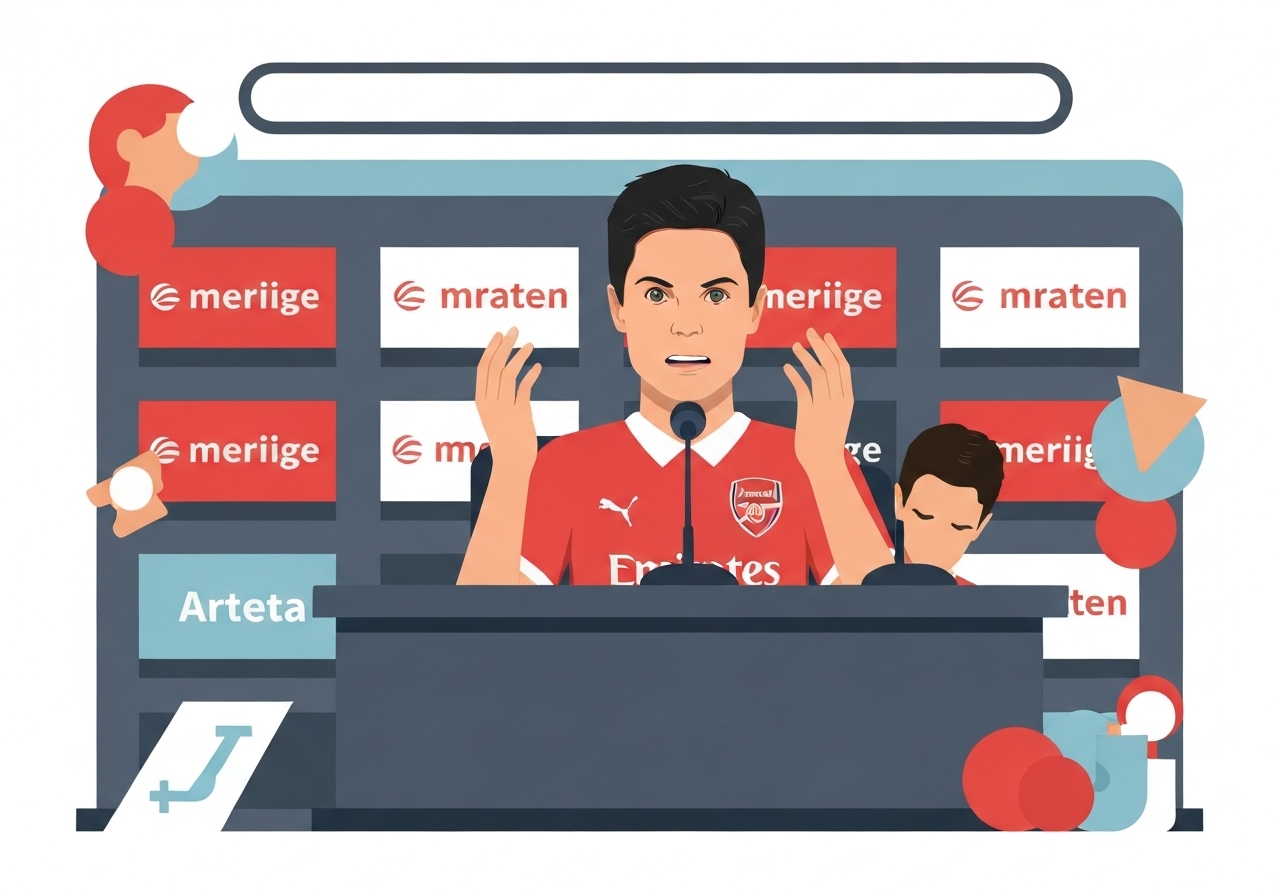
Arsenal manager Mikel Arteta spoke to the media after Tuesday’s Carabao Cup victory over Crystal Palace, a win decided on penalties that sends Arsenal into the semi-finals. He reviewed the game’s key moments, praised individual contributions including Kepa’s decisive stop and Gabriel Jesus’s 100th appearance, and addressed squad rotation, injuries and narrow margins that shaped the tie. Arteta acknowledged the conceded set-piece goal late in normal time but highlighted the team’s composure in the shootout that ultimately secured progress.
Key takeaways
- Arsenal reached the Carabao Cup semi-finals after a penalty shootout win over Crystal Palace on Tuesday, with Kepa saving the decisive spot-kick.
- Mikel Arteta praised the squad’s energy and cohesion despite numerous rotations, saying the team generated several big chances during the 90 minutes.
- Arsenal conceded a late goal from a set-piece that forced the match to penalties; Arteta noted Palace’s organisation and the fine margins involved.
- Gabriel Jesus marked what Arteta said was his 100th Arsenal appearance and was singled out for resilience after a long recovery period.
- Christian Nørgaard was credited with a strong, stabilising performance and praised for improving team balance in midfield.
- Martinelli finished with a knock and did not continue comfortably after the second half; Piero Hincapié carried an injury picked up against Everton.
- Arteta emphasised trust in the squad, the importance of attention to detail during a busy calendar and the need to convert chances more consistently.
Background
The Carabao Cup has become a target for many Premier League clubs seeking silverware amid demanding league and European schedules, and Arsenal entered this fixture managing minutes across a congested calendar. Crystal Palace arrived with a reputation for defensive organisation and compact shape, which had limited opponents’ clear opportunities this season. Arteta has used rotation throughout the campaign to preserve fitness and give squad members competitive minutes, a strategy that was visible in his selection for this tie. That approach increases reliance on squad depth and on-game management in matches that can be decided by small incidents such as late set-piece goals or individual saves.
Recent Premier League and cup runs have tested Arsenal’s defensive depth after injuries to defenders earlier in the season; the manager referenced ongoing adjustments in the backline and forward areas. Palace’s low-risk, counter-attacking style often forces opponents to create chances patiently, and that tactical context helps explain Arsenal’s dominance in possession but smaller margins in the final third. Cup ties decided by penalties inherently amplify the role of goalkeepers and composure under pressure, which shaped the narrative of Tuesday’s game. The result extends Arsenal’s season objectives while putting immediate focus on recovery and availability for upcoming fixtures.
Main event
The match unfolded with Arsenal generating multiple clear opportunities but without a comfortable lead by full time, according to Arteta’s assessment that the margin “should have been much bigger.” Palace remained compact and capitalised on a set-piece to equalise late in normal time, forcing penalties. Arteta described the conceded goal as a product of Palace’s organisation and a reminder that any lapse can be punished in tight cup contests. In the shootout, Kepa produced the final save that clinched progression, and Arteta expressed particular satisfaction for the goalkeeper’s contribution in that decisive moment.
Gabriel Jesus featured and, as Arteta noted, reached the milestone of 100 appearances for the club, a marker of his recovery and persistence after a challenging period. Christian Nørgaard started and, per Arteta, executed the role expected of him, improving the performance of team-mates around him. The manager acknowledged Martinelli left the field with a knock and was uncomfortable continuing after the second half, while Piero Hincapié carried an issue sustained earlier against Everton. Arteta emphasised the squad’s professional attitude, citing specific players such as Cristhian Mosquera and Kepa as examples of contributors who accept roles and deliver when called upon.
Throughout his post-match remarks Arteta stressed the need to keep generating chances and to trust the players, noting the team again conceded only one shot in the match while creating several big openings. He framed narrow wins as part of winning in different contexts and underlined the importance of maintaining performance levels over a period of frequent matches. He also reiterated that margins in cup competitions remain very small and demand attention to details if Arsenal are to collect trophies.
Analysis & implications
Arteta’s comments underline two concurrent realities for Arsenal: a squad deep enough to rotate and create quality chances, and the fragility of results when decisive moments are not converted. The late set-piece goal and the reliance on a penalty shootout expose an area for improvement in defensive concentration at critical moments, particularly as the club pursues multiple targets this season. If Arsenal are to sustain a title push domestically while advancing in cup competitions, reducing such lapses will be important to avoid unnecessary extra-time and penalties that increase fatigue.
Kepa’s decisive contribution in the shootout offers tactical and selection implications. A goalkeeper who can influence tight knockout games increases managerial options when rotating the squad, but it also raises questions about goalkeeper minutes and continuity. Arteta’s praise of Nørgaard suggests the club’s midfield acquisitions and selection choices are helping to stabilise transitions between defense and attack, which could improve chance conversion if service to forwards becomes more consistent.
Gabriel Jesus reaching 100 appearances is more than a milestone: Arteta’s framing of his resilience highlights the forward’s psychological and physical recovery, and his involvement could become increasingly important for Arsenal’s attacking rotation. Conversely, knocks to players such as Martinelli and Hincapié underscore the medical and rotation challenges that arise in a congested schedule; how the club manages these knocks (short-term rest versus rushed returns) will shape availability in the coming weeks. Overall, the match illustrated both the squad’s capacity to cope and the slender margins that still separate the team from more commanding cup wins.
Comparison & data
| Match detail | Value |
|---|---|
| Competition | Carabao Cup (quarter-final) |
| Opponent | Crystal Palace |
| Result | Arsenal win on penalties (progress to semi-final) |
| Decisive moment | Kepa saved the final penalty |
| Notable appearance | Gabriel Jesus — 100th appearance |
| Shots conceded (Arsenal) | 1 (as noted by manager) |
The table summarises the match-specific facts referenced by Arteta. While possession and chance creation favoured Arsenal, the single conceded shot—coming from a set-piece—was sufficient to take the game to penalties. That contrast between statistical control and an isolated decisive incident is a recurring theme in knockout football and the precise detail Arteta highlighted when reflecting on the tie.
Reactions & quotes
Arteta framed the victory as validation of squad attitude and the value of rotation while noting the emotional difficulty of conceding late. He was explicit about the need to keep improving finishing margins and the mental focus in set-piece scenarios.
We are in the semi-final and that is where we wanted to be; the team showed cohesion and quality despite many changes.
Mikel Arteta, Arsenal manager
On the responsibility shown in the shootout and individual contributions, Arteta singled out the goalkeeper and returning attackers for praise, contextualising their roles in the win.
Kepa made the last save and that was crucial; Gabriel Jesus’s performance after his recovery shows his resilience.
Mikel Arteta, Arsenal manager
Unconfirmed
- The precise medical prognosis for Piero Hincapié following the knock he suffered against Everton has not been publicly disclosed and remains pending official injury updates.
- The long-term impact of Martinelli’s knock from this match is not yet confirmed and will depend on club medical assessments and any subsequent scans.
Bottom line
Arsenal’s penalty shootout win over Crystal Palace secures Carabao Cup semi-final football and highlights both squad resilience and small margins that can decide knockout ties. The victory showcased contributions from rotated players and underlined the importance of goalkeeper moments and forward recovery, exemplified by Jesus’s 100th appearance and Kepa’s decisive save.
At the same time, the late conceded set-piece and the series of knocks to key players are reminders that rotation brings both opportunity and risk in a congested schedule. The coming fixtures will test Arsenal’s ability to maintain performance levels, manage injuries, and convert created chances into more comfortable results if they are to sustain momentum across competitions.