
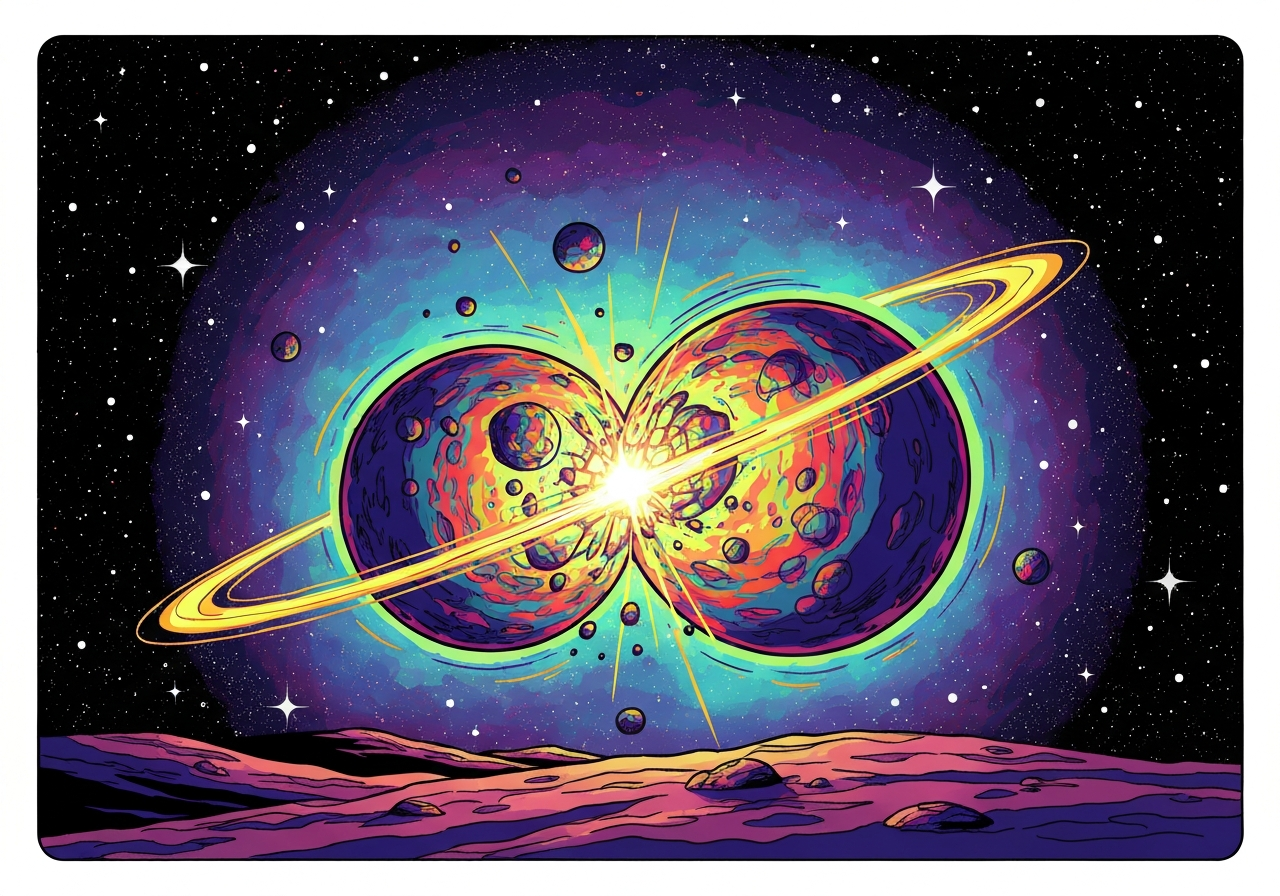
Lead: Astronomers report evidence that two planets smashed together in the Gaia20ehk system, producing a cloud of hot debris that briefly dimmed and brightened the host star. The system, an otherwise steady main-sequence star about 11,000 light-years away, began showing unusual visible dimming and simultaneous infrared brightening beginning around 2016. Researchers say the observations are consistent with multiple grazing impacts culminating in a catastrophic collision that heated and dispersed rock and dust. The finding, published 11 March in The Astrophysical Journal Letters, could resemble the giant impact thought to have formed Earth’s Moon about 4.5 billion years ago.
Key Takeaways
- Gaia20ehk, a sunlike main-sequence star ~11,000 light-years away, exhibited unusual brightness changes first flagged in 2016.
- Visible-light monitoring showed short dips and chaotic fluctuations while infrared observations spiked, implying hot obscuring material.
- Team led by Andy Tzanidakis interprets the data as debris from a collision between two planets in the system.
- The dust cloud orbits at roughly 93 million miles from the star — comparable to the Earth–Sun distance for the Earth–Moon system — raising the possibility of eventual exomoon formation.
- The work leverages decades-scale datasets to detect slow, rare events; the study was published 11 March in ApJ Letters.
- If similar impacts are common, they could inform how frequently moon-forming collisions occur and the broader implications for habitability.
Background
Planet formation is dominated early on by collisions and mergers among planetesimals and growing embryos. During the first hundreds of millions of years, these impacts are frequent and chaotic; over time, systems generally settle into stable orbital architectures like our Solar System. Giant impacts, including the leading hypothesis for the Moon’s origin, occurred during that formative era and redistributed large amounts of material into circumplanetary debris disks.
Detecting comparable collisions in mature, distant systems is difficult because the event geometry must align with our line of sight and the debris must produce measurable photometric or infrared signatures. Most transient surveys emphasize fast transients; Tzanidakis and collaborators intentionally mined long-baseline photometry to reveal phenomena that evolve over years or decades. That patient approach increases the chance of catching rare, slow-moving changes such as a planet-scale collision.
Main Event
The anomaly began as unexpected dimming episodes in visible-light monitoring of Gaia20ehk. Those dips were short and irregular at first, then evolved into more chaotic attenuation. Follow-up observations with infrared-capable telescopes showed the opposite trend: as visible flux fell, infrared emission rose, suggesting the occulting material was heated and glowing in the infrared.
Tzanidakis and colleagues interpret the sequence as two planets on intersecting orbits that experienced multiple grazing encounters before a final, high-energy collision. Grazing impacts would shed some material but not produce the same infrared output as a fully catastrophic merger; the later infrared spike indicates a much hotter, more abundant debris field consistent with a major smash-up.
The inferred orbit of the debris lies near 93 million miles from the star, a distance comparable to the Earth–Sun spacing seen by the Earth–Moon system, which suggests any leftover material could, over long timescales, coalesce into a moonlike body. However, that assembly would take millions of years, so astronomers are unlikely to witness the full moon-formation process directly.
Analysis & Implications
If the collision interpretation holds, the observation offers a rare real-time window into a process central to planet formation and system architecture. A confirmed exoplanet-scale impact that parallels the Moon-forming event would provide an empirical anchor for models that currently rely heavily on simulations and Solar System inferences. It could refine constraints on impact energies, angular momentum exchange, and the mass of debris produced by such events.
Astrobiology stands to gain context: Earth’s Moon is hypothesized to have influenced tides, climate stability, and possibly tectonics and biological mixing. Establishing how often moon-forming collisions occur in the galaxy bears on how frequently planetary conditions like Earth’s might arise. If giant impacts are common late-stage events, moons and the consequences they bring could be widespread; if rare, the Earth–Moon configuration might be a less-likely ingredient for habitability.
Methodologically, the study highlights the value of combining long-term visible-light archives with contemporaneous infrared monitoring. Visible dips alone could be misread as stellar variability or dust from smaller bodies; the infrared excess provides a thermal signature that distinguishes hot collision debris from cooler, distant dust. That diagnostic will guide future searches for similar events.
Comparison & Data
| Property | Earth–Moon/ Sun | Gaia20ehk debris (inferred) |
|---|---|---|
| Characteristic distance from host star | ~93 million miles (Earth–Sun) | ~93 million miles (reported) |
| Approx. age of impact | ~4.5 billion years ago (Moon-forming) | Recent; observed beginning ~2016 |
The table shows that the reported debris radius around Gaia20ehk is comparable to the Earth–Sun separation relevant to our Moon-forming hypothesis, making the analogy compelling but not definitive. Timescales differ: the Moon-forming collision happened billions of years ago, whereas the Gaia20ehk event unfolds over years to decades and will require long-term monitoring to quantify debris evolution and cooling rates.
Reactions & Quotes
Team members and external scientists emphasize both the rarity of the observation and its potential to inform models.
“It’s incredible that various telescopes caught this impact in real time; there are only a few planetary collisions on record,”
Andy Tzanidakis, lead researcher
Tzanidakis framed the discovery as the result of coordinated, multiwavelength follow-up of an initially puzzling light curve. His team credits the ability to compare visible and infrared behavior for resolving the nature of the obscuration.
“Not many researchers are looking for phenomena that play out over a decade — that patience opens a new discovery space,”
James Davenport, University of Washington
Davenport highlighted the methodological lesson: long baselines and archival mining can reveal slow, high-impact events missed by surveys tuned to shorter timescales. External peer commentary remains cautious but intrigued, noting that independent confirmation and modeling will be needed.
Unconfirmed
- Whether the obscuring material will ultimately form a stable exomoon is unknown; coalescence would likely require millions of years and favorable angular momentum distribution.
- The exact masses and compositions of the colliding bodies have not been directly measured; current inferences rely on light-curve modeling and thermal emission estimates.
- Alternative scenarios, such as large-scale disruption of a single body or repeated asteroid bombardment, have not been fully ruled out and require further modeling.
Bottom Line
This set of observations around Gaia20ehk represents one of the most persuasive nearby examples of a planetary-scale collision recorded in progress. The combination of visible dimming and a contemporaneous infrared spike maps well onto a narrative of grazing impacts followed by a catastrophic merger and hot debris production.
While confirming the event as a true analogue of the Moon-forming collision will demand more data and detailed dynamical modeling, the detection demonstrates how long-duration surveys plus targeted infrared follow-up can reveal rare, formative episodes in planetary systems. Finding more examples will be essential to understanding how common moon-forming impacts are and what that means for planetary habitability across the Milky Way.