
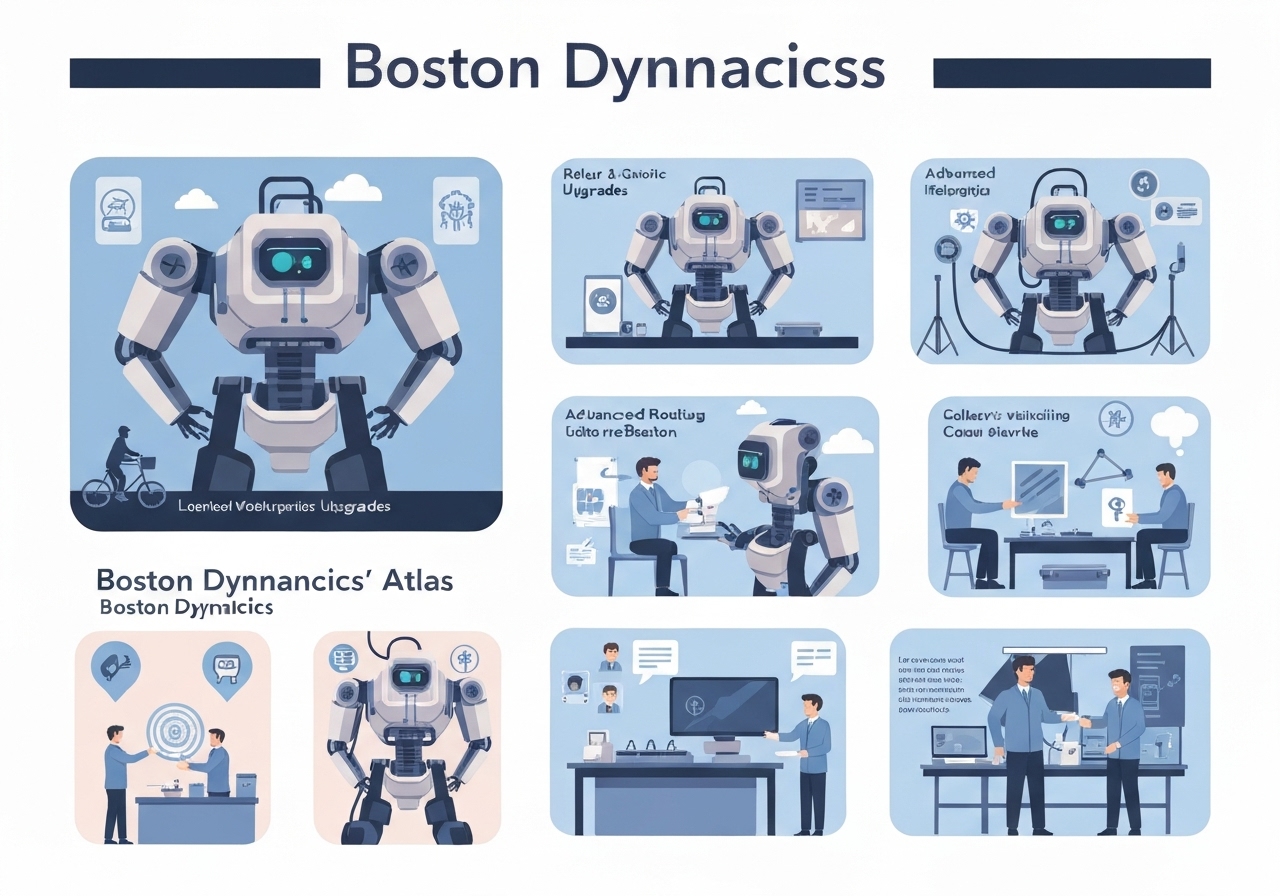
— Boston Dynamics showed a significantly redesigned Atlas humanoid at its Waltham, Massachusetts, facility, demonstrating new mobility, manipulation and control features. Engineers and CBS correspondent Bill Whitaker observed moves ranging from cartwheels and torso pivots to self-righting maneuvers, enabled by mechanical changes and an upgraded AI stack powered by Nvidia chips. The company demonstrated teleoperation-based training sessions — using VR-guided human operators to teach Atlas tasks such as stacking cups and tying knots — while stressing that reliability, cost and real-world deployment remain ongoing challenges. Leadership framed the improvements as deliberate steps toward industrial and service applications, not immediate mass rollout.
Key Takeaways
- Demonstration date and place: January 2026 at Boston Dynamics’ headquarters in Waltham, Massachusetts, observed by CBS News correspondent Bill Whitaker.
- Mobility upgrades: Atlas now performs complex maneuvers including cartwheels, 180–360º torso rotation and running with smoother, human-like fluidity.
- Mechanical redesign: Engineers removed wires that cross rotating joints to allow continuous rotation and easier maintenance, reducing a common failure point.
- Manipulation hardware: Each hand has three digits that reconfigure between opposing two-finger grasps and wider grips; tactile sensors supply force feedback to the neural network.
- Software and compute: Atlas’ learning pipeline uses teleoperation with VR and imitation training; Nvidia accelerators power the onboard AI stack.
- Training demonstration: Teleoperators taught Atlas tasks — stacking cups and tying a knot — by repeating actions until the robot reliably reproduced them.
- Market stance: Boston Dynamics warns of a current hype cycle and emphasizes that deployment depends on improving reliability and affordability over time.
Background
Boston Dynamics has been among the most visible developers of dynamic legged robots since its early humanoid prototypes. In 2021, 60 Minutes and other outlets documented an earlier Atlas model that could run, jump and recover balance but moved in comparatively stiff, mechanical ways. Over the past five years the company has pursued a dual path of mechanical redesign and data-driven control to close the gap between laboratory demonstrations and repeatable field performance.
The broader robotics ecosystem is also shifting. Advances in machine learning, more powerful edge GPUs from companies such as Nvidia, and improved sensor suites have accelerated progress in manipulation and perception. At the same time, commercial interest from manufacturing, logistics and inspection sectors has amplified expectations that humanoids might supplement human labor in hazardous or repetitive tasks. That interest fuels investment and media attention, producing optimistic forecasts alongside technical realism from developers.
Main Event
At the Waltham demo engineers showcased Atlas performing sequences that blend agility and manipulation. Rather than pivoting by stepping and reorienting its whole body, Atlas now rotates its upper torso independently, enabling it to face and operate in a new direction without full-body turning. The team attributes that capability to a drivetrain and cabling redesign that eliminates wires traversing rotating joints.
On manipulation, Atlas uses three-digit hands that can change configuration: digits swing to form opposing grasps for small objects or spread to envelop larger items. Tactile sensors on finger pads feed force and contact data into the robot’s neural controller, letting the system modulate grip pressure during learned tasks. Demonstrators emphasized that dexterous force control is still an area for improvement.
Boston Dynamics also displayed teleoperation training: a human operator in VR demonstrates a task repeatedly while the robot records sensorimotor traces and refines policy through imitation learning. During the session shown to media, Atlas practiced cup-stacking and knot-tying until its success rate rose to a reliable level for the limited task set. Company leaders framed teleoperation as an effective bridge between human skill and autonomous execution, particularly for complex manipulations.
Analysis & Implications
Mechanically enabling continuous joint rotation and removing wire stress points addresses a major reliability bottleneck for long-lived machines. In practice, fewer cable failures should lower maintenance intervals and support more continuous operation in industrial settings. That said, field conditions introduce dust, impacts and variable loads that lab demonstrations do not fully replicate, so operating-life gains will need verification in real deployments.
On the software side, teleoperation plus imitation learning shortens the path from human demonstration to robotic competence for specific tasks. This reduces the need to hand-engineer controllers for every manipulation. Still, transferring performance from controlled demos to unpredictable factory floors or homes requires robustness to novel objects, variable lighting and occlusions — areas where perception and generalization remain active research problems.
Economic and labor implications are nuanced. If humanoids achieve reliable, cost-effective manipulation, they could complement labor in hazardous or repetitive roles, raising productivity but also provoking debates about displacement, re-skilling and regulation. Boston Dynamics’ emphasis on time-to-reliability and affordability hints that commercial-scale substitution is a multiyear prospect, not an immediate disruption.
Comparison & Data
| Attribute | Atlas (2021) | Atlas (2026 demo) |
|---|---|---|
| Mobility | Run, jump, balance recovery | Cartwheels, smoother running, 180–360º torso pivots |
| Hand design | More limited end-effectors, less tactile feedback | Three configurable digits with tactile sensors |
| Cabling | Wires across rotating joints | No wires across rotating joints (continuous rotation) |
| Control | Model-based controllers | Teleoperation + imitation learning, Nvidia AI accelerators |
The table summarizes observable differences between the earlier Atlas and the unit shown in January 2026. These changes indicate a shift from purely model-based control to hybrid systems that combine human demonstrations, learning-based policies and mechanical redesign to expand capability and maintainability.
Reactions & Quotes
Before one demonstration, Boston Dynamics CEO Robert Playter characterized the approach to humanoid design as intentionally pushing beyond human-like limits to achieve functional advantage in machines.
“We think that’s the way you should build robots. Don’t limit yourself to what people can do, but actually go beyond.”
Robert Playter, CEO, Boston Dynamics
Scott Kuindersma, head of robotics research at Boston Dynamics, explained a specific engineering choice that helped enable continuous rotation and reduce hardware failures.
“One of the reliability issues is that wires start to break over time… we don’t have any wires that go across those rotating parts anymore.”
Scott Kuindersma, Head of Robotics Research, Boston Dynamics
CBS correspondent Bill Whitaker, who saw both early and current Atlas demonstrations, contrasted the 2021 machine with the newer model and highlighted media and market expectations.
“There is quite a bit of hype around these humanoids right now. Financial institutions predict millions, if not billions, of robots — we’re not there yet.”
Bill Whitaker, CBS News correspondent
Unconfirmed
- Predictions that “millions or billions” of humanoid robots will be in everyday use remain speculative and lack a clear industry roadmap or timetable.
- Exact commercial availability dates and per-unit pricing for the upgraded Atlas have not been published by Boston Dynamics as of January 4, 2026.
- The durability of cabling and actuator systems in long-term, dirty, or high-impact industrial environments has not been independently verified beyond company demonstrations.
Bottom Line
Boston Dynamics’ January 2026 demonstration shows meaningful mechanical and software improvements for Atlas: broader range of motion, reconfigurable hands with tactile sensing, and a training pipeline that leverages teleoperation and Nvidia compute. Those gains reduce particular technical barriers, especially in joint reliability and task learning, and make a stronger case for near-term trials in controlled industrial settings.
However, media-visible demonstrations do not equal immediate mass deployment. Real-world adoption will depend on demonstrated durability, scalable manufacturing, predictable maintenance costs and regulatory and workforce adaptations. Observers should watch for third-party trials, quantified uptime metrics, pricing announcements and evidence that learned policies generalize outside lab conditions.
Sources
- CBS News — report on Boston Dynamics’ Atlas demo (news report, January 4, 2026)
- Boston Dynamics — company site and technical pages (official/company)
- 60 Minutes (television news program with earlier Atlas coverage, archival reporting)
- Nvidia — product and developer documentation (company/technical)