
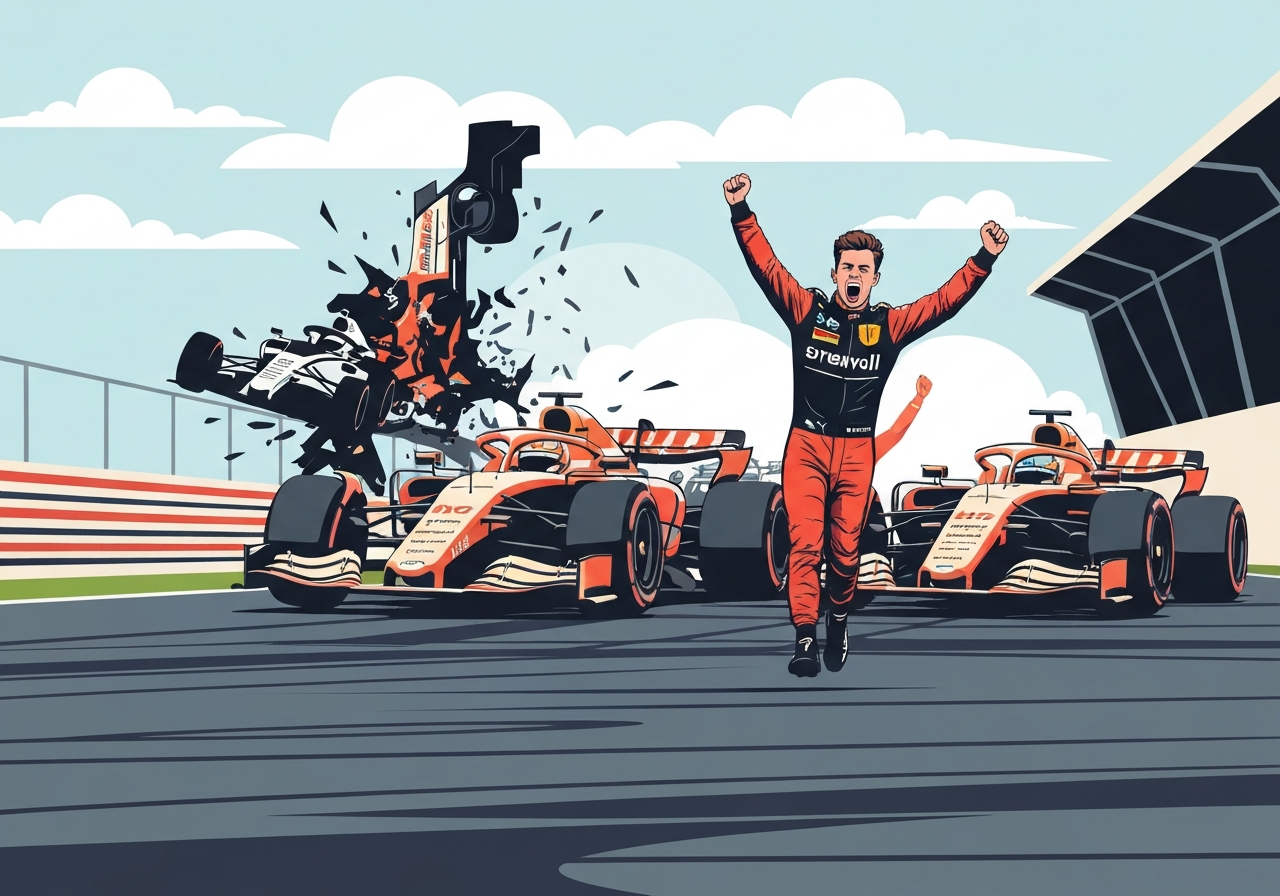
Lead
George Russell won the 2026 Australian Grand Prix in Melbourne after a race of early drama and strategic swings, as Mercedes secured a one-two with teammate Antonelli second. Local favourite Oscar Piastri was eliminated before the start when he crashed on the formation (installation) lap after losing grip exiting Turn 4. Ferrari finished third and fourth with Charles Leclerc ahead of teammate Lewis Hamilton, while Max Verstappen recovered from the back of the grid to sixth. Several new and rebranded entries made notable early impressions, including Audi and the American-backed Cadillac programme.
Key takeaways
- George Russell won the race at the chequered flag on Lap 58, giving Mercedes a season-opening one-two with Antonelli finishing second.
- Charles Leclerc took third by 0.6 seconds over Lewis Hamilton; Norris finished fifth with Verstappen sixth after a two-stop strategy and charge from the rear.
- Oscar Piastri crashed on the formation lap exiting Turn 4 and was classified as a retirement before the race officially started.
- Audi scored points in their first race as a works entry with Bortoleto ninth; Gasly brought Alpine home tenth for the final points spot.
- Several drivers recorded retirements: Fernando Alonso (Aston Martin), Valtteri Bottas (Cadillac), Isack Hadjar (Red Bull), Oscar Piastri (McLaren), Nico Hülkenberg (Audi), and Lance Stroll (Aston Martin) during the event’s unfolding updates.
- Perez completed Cadillac’s debut race for the American-backed team, crossing the line after Bottas suffered a DNF in the same garage.
- Russell’s victory lifted him to the lead of the 2026 World Championship standings for the first time in his career.
Background
The 2026 Formula One season opened at Albert Park in Melbourne amid elevated attention on the home driver, Oscar Piastri, after a high-profile winter. Teams arrived with a mix of updated powertrains and revised strategies; Mercedes’ preseason pace had suggested they would be competitive, while Red Bull and Ferrari remained expected challengers. Off-track developments also shaped interest: Audi entered as a works team and Cadillac began its first official campaign, creating fresh storylines about manufacturer investment in F1.
Albert Park’s short lap and technical mix often reward tyre management and strategic flexibility; the installation lap crash underlined how fragile pre-race routines can be when track temperature, tyre warm-up and low-speed traction collide. Past races in Melbourne have produced attritional events where late-race tyre life and safety-car windows reshuffle grids, so teams came prepared with varied pit plans. Broadcaster coverage and team radio provided near-real-time narrative as the order evolved through the 58-lap contest.
Main event
The race opened with immediate turbulence: Piastri lost grip exiting Turn 4 on the formation lap and struck the barrier nose-first, removing the Australian from his McLaren before the official start. The incident forced marshals and race control to manage the debris while remaining drivers adjusted strategies on the fly. Once racing got under way, Russell initially dropped places but then established a lead through measured pace and tyre conservation.
Mercedes paced the event, with Antonelli following Russell closely for much of the distance. Leclerc and Hamilton formed a resilient Ferrari pair, trading moments but ultimately finishing third and fourth respectively, with the margin for the podium positions shrinking late in the race. Lando Norris defended fifth from a charging Max Verstappen, who had started deep on the grid and adopted a two-stop strategy that allowed him to recover into the top six.
Mid-race, team calls and pit windows became decisive. Verstappen’s mid-distance stops produced the race’s fastest laps as he hunted Norris; Russell elected to go long on hard tyres put on during an early virtual safety car phase, a high-risk choice that paid off as tyre degradation remained manageable to the finish. Battles further down the order saw Bearman, Lindblad (Racing Bulls debutant), and Bortoleto (Audi) trading positions for the final points places through late-race exchanges.
Analysis & implications
Mercedes’ one-two in Melbourne confirms the team’s strong preparation and strategic execution at the start of the season. Russell’s ability to manage a long stint on harder rubber demonstrates renewed confidence in set-up and tyre allocation choices from the garage, and it immediately places him as a championship contender. Antonelli’s second place underscores Mercedes’ stable depth and gives the team a valuable constructors’ advantage.
Ferrari’s 3-4 shows improved race pace and consistency compared with last season, but the narrow margin between Leclerc and Hamilton suggests intra-team battles will be a theme and that Ferrari must fine-tune decisions such as pit timing to convert pace into wins. Red Bull and Verstappen’s recovery to sixth after a compromised grid slot indicates they remain formidable in race trim, particularly on aggressive two-stop approaches and when deploying fresh tyres late to post fastest laps.
The arrivals of Audi and Cadillac to meaningful race-day contributions matter beyond single-race points: Audi’s ninth place for Bortoleto and Cadillac getting a car across the line in their first official outing signal increasing manufacturer parity in the paddock. Bottas’ mechanical issue and Perez’s completion of the race for Cadillac show the teething problems and early promise typical of new entries. These developments could tighten midfield competition across the season.
Comparison & data
| Position | Driver | Team |
|---|---|---|
| 1 | George Russell | Mercedes |
| 2 | Antonelli | Mercedes |
| 3 | Charles Leclerc | Ferrari |
| 4 | Lewis Hamilton | Ferrari |
| 5 | Lando Norris | McLaren |
| 6 | Max Verstappen | Red Bull |
| 7 | Bearman | Haas |
| 8 | Lindblad | Racing Bulls |
| 9 | Bortoleto | Audi |
| 10 | Pierre Gasly | Alpine |
This table summarises the top-10 classification at the chequered flag. The result highlights Mercedes’ race control and tyre strategy, Ferrari’s consistent pace, and midfield mobility with debutant and returning entries picking up notable positions.
Reactions & quotes
The immediate post-race commentary captured drivers’ relief and the intensity of the opening fight.
“It was a hell of a fight at the beginning! I made a bad start… just really glad to cross the finish line.”
George Russell (broadcast)
“Was not the best start we could have wished for, I lost a lot of places and I had to recover. But overall, it was a good race.”
Antonelli (broadcast)
“I pushed as hard as I could from the back; the two-stop helped but we still have work to do.”
Max Verstappen (team radio/broadcast)
Unconfirmed
- Whether Piastri’s loss of grip was caused primarily by tyre temperature, a mechanical fault, or track contaminants has not been independently confirmed by McLaren at the time of writing.
- Early live updates suggested Stroll had resumed driving after an apparent retirement; later race updates listed him as retired—final confirmation from Aston Martin on the precise sequence was pending.
Bottom line
Melbourne produced a high-impact start to the 2026 season: Russell’s win and Mercedes’ one-two signal a strong opening statement, while Piastri’s formation-lap crash denied the home crowd a contest from their local contender. The result immediately reshapes early championship narratives and gives Mercedes the initial momentum in both drivers’ and constructors’ standings.
Beyond the podium, the weekend underlined the value of strategic flexibility—Verstappen’s recovery from a poor grid slot and Audi and Cadillac’s notable first-day contributions show the midfield picture will be fluid. Teams and drivers will take these lessons forward to the next round in China, where tyre choices, pit sequencing and the reliability of new entries will be tested further.