
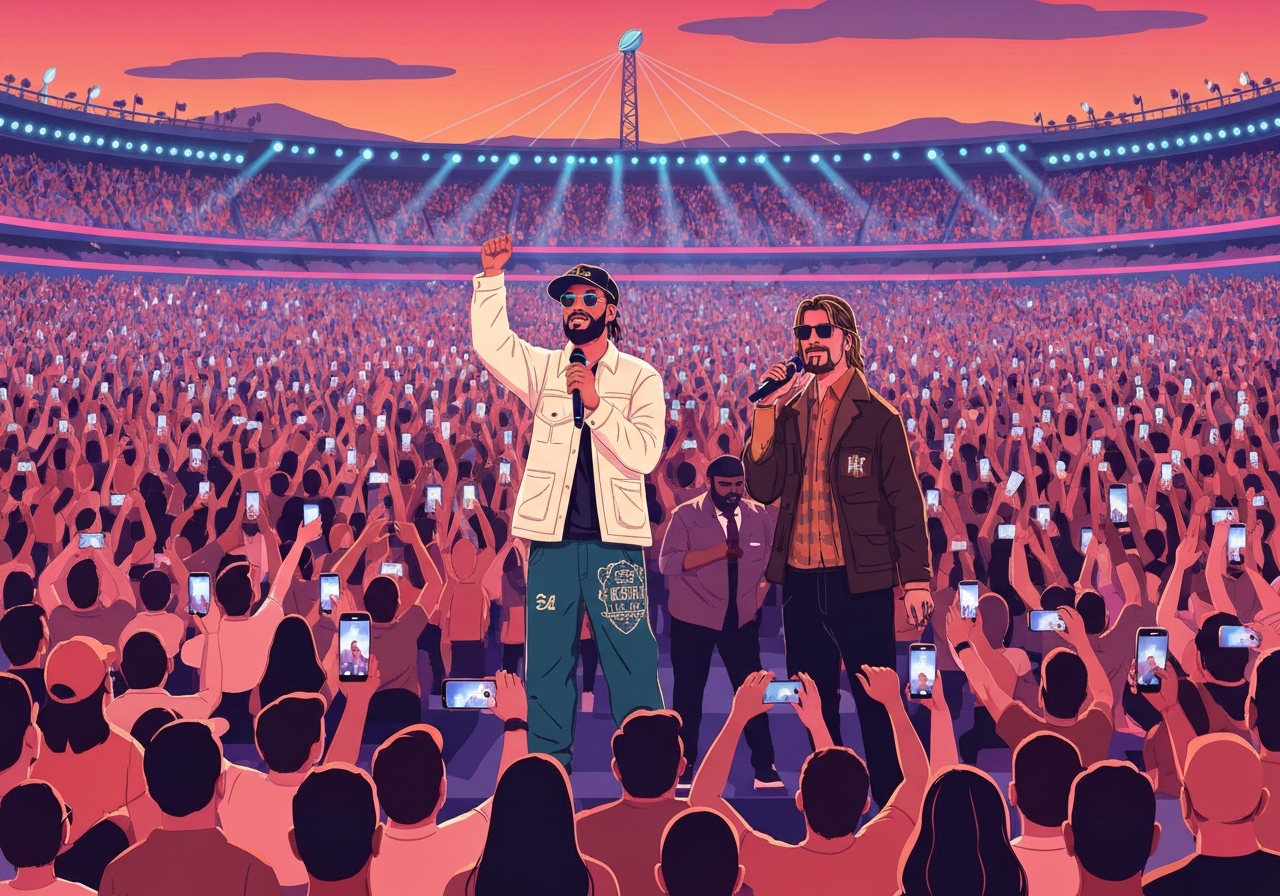
Lead: On Sunday, Feb. 8, 2026, at Levi’s Stadium in Santa Clara, Bad Bunny’s official Super Bowl halftime performance drew far larger audiences than Turning Point USA’s alternative broadcast headlined by Kid Rock. Early online indicators show millions watched both streams, but Bad Bunny’s official upload and live window outpaced the conservative counterprogramming by a wide margin. The NFL has not released official Nielsen halftime ratings yet; digital view totals available through Monday afternoon, Feb. 9, provide the clearest early picture.
Key Takeaways
- Bad Bunny’s official NFL/Apple Music Halftime Show video surpassed 35 million YouTube views by the afternoon of Feb. 9, 2026.
- Turning Point USA’s pre-taped “All-American Halftime Show,” headlined by Kid Rock, drew an estimated peak of 6.1 million concurrent viewers on YouTube, per reporting by The New York Times.
- TPUSA’s stream accumulated roughly 20 million total views after posting, with many views occurring after the live halftime window.
- Last year’s halftime performance by Kendrick Lamar reached 133.5 million viewers, the largest audience on record for a Super Bowl halftime show.
- The NFL’s official television and Nielsen figures for Super Bowl LX and its halftime show were not available as of Feb. 9, 2026.
- The game itself ended with the Seattle Seahawks defeating the New England Patriots, 29-13, on Feb. 8, 2026.
- Bad Bunny’s set included guest appearances by Lady Gaga and Ricky Martin, broadening its mainstream appeal and social-media reach.
Background
Super Bowl halftime shows have become cultural touchstones, mixing blockbuster musical performances with mass television audiences. In recent years the halftime slot has also become a flashpoint for political and cultural debate, particularly when artists’ identities or politics spark controversy among parts of the viewing public. Turning Point USA staged an alternative broadcast in response to criticism over the NFL’s selection of Bad Bunny, an artist who primarily performs in Spanish and has publicly criticized U.S. immigration enforcement.
Counterprogramming during big live events is not new: broadcasters and advocacy groups have long attempted to siphon viewers from marquee telecasts by offering alternative content tailored to specific audiences. What made the Feb. 8 window notable was the scale of the modern digital ecosystem—live TV, streamed uploads, social clips and on-demand playback all contribute to how audiences are measured and compared. That complexity complicates immediate comparisons until official ratings are released by Nielsen and other measurement firms.
Main Event
On Feb. 8 at Levi’s Stadium in Santa Clara, Bad Bunny delivered a high-profile halftime set featuring guest turns from Lady Gaga and Ricky Martin. The live performance aired during the NFL’s broadcast of Super Bowl LX between the Seattle Seahawks and New England Patriots. The official broadcast and its postgame uploads were the principal channels for mainstream viewers.
Turning Point USA ran a pre-taped “All-American Halftime Show” during the same halftime window, headlined by Kid Rock and including country acts Brantley Gilbert, Lee Brice and Gabby Barrett. TPUSA positioned the program as an intentional alternative to the NFL’s choice of entertainer and promoted it across conservative media channels.
Early digital metrics diverged sharply. According to reporting cited by multiple outlets, TPUSA’s event peaked at roughly 6.1 million concurrent YouTube viewers during the halftime window, while the NFL’s official upload of Bad Bunny’s performance surpassed 35 million cumulative views by the afternoon of Feb. 9. TPUSA’s posted stream went on to reach approximately 20 million total views after the broadcast, with the majority of that traffic occurring post-live.
Analysis & Implications
These early numbers suggest that the NFL’s official halftime show retained a dominant share of attention across platforms, even as partisan alternative programming attracted a significant niche audience. The official upload’s rapid accumulation of tens of millions of views indicates both live attention and extended on-demand interest, metrics that matter to advertisers and brand partners beyond live Nielsen ratings.
For Turning Point USA, the ability to assemble several million concurrent viewers demonstrates the organizational reach of politically aligned media projects in the streaming era. Even so, peak concurrent figures do not directly translate to sustained mass-market influence; the TPUSA stream’s viewership growth after the fact suggests much of its audience arrived through shares and on-demand playback rather than live switchover during the game.
From a commercial perspective, the gap between historical peak halftime audiences—Kendrick Lamar’s 133.5 million viewers in 2025—and these early digital tallies illustrates how measurement is shifting. Nielsen TV ratings remain the currency for live-ad pricing, but digital views, social engagement and cross-platform replay increasingly factor into a performance’s total reach and cultural footprint.
Comparison & Data
| Program | Reported Peak/Concurrent | Reported Total Views (as of Feb. 9) |
|---|---|---|
| Bad Bunny (NFL official upload / halftime performance) | Live TV peak: pending Nielsen | >35 million (YouTube upload) |
| Turning Point USA “All-American Halftime Show” (Kid Rock) | ~6.1 million concurrent (reported by The New York Times) | ~20 million total views (mostly after broadcast) |
| Kendrick Lamar (2025 halftime) | — | 133.5 million viewers (Nielsen, 2025) |
The table above aggregates the public, early digital figures cited in news reporting as of Feb. 9, 2026. It does not replace official Nielsen television metrics, which typically capture live television audiences more comprehensively and remain pending for Super Bowl LX. Digital totals combine live streams and post-event uploads and therefore reflect both live interest and subsequent on-demand viewing.
Reactions & Quotes
“The All-American Halftime Show is an opportunity for all Americans to enjoy a halftime show with no agenda other than to celebrate faith, family, and freedom.”
Andrew Kolvet, Turning Point USA spokesperson (statement)
Kolvet’s statement framed the TPUSA event as a values-focused alternative, a messaging strategy intended to mobilize conservative viewers during a high-profile broadcast window.
“The Super Bowl Halftime Show is absolutely terrible, one of the worst, EVER!”
Donald J. Trump, Truth Social post
The former president’s brief post during the game underscored how prominent critics used social platforms to broadcast opinion in real time; the timing of the comment also suggested many critics were watching the official halftime programming as it aired.
Unconfirmed
- Official Nielsen ratings and the final consolidated TV+streaming audience totals for the Super Bowl and halftime show had not been released as of Feb. 9, 2026.
- The precise live television viewership for Bad Bunny’s halftime performance (peak and average) remains unverified pending the Nielsen report.
- Attribution of TPUSA’s post-broadcast views to live diversion versus later discovery has not been publicly disaggregated by the platform.
Bottom Line
Early indicators show Bad Bunny’s official Super Bowl halftime performance reached a substantially larger audience across mainstream and on-demand channels than Turning Point USA’s alternative Kid Rock broadcast, though both attracted millions. The TPUSA stream’s multi-million concurrent peak demonstrates the potency of politically oriented counterprogramming in the streaming era, even when it remains a fraction of the primary broadcast’s reach.
Full understanding requires the release of Nielsen and other consolidated metrics. Still, the available figures illustrate an important dynamic: major live events retain broad, mainstream audiences while niche, ideologically targeted streams can still marshal sizable, concentrated viewership. For advertisers, rights holders and cultural commentators, the split underscores that reach and influence are increasingly multi-platform and measured in several complementary ways.
Sources
- San Francisco Chronicle (news report)
- The New York Times (news report cited for concurrent YouTube figure)
- NFL (official YouTube channel) (official upload and postgame video)
- Turning Point USA (YouTube channel) (alternative halftime stream)
- Truth Social (social media platform for presidential post)