
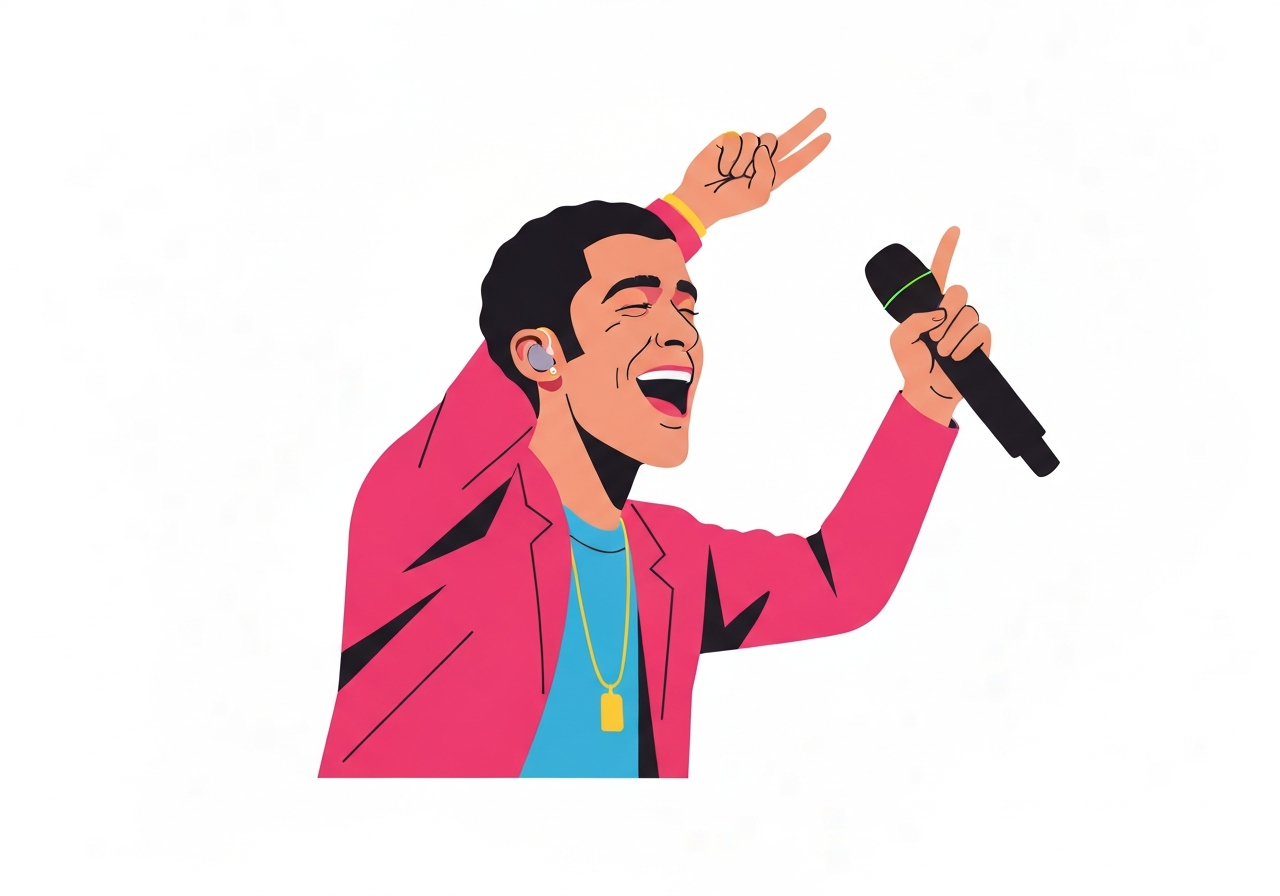
Lead: On Feb. 8, 2026 at Levi’s Stadium in Santa Clara, Puerto Rican star Bad Bunny delivered a 13-minute Super Bowl halftime performance that foregrounded Latino culture and, for the first time in the game’s 60-year history, was performed largely in Spanish. The set blended street scenes, a wedding, sports imagery and nods to Puerto Rico’s recent hardships, and featured guest turns by Lady Gaga and Ricky Martin. The show was widely read as a celebration of Latin identity and an assertion of inclusion, and it produced immediate praise, criticism and political commentary.
Key Takeaways
- Bad Bunny headlined a 13-minute halftime set on Feb. 8, 2026 at Levi’s Stadium, marking the first largely Spanish-language halftime show in Super Bowl history.
- The performance included songs such as “Nuevayol,” “Baile Inolvidable” and “El Apagón,” and featured guest appearances by Lady Gaga and Ricky Martin.
- Staging evoked New York–style street scenes, a bodega with a “We accept EBT” sign, a Puerto Rican social club and a sugar-cane motif referencing labor and the island’s culture.
- Bad Bunny’s album Debí Tirar Más Fotos won album of the year at the 2026 Grammys; his Super Bowl set followed a year of major milestones for Latin music and the artist.
- The performance arrived amid political controversy over immigration policy; President Trump posted scathing criticism while other conservative groups staged counterprogramming.
- The N.F.L. and broadcast partners retained the ability to delay or censor live signals; league officials said they did not expect an explicit political protest onstage.
- Fans in Puerto Rico organized local viewing events, including a 5,000-person lottery-distributed gathering at Parque del Tercer Milenio in San Juan.
Background
Bad Bunny, born Benito Antonio Martínez Ocasio, has risen in the last decade to global superstardom by blending reggaeton with salsa, bomba and other Puerto Rican rhythms. His 2025 album Debí Tirar Más Fotos has been widely praised for exploring Puerto Rican identity; it won album of the year at the 2026 Grammy Awards, cementing his crossover cultural reach. The Super Bowl halftime is the world’s most-watched live entertainment moment, and selecting Bad Bunny was framed by some as the N.F.L.’s push to broaden its audience and international appeal.
The artist’s presence on this stage also collided with a heightened political moment. Immigration enforcement and rhetoric under the Trump administration turned celebrity appearances into flashpoints, and Bad Bunny’s public stands — including a Grammy remark of “ICE out” — generated intense reaction. Federal officials and conservative commentators both weighed in when the league announced the performer last fall, making the halftime show a focal point for debates about language, representation and patriotism.
Main Event
The halftime set ran roughly 13 minutes and moved through a series of vignettes that illustrated different facets of Latino life. Early sequences recreated a New York–style street, complete with a bodega marquee reading “We accept EBT,” domino players and references to Puerto Rican neighborhoods; “Nuevayol” sampled classic salsa while mixing dembow and reggaeton rhythms.
A wedding scene featured Lady Gaga performing a salsa-inflected rendition of “Die With a Smile” in English while Bad Bunny sang in Spanish, after which Ricky Martin appeared to sing “Lo Que Le Pasó a Hawaii.” Celebrity guests — including Pedro Pascal, Jessica Alba, Cardi B, Karol G and Young Miko — populated the set, reflecting a mix of Latino and Latin American figures.
Visual motifs referenced Puerto Rico’s struggles and resilience: an “El Apagón” segment invoked the island’s post–Hurricane Maria power failures, and Bad Bunny briefly climbed an electricity pole in a sequence recalling the song’s documentary-like video. At one point he read a list of countries across North and South America, and he closed by holding a football emblazoned with “Together, We Are America” before leaving the stage.
Analysis & Implications
Culturally, the halftime show signaled a major mainstream recognition of Spanish-language performance at an American ritualized event. For Latino audiences the presentation was both representation and reclamation: it staged familiar social spaces and musical traditions on the largest live-entertainment platform in the United States. That visibility can broaden commercial markets for Latin music while reshaping what large-scale American broadcast events look and sound like.
Politically, the performance functioned as a statement through imagery and repertoire rather than explicit protest. Bad Bunny’s choice to list countries across the Americas and to use symbols like the EBT sign and an electricity pole operated as a form of cultural argument about belonging and infrastructure neglect; these gestures resonated without becoming a direct policy call. In a polarized moment, the artist’s emphasis on joy and unity limited immediate institutional fallout but did not erase broader debates about immigration and national identity.
For the N.F.L., the show illustrated a balancing act: courting new viewers while managing sponsor, broadcaster and political pressure. League officials’ repeated references to broadcast and league delays underscore how tightly curated such moments remain, even as fans on the field and on social platforms can amplify parts of a performance in real time. The commercial upside — streaming, music sales and ad attention — will be weighed against the risks of alienating segments of the domestic audience.
Comparison & Data
| Year | Headliner | Notable Firsts / Notes |
|---|---|---|
| 2026 | Bad Bunny | First largely Spanish-language halftime set in Super Bowl history; 13-minute program |
| 2016 | Coldplay / Beyoncé / Bruno Mars | High-profile political readings (Beyoncé’s Formation visual elements) |
| 2004 | Janet Jackson / Justin Timberlake | “Wardrobe malfunction” prompted reforms in live broadcast controls |
The table places Bad Bunny’s set alongside prior halftime moments that reshaped public conversations. While earlier controversies forced broadcast and league policy changes, this show’s primary impact is cultural visibility for Spanish-language performance on a mass U.S. broadcast.
Reactions & Quotes
Organizers, officials and artists responded in different registers: celebratory endorsements, political rebukes and technical notes about live broadcasting. Below are representative remarks with context.
“ICE out.”
Bad Bunny (Grammy acceptance, Feb. 2026)
That short proclamation at the Grammys last week preceded speculation about whether Bad Bunny would use the Super Bowl stage for an explicit political protest. At the Super Bowl he made no comparable one-line denunciation onstage, but he reiterated themes of inclusion and belonging in both English and Spanish.
“Absolutely terrible, one of the worst, EVER!”
President Donald J. Trump (Truth Social)
President Trump criticized the performance on social media, focusing on language and cultural differences. His comments mirrored a broader conservative backlash that included counterprogramming events and public complaints about the choice of a predominantly Spanish set list.
“This will be a celebration, with a world audience on its feet.”
Desiree Perez (Roc Nation, statement)
Roc Nation, the halftime producer, defended the selection as both a cultural moment and entertainment; the company emphasized the show’s technical ambition and global reach in pregame remarks.
Unconfirmed
- Whether any league or broadcast delay censored specific visual elements during the live set remains unverified; league officials noted delay capabilities but did not report specific interventions.
- Some online posts suggested coordinated enforcement actions at the stadium tied to the performer; official statements said there were no immigration enforcement operations, and reports of targeted actions are unconfirmed.
- Motivations attributed to individual guest appearances (beyond the artists’ public statements) were reported by some outlets but lack independent confirmation of private arrangements.
Bottom Line
Bad Bunny’s halftime performance was an intentional cultural statement staged as mainstream entertainment: a largely Spanish-language program that inserted Latin American social and musical references into the Super Bowl’s national ritual. It advanced commercial and representational gains for Latin music while avoiding an overt, single-issue protest onstage.
The show is likely to have several durable effects: expanded expectations for language and cultural diversity at mass-audience events; a renewed public conversation about where and how political meaning is expressed in entertainment; and measurable commercial returns for the artist and collaborators. How sponsors, broadcasters and the league adjust going forward will reveal whether this moment is an isolated milestone or a turning point in halftime programming.