
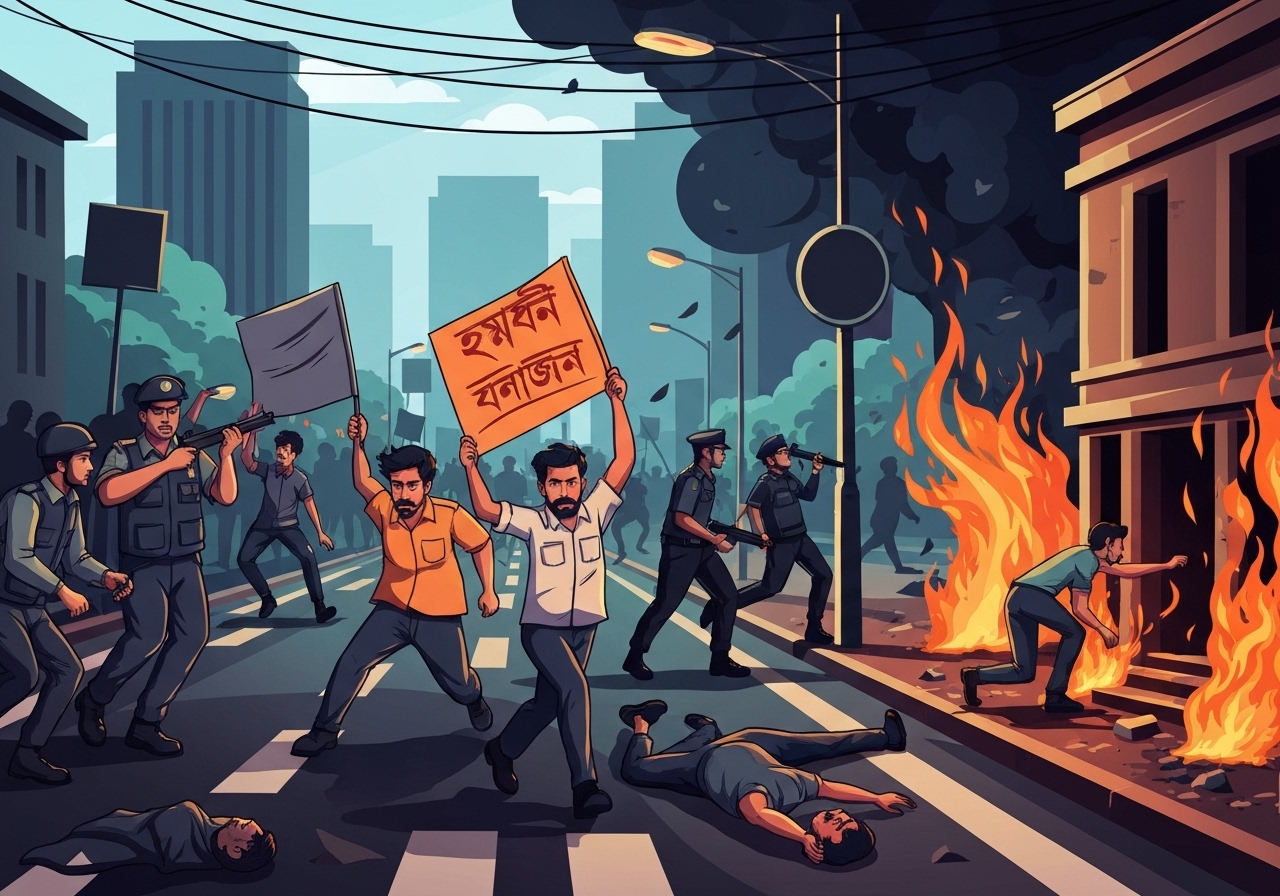
Lead: The death on Dec. 19, 2025, of 32-year-old student leader Sharif Osman bin Hadi, flown to Singapore after being shot on Dec. 12, touched off violent unrest in Dhaka. Protesters poured into the streets late Thursday and targeted newspaper offices and several politicians’ homes, prompting fears the unrest could further destabilize an already fragile political transition. Security forces struggled to contain arson and clashes in central Dhaka, while journalists and bystanders reported being trapped or chased from newsrooms. The episode has amplified international concern about human rights and the rule of law in Bangladesh.
Key Takeaways
- Sharif Osman bin Hadi, 32, died in Singapore on Dec. 19 after being shot in the head on Dec. 12 and flown abroad for treatment.
- Protests and rioting began late on Dec. 19 in Dhaka, with at least two major newspaper offices set on fire and arson reported at politicians’ homes in multiple cities.
- The incident occurred against a backdrop of a collapsed government: former Prime Minister Sheikh Hasina’s administration fell in August 2024 after a monthslong standoff with a youth-led movement.
- A U.N. fact‑finding report attributes at least 1,400 protester deaths to security forces and ruling-party actors during last year’s unrest.
- Journalists reported being trapped inside newsrooms; one reporter used social media to say smoke filled her office while another witnessed a crowd marching toward a newsroom chanting slogans.
- Political leaders warned that renewed violence could derail efforts to restore democratic institutions and an already tenuous transition process.
Background
The shooting of Sharif Osman bin Hadi and his subsequent death come amid prolonged political turbulence in Bangladesh. In August 2024, Prime Minister Sheikh Hasina’s government collapsed after a monthslong standoff with youth-led protests that demanded accountability and political change. That movement grew into a broader crisis involving street demonstrations, mass detentions, and pitched confrontations between protesters and security forces.
A U.N. fact-finding mission concluded that at least 1,400 protesters were killed during last year’s unrest, a figure that has intensified international scrutiny of Bangladesh’s security response and the role of political actors. Media outlets and civil society groups have repeatedly voiced concerns about press safety and threats to free assembly since the collapse of the government. The country’s political actors remain deeply polarized, with accusations of extrajudicial violence and targeted intimidation becoming central grievances.
Main Event
The immediate trigger was the death of Mr. Hadi, a prominent student organizer known for criticizing the former Awami League government. He was shot on Dec. 12, treated in Bangladesh, then transferred to a hospital in Singapore where he died on Dec. 19. News of his passing spread quickly, and by late Thursday night demonstrators had massed in central Dhaka.
Several newsrooms and newspaper buildings were targeted by arsonists as crowds moved through the city. Witnesses described mobs setting fire to the office of Prothom Alo and an attack on The Daily Star’s newsroom; a journalist posted on social media that thick smoke filled the building while she was inside. Authorities said they were deploying units to disperse violent crowds, but efforts to protect media facilities and residential targets were reported as inconsistent across districts.
In addition to attacks on press properties, arson was reported at the homes of multiple politicians in different cities, heightening fears of a wider spiral of retaliatory violence. Local emergency services reported multiple small fires and clashes between protesters and police; hospitals received people with burn and smoke-inhalation injuries, though official casualty tallies from the new wave of unrest had not been consolidated at the time of reporting.
Analysis & Implications
The unrest risks undermining efforts to stabilize Bangladesh’s political transition following the fall of the Hasina government in August 2024. The targeting of media outlets suggests a mounting hostility toward independent reporting and a desire among some actors to control the public narrative. If press centers continue to be attacked, independent news-gathering and public information flows will be further constrained, complicating humanitarian and accountability responses.
Internationally, the U.N. finding of 1,400 deaths last year already placed Bangladesh under intense diplomatic scrutiny; fresh instability could prompt renewed sanctions discussions, conditional aid reviews, or more robust human-rights monitoring. Economically, recurring unrest can deter investment and disrupt supply chains in a country that relies heavily on manufacturing exports and remittances.
Domestically, the violence may deepen polarization between youth-led protest movements and established political blocs. Political leaders who fear losing ground may respond with heavy-handed measures, while protesters could harden demands for justice and institutional reforms. The risk of cycles of retaliation—attacks on political figures followed by crackdowns by security forces—raises the probability of prolonged instability.
Comparison & Data
| Date | Event |
|---|---|
| Aug. 2024 | Collapse of Sheikh Hasina’s government after monthslong protests |
| Dec. 12, 2025 | Sharif Osman bin Hadi shot in Dhaka |
| Dec. 19, 2025 | Mr. Hadi dies in Singapore; riots erupt in Dhaka |
| 2024 (U.N. report) | At least 1,400 protesters reported killed |
The table above places the Dec. 2025 violence in a short chronology of the country’s recent political ruptures. The U.N. figure of 1,400 deaths remains a critical baseline for assessing the scale of last year’s crackdown; authorities and independent monitors have offered differing tallies in the past, which complicates reconciliation and accountability processes.
Reactions & Quotes
“There’s too much smoke. I’m inside. You are killing me.”
Zyma Islam (journalist, social media post)
Zyma Islam’s message was posted from inside a newsroom as smoke and flames spread, underlining the immediate danger to journalists on the ground. Media organizations said staff had to evacuate and that equipment and archives were at risk.
“I saw a group marching to our office, chanting slogans against India.”
Journalist outside a Dhaka newsroom (on condition of anonymity)
The witness account signals the charged and symbolic language used by some protesters; it also highlights how foreign-policy rhetoric can surface in street actions even when the central grievance is domestic political violence.
Unconfirmed
- Claims about who ordered or carried out the shooting of Sharif Osman bin Hadi remain unverified pending forensic and investigative disclosures.
- Attribution of specific arson attacks to organized political groups or spontaneous mobs has not been conclusively established by independent investigators.
- Accurate casualty and arrest totals from the Dec. 19–20 unrest were not available at time of reporting; official tallies differ from eyewitness and NGO accounts.
Bottom Line
The death of Sharif Osman bin Hadi has reignited deep political fault lines in Bangladesh, turning a targeted killing into a broader security crisis that threatens press freedom and democratic recovery. The targeting of newspapers and the pattern of arson raise alarm about the shrinking space for independent media and the potential normalization of violence as a political tool.
Short-term prospects depend on whether authorities can secure population centers without resorting to indiscriminate force and whether political leaders pursue transparent investigations into the shooting. International actors will likely monitor developments closely; sustained instability could prompt diplomatic or economic responses that would affect Bangladesh’s governance and economy for months to come.
Sources
- The New York Times — International news report detailing the Dec. 19 unrest and Mr. Hadi’s death (news).
- Reuters — Wire service reporting and photographic coverage from Dhaka (news agency).
- U.N. Human Rights Office (OHCHR) — U.N. fact‑finding mission material and statements on civilian deaths and human-rights concerns in Bangladesh (official report/UN body).