
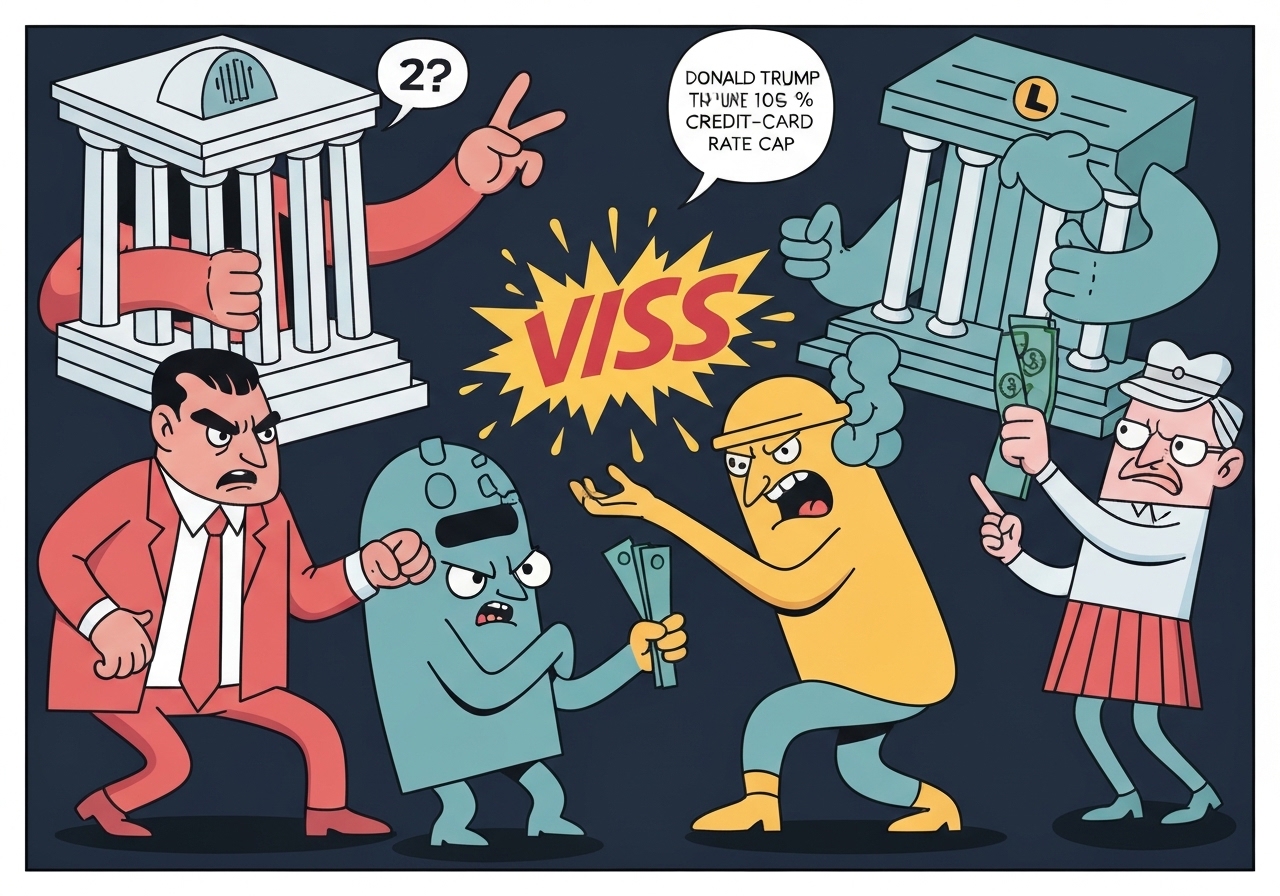
President Donald Trump’s announcement on Jan. 14, 2026 proposing a 10 percent cap on credit-card interest rates has prompted major U.S. banks to prepare aggressive resistance. Leading lenders, including JPMorgan Chase, Bank of America, Citigroup and Wells Fargo, signaled this week they will press lawmakers and regulators against the measure. Bank executives argue the cap would force lenders to shrink unsecured lending or shift costs to other products, a dynamic they say could reduce consumer credit access. Lawmakers and markets are now weighing the political momentum behind the proposal against the industry’s warnings.
Key Takeaways
- President Trump proposed a 10% cap on credit-card interest rates on Jan. 14, 2026; the announcement was made via social media and has spurred debate in Washington and on Wall Street.
- Major banks — JPMorgan Chase, Bank of America, Citigroup and Wells Fargo — have signaled unified opposition, with executives describing the proposal as materially harmful to lending economics.
- Bank executives indicated a range of responses is possible, including lobbying, legal action and business-model adjustments to limit losses.
- A research paper cited in industry discussions estimates the cap could render as many as 80% of current cardholders unprofitable for issuers, potentially leading to tightened credit supply (study details not publicly confirmed).
- Analysts expect pushback during earnings calls this week, where banks will outline potential impacts on loan portfolios and consumer pricing.
- Policymakers must balance short-term consumer relief from lower interest with longer-term effects on credit availability, bank profitability and market competition.
Background
The proposal for a 10% cap arrives amid heightened political scrutiny of consumer finance and broad public concern about household debt burdens. Credit-card borrowing has been a major profit center for lenders since the 1990s, funding both rewards programs and credit access for higher‑risk borrowers. Over the past decade, revenue from interest and fees helped banks offset compressed margins in other areas of their businesses.
Some consumer advocates and politicians argue that high card interest exacerbates inequality and traps borrowers in cycles of debt, prompting calls for rate limits. Banks counter that rate caps compress margins, force tougher underwriting, and could push risk-bearing costs into upfront fees or other loan categories. Historically, efforts to regulate consumer rates have produced mixed outcomes: some caps reduced borrower costs but also led to reduced credit availability for higher‑risk segments.
Main Event
The White House announcement on Jan. 14 did not immediately translate into proposed legislation, but the signal was enough to set off rapid industry response. JPMorgan’s finance chiefs and other senior executives spent the days after the announcement briefing investors and preparing public statements. On earnings calls, executives framed the cap as a policy that would change core pricing dynamics for unsecured lending.
Banks say their contingency plans range from intensified lobbying in Congress and regulatory comment letters to restructuring card portfolios and altering underwriting standards. Executives argued that a uniform 10% ceiling would make many existing accounts loss-making, especially those extended to customers with weaker credit scores, which in turn would lead issuers to narrow who receives revolving credit.
Industry officials have also warned of secondary effects: reduced rewards programs, higher annual or balance-transfer fees, and more stringent approvals for new cards. These measures, they say, would preserve profitability in a capped-rate environment but shift the cost burden and reduce consumer choice.
Analysis & Implications
If enacted, a 10% APR cap would be a seismic shift in U.S. consumer finance. Banks’ interest income from credit cards currently finances cross‑subsidies—such as rewards and promotional pricing—that support broad consumer access. A sharp reduction in that income stream would force issuers to reprice products, restrict lending to lower‑risk borrowers, or curtail marketing efforts that bring new customers into credit markets.
From a macroeconomic perspective, proponents of the cap argue it would lower consumer interest burdens and reduce default risk for heavily indebted households. Opponents contend that reduced access to revolving credit could increase reliance on costlier alternatives, such as payday loans, or push consumers to hold larger cash balances, which could moderate consumption and hurt near‑term growth.
Politically, the proposal places lawmakers in a difficult position: supporting a cap can be framed as consumer protection, but doing so risks backlash from business constituencies and financial markets. The path to law would almost certainly involve committee hearings, agency analysis and likely amendments; industry lobbying and legal challenges could slow or alter any final measure.
Comparison & Data
| Item | Reported / Proposed |
|---|---|
| Proposed statutory cap | 10% APR |
| Estimated share of cardholders at risk (study cited in debate) | Up to 80% (study details unconfirmed) |
| Major banks indicating opposition | JPMorgan Chase, Bank of America, Citigroup, Wells Fargo |
The table summarizes the central figures driving the debate: the 10% proposal and the industry-cited estimate that a large share of existing accounts could become unprofitable. Those estimates are driving both the public messaging from banks and the urgent scrutiny in Washington.
Reactions & Quotes
Industry leaders framed the proposal as a policy that would ripple through consumer finance markets and the broader economy. Bank spokespeople emphasized contingency planning and the need for further economic analysis.
“Everything’s on the table,”
Jeremy Barnum, CFO, JPMorgan Chase (comment to reporters)
Consumer advocates welcomed the proposed cap as a long‑overdue restraint on high borrowing costs but urged careful legislative drafting to avoid unintended consequences.
“Capping abusive interest rates can protect borrowers, but policymakers must ensure alternatives don’t harm the most vulnerable,”
Consumer advocacy group representative (statement)
Unconfirmed
- The specific research study estimating that up to 80% of cardholders would become unprofitable has been cited in industry discussions but its authorship, full methodology and peer review status are not publicly verified.
- The timeline for any congressional introduction or formal rulemaking tied to the White House announcement remained unclear at publication; no draft legislation had been posted publicly as of Jan. 14, 2026.
- The precise mix of bank responses (litigation, fee changes, underwriting shifts) and their timing would depend on final legislative text and regulators’ implementation guidance and therefore remains uncertain.
Bottom Line
The Jan. 14 proposal for a 10% credit‑card rate cap has launched a high‑stakes policy fight between the White House and the financial industry. Major banks are mobilizing resources to oppose the measure, arguing it would force lenders to pare back unsecured credit and change how consumer finance products are priced and delivered.
For consumers, the outcome matters: a cap could reduce headline interest burdens for those who retain card access, but it could also shrink the pool of borrowers who qualify for revolving credit or lead to higher non‑interest fees. Policymakers will need to weigh immediate consumer relief against potential long‑term effects on credit access, market competition and bank stability.