
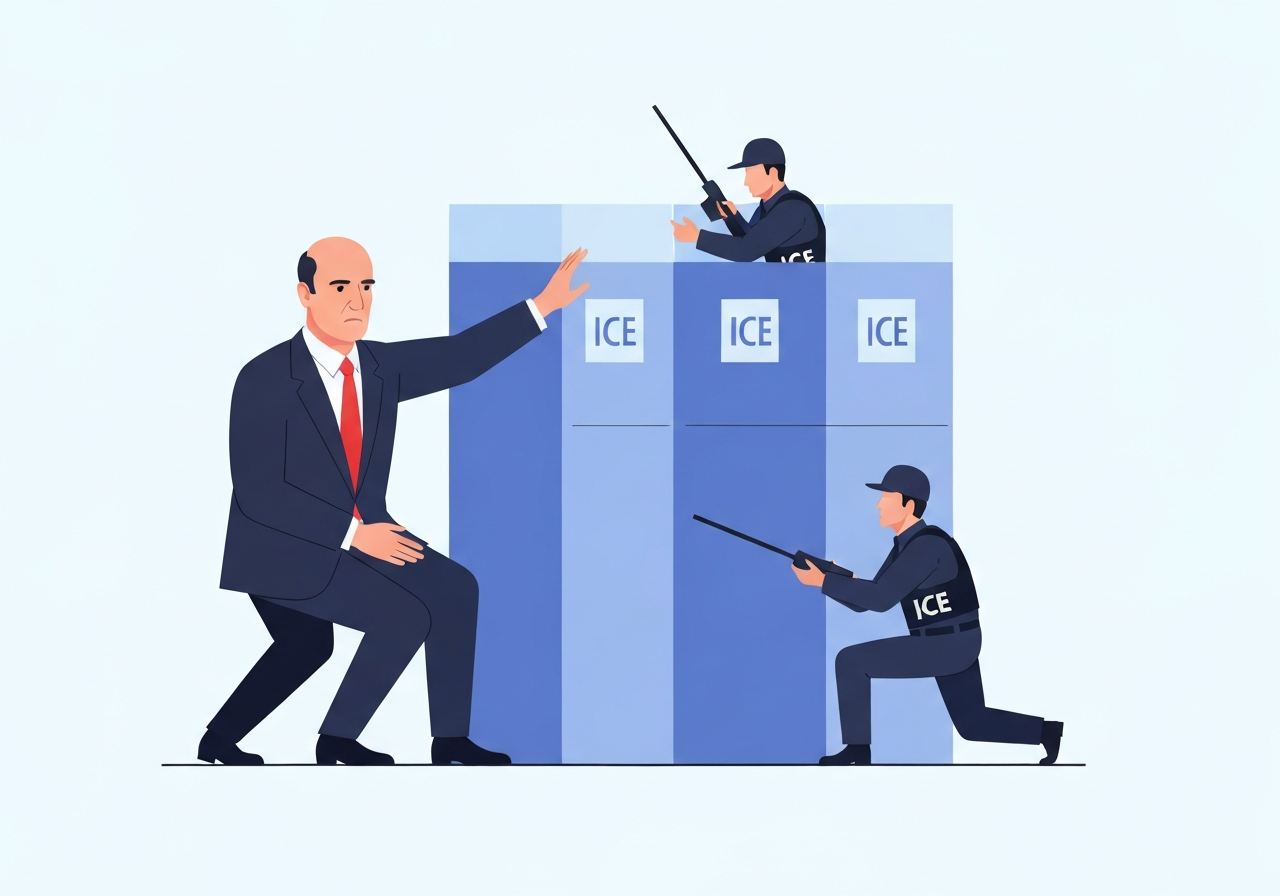
Steve Bannon and President Donald Trump have escalated public calls for federal intervention in U.S. elections, saying federal authorities should play a new role in administering or policing polling places ahead of this year’s midterms. Bannon told listeners his allies plan to have Immigration and Customs Enforcement (ICE) present at polling locations “come November,” while Trump separately advocated for the federal government to take over voting duties. The statements, voiced on conservative media platforms and during a White House appearance, have prompted state election officials to rehearse legal and administrative responses. Election administrators say they are preparing litigation, communications and operational plans in case federal action is attempted.
Key takeaways
- Steve Bannon said on his War Room podcast that ICE will “surround the polls” during November midterms; the remark was broadcast in late April 2025 and referenced planning for federal action.
- President Trump repeated calls to “nationalize” voting on the Dan Bongino radio show and during an Oval Office press conference, arguing federal takeover of election administration should be considered.
- State election officials from multiple states are conducting tabletop exercises and coordinating legal and administrative responses to potential federal interference, according to interviews at the National Association of Secretaries of State winter conference.
- No formal federal policy or executive order to deploy ICE to polling places has been announced; officials say current federal authority to run elections is limited and largely untested in this context.
- Election law experts warn that unilateral federal takeover of state-run elections would face substantial constitutional and statutory challenges and could prompt immediate litigation.
- Democratic state secretaries and other officials are preparing layered responses—litigation, communications and on-the-ground administrative measures—to protect local election operations.
Background
The U.S. Constitution assigns primary responsibility for conducting elections to the states, a framework that has evolved with federal statutes addressing voting rights, funding, and certain criminal enforcement. Historically, disputes that appear to involve federal overreach in elections have led to court battles and political standoffs; the 2000 Bush v. Gore litigation and later federal actions around voting access illustrate how disputes move quickly into the judiciary. Recent years have seen heightened attention to election security, voter access, and partisan claims of fraud, which have sharpened tensions between federal actors who claim national security or immigration enforcement roles and state election administrators who manage ballots and polling places.
Steve Bannon, a former senior adviser to President Trump, remains an influential voice in conservative circles and uses his War Room podcast to shape messaging and strategy. President Trump’s public suggestion to “nationalize” voting follows a timeline of repeated claims that past elections were tainted — assertions that courts and election officials have repeatedly rejected. State election leaders, including secretaries of state and county clerks, operate within differing political environments: some states have safeguards and robust staffing, while others face resource constraints that make sudden federal interventions more disruptive.
Main event
On a War Room episode in late April 2025, Bannon said federal immigration agents would be present at polling sites in November, framing the measure as a response to what he described as Democratic efforts to “steal the country.” That comment came a day after a radio interview in which President Trump urged Republicans to seize control of voting administration and suggested the federal government could step in. Trump reiterated the point in an Oval Office news conference, saying, “If you think about it, a state is an agent for the federal government in elections,” and questioning why the federal government does not already run them.
State election officials reacted by intensifying planning efforts. At the National Association of Secretaries of State winter meeting, several Democratic secretaries told reporters they have joined scenario-planning calls and tabletop exercises to anticipate possible federal moves. Those exercises, officials said, cover legal strategies, public messaging, and operational safeguards to prevent disruption at polling places. Minnesota Secretary of State Steve Simon (D) described a three-part preparedness posture: litigation, communications, and administrative contingency operations.
To date, there has been no formal federal directive deploying ICE or another agency to polling stations, and federal agencies have not issued public operational plans that would authorize such a deployment. Legal scholars note that ICE’s statutory missions center on immigration enforcement and do not include election administration, making any directed use at polling sites legally novel and likely contested. Election administrators stressed they would document any federal presence and stand ready to challenge actions they deem unlawful or coercive.
Analysis & implications
If senior administration figures pursue a strategy to place federal agents at polling sites or otherwise centralize election administration, the move would raise immediate constitutional and statutory questions. The Constitution grants states primary control over the times, places and manner of elections, while Congress has authority to regulate federal elections in certain respects. A unilateral executive attempt to override state control would likely prompt expedited litigation and possible injunctions from federal courts, producing last-minute uncertainties for voters and local officials.
Beyond the courtroom, such actions could have practical consequences on the ground: deployment of federal law enforcement to polling places could chill turnout among immigrant communities and others already wary of enforcement, election officials warn. Local election workers and polling stations could face disruptions if personnel focus on security postures rather than facilitating voting. That outcome could lead to partisan claims of suppression and intensify distrust in election results irrespective of actual vote counts.
Politically, the public rhetoric from Bannon and Trump may recalibrate the 2025 midterm campaign narratives, shifting attention toward election integrity and federal authority. For Republicans advocating federal involvement, the message may energize a base receptive to tougher enforcement; for Democrats and civil-liberties groups, the rhetoric fuels mobilization to defend state control and voter access. International observers may also view attempts to federalize election administration as a challenge to U.S. norms of decentralized voting, with potential diplomatic and reputational implications.
Comparison & data
| Actor | Statement / Action (April 2025) |
|---|---|
| Steve Bannon | Announced plans to have ICE “surround the polls” in November on War Room podcast |
| President Trump | Suggested Republicans should “nationalize” voting; repeated idea in Oval Office remarks |
| State election officials | Conducting tabletop exercises and planning legal/administrative responses |
The table above summarizes the public positions voiced by each actor and the immediate operational response by state officials. While rhetoric escalated quickly in late April 2025, there is a clear distinction between public statements and formal policy actions; to date, no executive order or statutory change has been announced to transfer election administration from states to the federal government.
Reactions & quotes
“We’re going to have ICE surround the polls come November,”
Steve Bannon, War Room podcast
Bannon framed ICE deployment as a deterrent to what he described as attempts to steal elections, presenting it as a preemptive posture rather than an announced federal policy.
“The Republicans should say, we want to take over. We should take over the voting,”
Donald J. Trump, Dan Bongino Show (radio)
Trump repeated this theme during an Oval Office press appearance, arguing the federal government could legally assume a larger role in administering elections—an assertion legal experts say would face immediate challenges.
“We’re imagining ways in which the federal government might explicitly or implicitly interfere… and we’re planning out what our response would be,”
Steve Simon, Minnesota Secretary of State (D)
State administrators described coordinated contingency planning involving litigation, communications, and administrative procedures to preserve voting access and the integrity of local operations.
Unconfirmed
- There is no independent confirmation that ICE has been formally tasked to patrol polling stations in November; Bannon’s statement reflects an intention or plan, not a published federal order.
- It is unconfirmed whether any federal agency has developed operational protocols for running or policing state-run elections in the manner described by senior advisers.
- Claims that a nationwide federal takeover could be executed without immediate legal blockage are unverified; experts expect rapid judicial intervention if attempts are made.
Bottom line
Public statements by Steve Bannon and President Trump in April 2025 have elevated the prospect of direct federal intervention in the midterm elections from hypothetical to a rehearsed contingency among state election officials. While the rhetoric signals intent and political strategy, it does not yet constitute a formal federal policy or documented operational plan to deploy ICE to polling places. The distinction between statements of intent and legally authorized action matters: courts, statutes and existing constitutional arrangements constrain rapid federal takeover of state-run elections.
State officials’ preparations—legal, communicative and administrative—reflect the realistic prospect that contested actions could appear in the run-up to November. For voters, the immediate risk is not only the legal outcome but the potential for confusion, reduced turnout in affected communities, and heightened distrust in results. Observers should watch for formal federal directives, court filings, or intergovernmental orders that would convert rhetoric into enforceable policy.
Sources
- Democracy Docket — news outlet report summarizing statements and state official interviews
- War Room — podcast platform (primary platform for Steve Bannon’s remarks)
- National Association of Secretaries of State (NASS) — nonprofit association (venue for state election official coordination)