
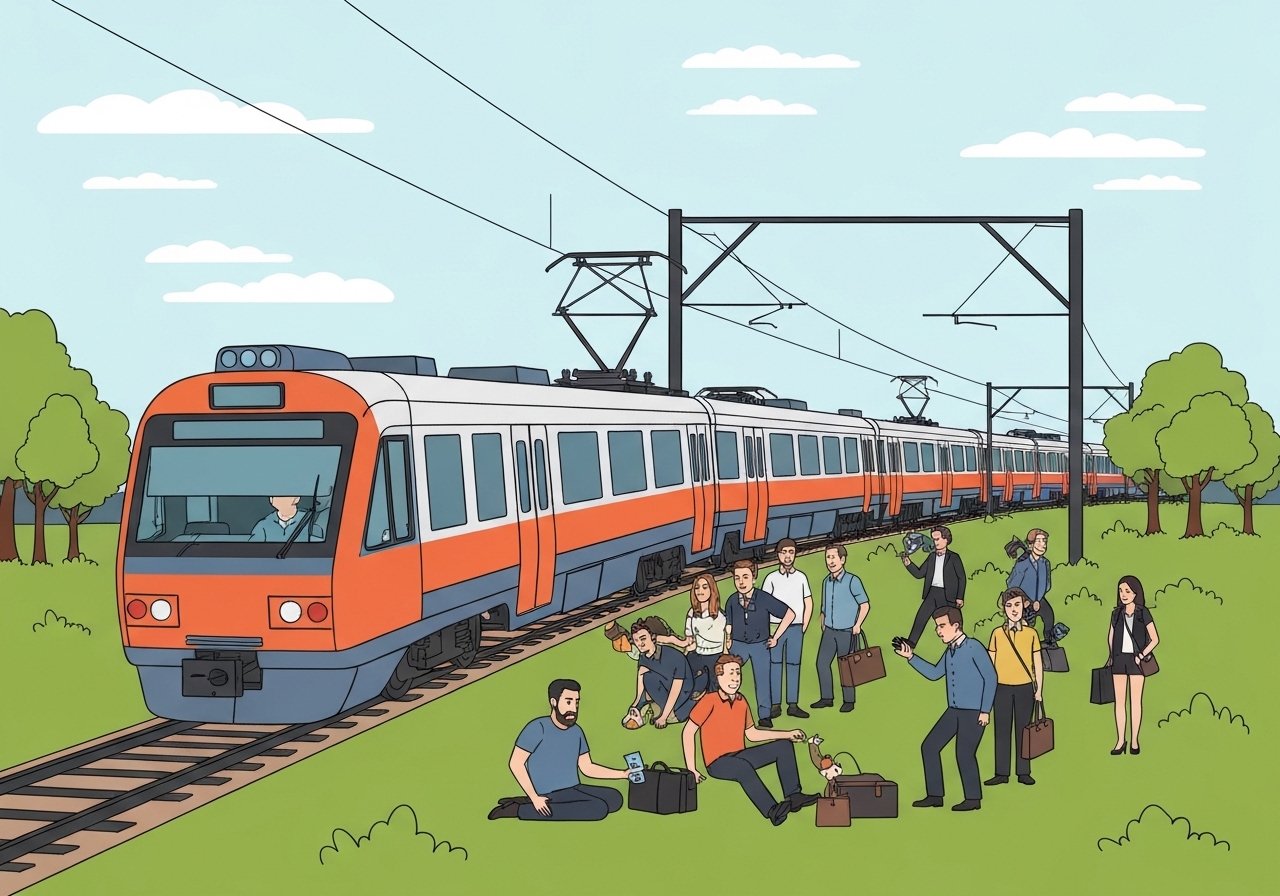
On Tuesday evening a Rodalies commuter train derailed between Gelida and Sant Sadurní, Catalonia, killing the driver and injuring at least 37 passengers, four of them seriously. Local emergency services said the train struck a retaining wall that fell onto the track during heavy storms battering north-eastern Spain; all passengers were later removed and emergency crews continued searching the wreckage. Eleven ambulances and 35 fire crews responded in Gelida, about 35 km west of Barcelona, and injured people were taken to Moisès Broggi, Bellvitge and Vila Franca hospitals. Authorities have suspended some regional services while investigations and weather-related inspections continue.
Key takeaways
- One train driver has died and at least 37 people were injured in the derailment between Gelida and Sant Sadurní; four victims are in serious condition.
- The Rodalies train collided with a retaining wall that had fallen onto the tracks during severe storms affecting north-eastern Spain.
- Emergency response included 35 fire crews and 11 ambulances; crews reported all passengers removed and no remaining people trapped inside.
- Ambulances transported injured passengers to Moisès Broggi, Bellvitge and Vila Franca hospitals in the region.
- Separately, another commuter train on the Barcelona network derailed after a storm-displaced rock struck an axle; that incident reported no injuries but caused service suspensions.
- The Catalonia derailment follows the Adamuz high-speed train collision in Andalusia two days earlier, which left at least 42 dead and is under separate investigation.
Background
Catalonia’s commuter network, operated by Rodalies, serves a dense suburban population around Barcelona and is vulnerable to extreme weather along some sections that run close to slopes and retaining walls. Spain has experienced a series of weather-driven rail incidents in recent weeks, prompting heightened scrutiny of trackside maintenance and runoff management. The region’s emergency system mobilises multiple agencies—local police (Mossos), regional fire services and health authorities—when incidents affect commuter lines that carry large numbers of daily passengers. Two days before this derailment, a much larger collision in Adamuz, Andalusia, highlighted broader safety concerns on Spanish railways and increased public attention to response times and infrastructure resilience.
Rodalies services are a mix of older rolling stock and modern trains; sections of track vary in exposure to landslips and rockfall. Local authorities in Catalonia had issued weather warnings for coastal and inland areas as storms moved across the north-east, raising the risk of fallen trees, landslides and debris hitting railways. Infrastructure operator ADIF is responsible for the tracks and has issued statements linking storm-displaced objects to at least one recent network incident, which has widened the scope of the technical inquiry into this derailment. Families of passengers were informed via emergency hotlines and station staff as hospitals received casualties for treatment.
Main event
The derailment took place between Gelida and Sant Sadurní on Tuesday evening when a Rodalies commuter train reportedly struck a retaining wall that had collapsed onto the track. Catalonia regional fire Inspector Claudi Gallardo confirmed that rescuers had removed all passengers from the wrecked carriages and that one driver had died at the scene. Local emergency services deployed 35 fire crews and 11 ambulances; teams conducted a thorough sweep of the area to rule out additional victims. The injured were triaged on site and then transferred to nearby hospitals—Moisès Broggi, Bellvitge and Vila Franca—where severe cases were admitted for further care.
Photographs shared by local police showed multiple emergency vehicles and personnel working around derailed carriages and debris on the line. In a later update, regional services said no further casualties remained inside the train, allowing crews to begin investigative and recovery operations. The weather at the time included heavy rain and strong winds, factors that local officials have highlighted as likely contributors to the retaining wall failure. Rail services on that section were suspended while clearance and safety inspections were carried out; alternative transport measures and timetable adjustments were deployed where possible.
Separately the same evening, another Rodalies service running between Blanes and Maçanet-Massanes suffered a derailment after its axle was struck by a rock dislodged by the storm, ADIF said. That second incident produced no reported injuries but added pressure on regional operators as they inspected vulnerable corridors and reviewed storm-related damage across the network. Together, the two incidents prompted authorities to maintain high alert levels and to coordinate infrastructure checks with weather services.
Analysis & implications
The immediate cause of the Gelida derailment appears linked to storm-driven structural collapse at trackside, underscoring how extreme weather can translate into acute rail safety hazards. If investigations confirm the wall’s failure was due to saturated ground or erosion, this will likely prompt targeted inspection programs and emergency reinforcement of vulnerable retaining structures along commuter lines. Infrastructure operator ADIF and regional bodies will face scrutiny over inspection schedules, maintenance funding and pre-storm mitigations, especially on slopes or cuttings prone to landslip.
Operationally, the incident will test the network’s resilience and contingency planning: suspension of services, passenger rerouting and timely medical response are immediate priorities, while longer-term impacts include potential timetable disruptions and increased maintenance costs. For passengers and unions, the deaths and injuries will raise pressure for accelerated upgrades to trackside protection and rockfall barriers. Insurers and municipal planners may also reassess flood- and landslide-risk maps that inform rail corridor management and capital investment decisions.
Politically, the derailment occurs amid heightened public sensitivity after the Adamuz collision that caused large-scale fatalities; national authorities may feel compelled to order rapid audits or temporary speed restrictions in defined high-risk zones. Cross-jurisdiction coordination—between ADIF, regional governments and emergency services—will be critical to restore safe operations and public confidence. Internationally, the incidents serve as a reminder that climate-driven weather extremes are an emerging operational risk for commuter and high-speed rail networks across Europe.
Comparison & data
| Incident | Timing | Fatalities | Injured | Location |
|---|---|---|---|---|
| Gelida commuter derailment | Tuesday evening | 1 (driver) | At least 37 (4 serious) | Between Gelida and Sant Sadurní, Catalonia |
| Blanes–Maçanet-Massanes derailment | Same evening | 0 | 0 reported | North-east of Barcelona |
| Adamuz high-speed collision | Two days earlier | At least 42 | Multiple (investigation ongoing) | Adamuz, Andalusia |
The table places the Gelida derailment in context: it is less lethal than the Adamuz high-speed collision but the human toll is still significant and the disruption to commuter services is consequential for the Barcelona metropolitan area. The Blanes–Maçanet-Massanes axle strike shows how storm-borne debris can damage rolling stock without causing casualties, yet still force suspensions and emergency inspections. Quantitatively, emergency deployments (35 fire crews and 11 ambulances) reflect a large-scale local response appropriate to multiple-casualty incidents on a busy suburban line.
Reactions & quotes
Regional emergency leaders and rail operators issued short statements as rescue and assessment work proceeded. Officials emphasised rescue completion, patient transfers and the need for a technical probe into infrastructure damage.
“All passengers had been removed from the train.”
Claudi Gallardo, Catalonia regional fire inspector
Inspector Gallardo’s brief declaration accompanied updates from crews on the ground confirming extraction of passengers and continuation of a sweep for further victims. His comment was delivered as ambulances and fire teams remained at the scene treating the injured and securing the area.
“The axle was struck by a rock dislodged by the storm.”
ADIF (Spanish rail infrastructure operator)
ADIF’s statement referred to a separate derailment on the same night and has been cited by authorities as evidence that the storms produced multiple hazards across the network. The operator’s comment has also fed into calls for immediate inspection of threatened track sections.
“Eleven ambulances were on the scene in Gelida treating those injured.”
Local emergency services
Emergency services used the figure to convey the scale of the medical response and to explain why some patients were moved to multiple hospitals in the area. That logistic detail illustrates typical triage and distribution procedures for mass-casualty transport in the region.
Unconfirmed
- Whether the retaining wall failure was caused solely by the storm or by pre-existing structural weakness remains under investigation.
- Any potential role of maintenance scheduling or delayed infrastructure repairs in the collapse has not been confirmed publicly.
- Links between this derailment and the Adamuz collision are procedural rather than causal; there is no confirmed systemic connection at this stage.
Bottom line
The Gelida derailment is a serious weather-related rail incident that resulted in one fatality and multiple injuries and has temporarily disrupted commuter services west of Barcelona. Early indications point to a retaining wall collapse triggered during a period of heavy storms, but technical investigators will need to determine the precise sequence of failures and any contributing maintenance or design factors.
Authorities face immediate priorities: care for the injured, support for victims’ families, a transparent investigation and targeted inspections of other vulnerable sections of the network. In the medium term, the event will likely increase scrutiny of infrastructure resilience to extreme weather and may accelerate preventive investment and revised inspection protocols across Spain’s rail network.