
Lead
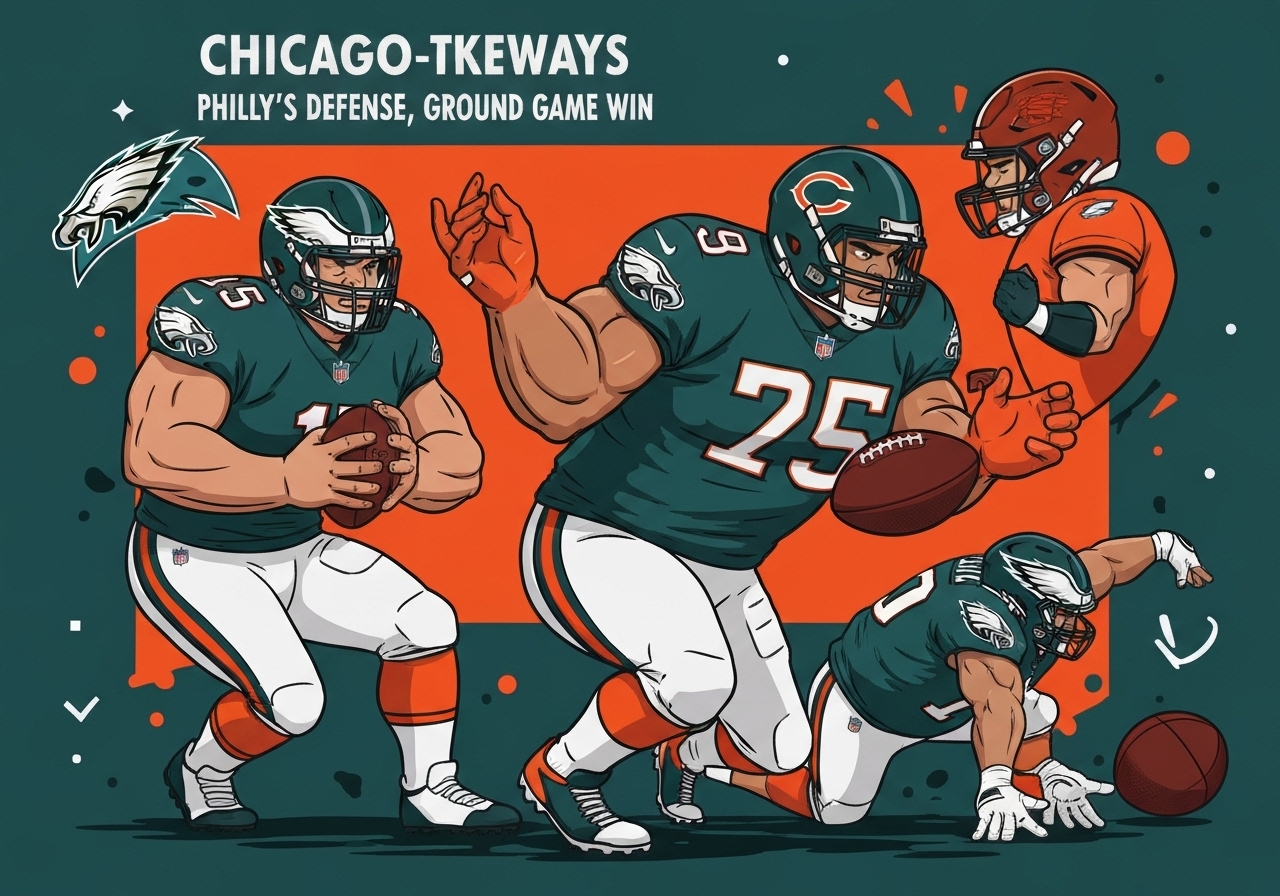
On Friday, Nov. 28, 2025 at Lincoln Financial Field, the Chicago Bears beat the Philadelphia Eagles 24-15, using a dominant rushing attack and a pivotal defensive turnover to seize control. Chicago improved to 9-3 with its fifth straight victory while Philadelphia fell to 8-4 and saw its division cushion shrink. The Bears outgained the Eagles 425-317 and outrushed them 281-87, with Kyle Monangai and D’Andre Swift combining for 255 yards. A defensive stop on a goal‑line push and two 100-yard rushers defined the game’s turning points.
Key takeaways
- Final score: Bears 24, Eagles 15 at Lincoln Financial Field on Nov. 28, 2025.
- Chicago dominated the ground game, outgaining Philadelphia 281-87 rushing; Monangai ran 130 yards on 22 carries, Swift 125 on 18.
- Two Bears exceeded 100 rushing yards for the first time since Walter Payton and Matt Suhey did it in 1985.
- Chicago piled up 425 total yards to Philadelphia’s 317 and controlled time of possession, 39:18 to 20:42.
- Bears converted 10-of-17 third downs (started 7-for-8 early); Eagles managed only 1 TD through three quarters and were 1-for-8 on third down before the late drive.
- Key turnover/stop: Nahshon Wright forced and recovered a red‑zone fumble and later wrestled a fourth‑and‑short push from Jalen Hurts, sparking a 14‑point Bears run.
- Eagles’ defense allowed 400-plus yards for the second straight game; their offense has scored more than 21 points only once since Week 8.
Background
Both clubs entered the matchup as division leaders: the Bears at 8-3 and the Eagles at 8-3 (records prior to the game reflected an ongoing tight NFC race). Chicago’s five-game streak and 9-3 record after the win keep it a half‑game ahead of Green Bay in the NFC North. Philadelphia came into the contest as the defending Super Bowl LIX champions but had lost to Dallas the previous week, leaving questions about its offensive form.
The teams’ recent histories set the stakes. The Bears have leaned on a revitalized rushing scheme all season, while the Eagles’ offense, built around Jalen Hurts and Saquon Barkley, has been expected to produce consistently at a high level following last season’s title. Fans and commentators had noted signs of strain for Philadelphia’s playcalling and execution as December approached.
Main event
Chicago established its identity early by pounding the ball between the tackles. D’Andre Swift’s 3-yard touchdown in the first quarter and Kyle Monangai’s 4-yard score late in a long drive highlighted a day when the Bears averaged 6.0 yards per carry. Monangai also broke the team’s longest play from scrimmage with a 31-yard run after Nahshon Wright recovered a red-zone fumble.
On defense, the Bears delivered a sequence that swung momentum: after a red-zone stop, Wright stripped and recovered the ball on a goal-line shove and later wrestled the ball away on a fourth‑down push attempt by Jalen Hurts. That sequence preceded a 14-point stretch that Chicago used to pull away and take command of the game.
Philadelphia managed two sustained touchdown drives, the latter coming late in the fourth quarter, but the offense otherwise sputtered. The Eagles had four three-and-outs and five punts; Saquon Barkley was limited to 13 carries for 56 yards. Caleb Williams and Chicago’s aerial game struggled in the windy conditions, reinforcing the decision to feed the run game repeatedly.
Analysis & implications
For Chicago, the win validates a run-first blueprint heading into the playoff push. Two 100‑yard rushers in a single game — the first Bears duo to do so since 1985 — suggests the offensive line and run scheme can sustain production in cold‑weather and windy conditions, which matter deeply in December and January. Time of possession advantages (nearly 39 minutes) also reduce turnover risk and keep opposing playmakers off the field.
Defensively, the Bears showed depth and situational discipline despite missing some starting linebackers. The unit’s ability to stop the Eagles on the signature short-yardage shove and to recover a forced fumble underscores the value of schemed third-down pressure and gap integrity late in tight games. Chicago’s defensive performance may force opponents to rethink short-yardage strategies.
For Philadelphia, the game intensified concerns about offensive playcalling and execution. The Eagles have now failed to score more than 21 points since Week 8 and have struggled on third down in consecutive games; the “Fire Kevin” chants captured fan frustration with coordinator Kevin Patullo’s tenure. While the roster still projects as a likely playoff team, the recent stretch raises legitimate questions about whether the offense can recapture the form it showed during the championship run.
Comparison & data
| Category | Bears | Eagles |
|---|---|---|
| Rushing yards | 281 | 87 |
| Total yards | 425 | 317 |
| Time of possession | 39:18 | 20:42 |
| Third downs | 10/17 | ? |
The table underscores the contrast: Chicago’s rushing advantage (281 vs. 87) translated into almost twice as many total plays controlled and nearly 19 extra minutes of possession. That imbalance limited Philadelphia’s chances to deploy its playmakers, while Chicago’s efficient rush attack produced sustained drives and scoring opportunities.
Reactions & quotes
The game produced a mix of team social posts and analyst commentary that captured the turning points and public mood.
“I’ll take that.”
— Nahshon Wright (via Chicago Bears social post)
Wright’s short remark, posted and amplified by the Bears’ official account, referred to his fumble force-and-recovery and the defensive stop that followed. The team highlighted the play as a decisive momentum swing.
“Suddenly, Chicago owns the NFL’s most productive rushing attack and can ride it in December and January.”
— Dan Wiederer, Bears senior writer (The New York Times)
This assessment summarized the broader implication that the Bears’ ground game could sustain a late-season push and change how opponents prepare for them.
Unconfirmed
- Return timeline for linebacker T.J. Edwards is not finalized; reports indicate he could be available next week but the team has not issued a medical clearance.
- Internal evaluations of offensive coordinator Kevin Patullo’s status are unreported; fan chants indicate pressure, but the organization has made no official staff announcement.
- Longer‑term durability of the Bears’ two‑back workload is an open question; no team statement has confirmed adjustments to snap counts for Swift or Monangai.
Bottom line
The Nov. 28 game was a clear momentum moment for Chicago: a dominant running performance paired with a critical defensive stand produced a road win that keeps the Bears atop the NFC North and positions them for a run into January. The tangible advantages — time of possession, third‑down efficiency and two 100‑yard rushers — offer a repeatable template for cold‑weather finishes.
For Philadelphia, the loss deepens a short stretch of offensive inconsistency that raises legitimate concerns heading into a December schedule that includes a Dec. 8 trip to Los Angeles to face the Chargers on Monday Night Football. The Eagles retain a playoff buffer, but the recent pattern echoes late‑season struggles from prior years and signals that corrective moves will be needed if they expect to defend their title.