
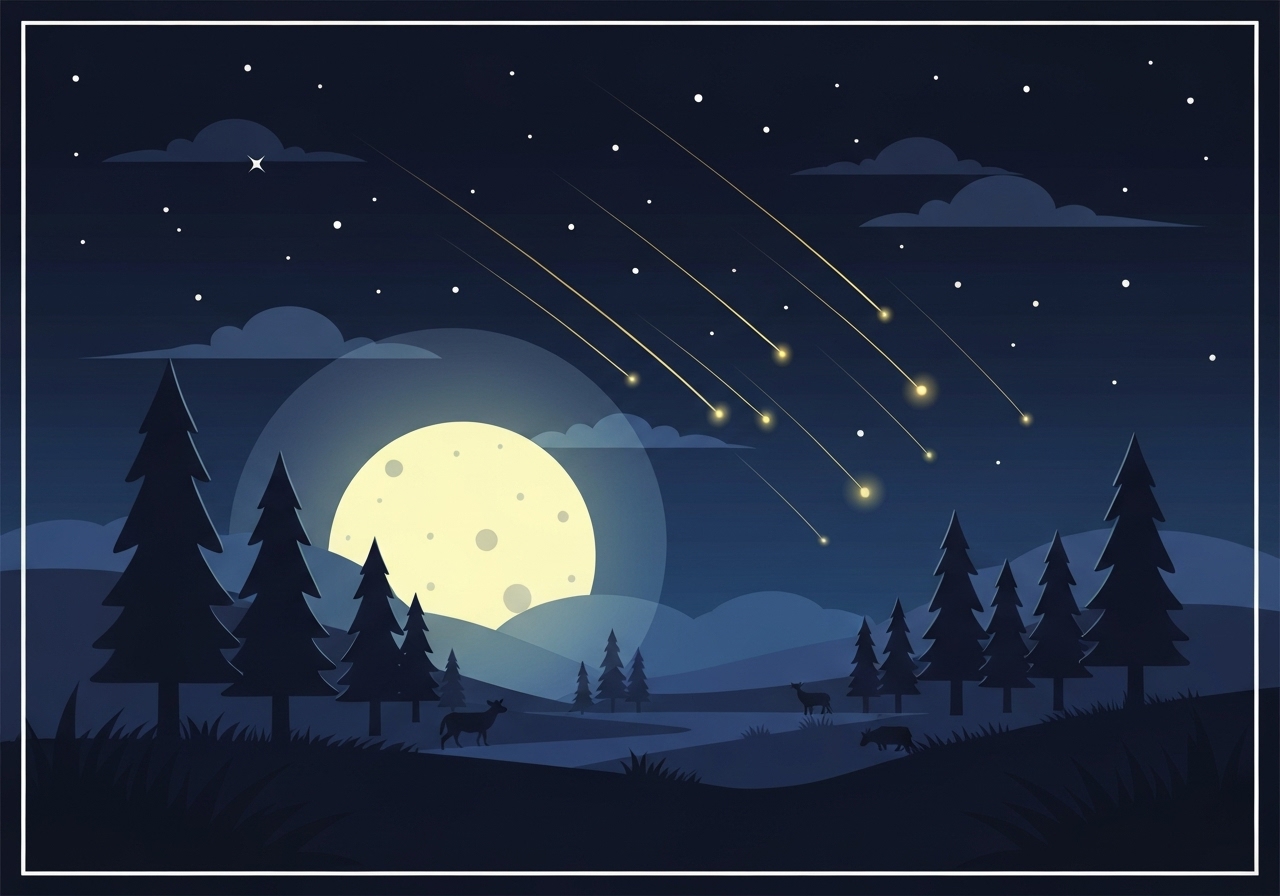
Lead: This week brings a quiet but notable double sky show: November’s full “beaver” supermoon reaches perigee at 8:19 a.m. ET Wednesday, though the Moon will be below the horizon for many observers so evening viewing is recommended. The Southern Taurid meteor shower is predicted to peak around 8 a.m. ET the same day, offering slow meteors and a chance of fireballs. Livestreams are available for those under cloudy skies, and experts say viewing conditions and the Moon’s brightness will determine how many meteors are visible.
Key takeaways
- The November full beaver supermoon peaks at 8:19 a.m. ET Wednesday (Old Farmer’s Almanac), but is best seen in the evening when it rises.
- This is the second of three consecutive supermoons in 2025; a supermoon occurs when the Moon is near perigee and appears slightly larger.
- The Southern Taurid meteor shower is expected to peak around 8 a.m. ET Wednesday (EarthSky); typical rates may be as low as ~5 meteors per hour.
- The Taurids originate from debris of comet 2P/Encke, which has a 3.3-year orbit — the shortest known for a comet of its class.
- Observers may still catch bright fireballs despite moonlight; experts warn moon glare will suppress most faint meteors.
- Virtual Telescope Project will stream the lunar peak from Manciano, Italy at 2 p.m. ET for those with obstructed skies.
- Regional visibility favors the Northern Hemisphere; in southern mid-latitudes the Taurid radiant sits low and many meteors may be hidden by the horizon.
Background
The name “beaver moon” comes from traditional North American seasonal calendars and marks the period when beavers intensify lodge and dam preparations for winter, a naming preserved in the Old Farmer’s Almanac. Indigenous naming traditions vary: the Tlingit call it the digging moon, the Dakota refer to a deer-rutting moon, and the Cree name it the frost moon, reflecting local ecological cues tied to the lunar cycle. Scientific interest in a “supermoon” stems from lunar orbital mechanics: when the Moon is near perigee its apparent diameter grows modestly and the illuminated disk can look brighter than average.
The Taurid meteor complex is a long-running annual phenomenon associated with comet 2P/Encke’s debris trail. Because Encke’s orbit is short (3.3 years), repeated passages have spread a complex of particles along the comet’s path, producing two related streams (Northern and Southern Taurids) that peak at different times in October–November. Taurids have a reputation for producing occasional large fireballs in some years, which has drawn extra attention from fireball networks and amateur skywatchers.
Main event
The Moon reaches its full, near-perigee phase at 8:19 a.m. ET Wednesday; however, in many North American time zones that moment falls before moonrise, so observers are advised to plan evening viewings when the Moon is above the horizon. The Old Farmer’s Almanac lists the precise timing and recommends scanning the eastern sky after sunset for the brightest view. For anyone hindered by clouds or urban light, the Virtual Telescope Project will broadcast a live view of the full Moon over Manciano, Italy starting at 2 p.m. ET.
The Southern Taurids are forecast to crest near 8 a.m. ET Wednesday, which again places the formal peak during daylight for many regions; meteor showers typically yield visible activity both before and after the peak night, so the best opportunities are during nighttime hours closest to the peak. Robert Lunsford, coordinator for the American Meteor Society’s fireball reports, notes the shower’s peak is broad and modest: typical detection rates can be around five meteors per hour under dark skies. The slow apparent speed of Taurid meteors produces longer, more luminous streaks when bright fragments enter the atmosphere.
Part of the interest this year comes from model predictions that Earth may encounter fresher, slightly larger particles within the Taurid stream — material more prone to producing fireballs. Even so, experts caution the full Moon’s glare will mask most faint meteors, so the practical chance is catching a handful of bright events rather than numerous faint streaks. For best results, find a dark site away from streetlights, lie back with a wide view of the sky, and watch anytime after sunset until the Moon reaches its highest point Wednesday night.
Analysis & implications
Astrophysically, consecutive supermoons have no measurable effect on human health or seismicity, but they do offer public outreach opportunities because the slightly larger apparent lunar disk captures attention. The “superness” is subtle: the Moon’s apparent size increase at perigee is generally a few percent, noticeable in photographs with a reference object but imperceptible to most unaided eyes. Still, the cultural value of named moons helps connect communities to seasonal cycles and natural history.
For meteor science, Taurid encounters that include larger particles are important data points for understanding the size distribution within a cometary debris stream. Large fragments that survive to low altitudes as fireballs allow recovery campaigns and can inform models of comet fragmentation and stream evolution. If the predictive models about fresher material are correct, networks monitoring fireballs may record a higher-than-normal incidence of bright events, improving statistical samples for study.
Operationally, the Moon’s brightness will complicate professional and amateur observations. Fireball networks relying on wide-field cameras still record bright events, but the lowered signal-to-noise for faint meteors reduces standard hourly counts. Outreach programs and planetariums can leverage livestreams and scheduled night-watch guidance to maintain public engagement even when sky conditions are suboptimal.
Comparison & data
| Event | Peak dates | Typical hourly rates |
|---|---|---|
| Southern Taurids | Nov 5, 2025 (peak ~8 a.m. ET) | ~5 meteors/hr (variable) |
| Northern Taurids | Nov 11–12, 2025 | Low to moderate |
| Leonids | Nov 16–17, 2025 | Moderate |
| Geminids | Dec 13–14, 2025 | High (major shower) |
| Ursids | Dec 21–22, 2025 | Low to moderate |
The table above aggregates peak dates and typical activity levels from the American Meteor Society and EarthSky. These figures are shorthand: actual hourly rates depend strongly on local darkness, horizon obstruction, and lunar phase. The Geminids in mid-December remain the season’s most reliable, high-rate display, while Taurid activity is characteristically sparse but notable for occasional bright fireballs.
Reactions & quotes
Experts emphasize the technical subtlety of a supermoon and the practical viewing constraints posed by moonlight.
“The supermoon’s size increase is real but subtle — not something most people will notice unaided,”
Dr. Alissa Bans, Emory University (physics, undergraduate director)
Forecasters who monitor meteors highlight the Taurids’ propensity to produce bright fireballs and caution observers about visibility limits this year.
“Taurid rates are usually low, but the stream can produce slow, long-lasting fireballs, and this year models suggest some larger particles may be encountered,”
Robert Lunsford, American Meteor Society (fireball report coordinator)
Event organizers point readers to livestream options when local conditions are poor and advise standard low-light viewing practices for best chance of seeing meteors.
Unconfirmed
- Precise counts of fireballs during the Taurid peak are uncertain until observational networks report; model-based predictions of more large particles are plausible but not yet confirmed by wide-field detections.
- Any local claims of dramatically enhanced meteor rates tied to this specific peak should be treated cautiously until corroborated by multiple reporting stations or camera networks.
Bottom line
The November beaver supermoon and the Southern Taurids present a modest, complementary pair of sky events: the Moon will offer a photogenic near-perigee full disk visible after sunset, while the Taurids may yield occasional bright fireballs despite overall low meteor rates. Moonlight will suppress most faint meteors, so casual viewers should temper expectations but still watch for memorable bright streaks.
For photographers and enthusiasts, plan evening observations away from heavy light pollution and consider the Virtual Telescope Project’s 2 p.m. ET livestream if clouds intervene. Scientists will monitor any unusually bright Taurid activity closely, as larger-than-average particles provide valuable data on the structure and evolution of cometary debris streams.
Sources
- CNN (news report)
- Old Farmer’s Almanac (reference/seasonal almanac)
- EarthSky (science outreach)
- American Meteor Society (professional/observational network)
- Virtual Telescope Project (observatory/livestream)
- Emory University Department of Physics (academic affiliation for quoted scientist)