
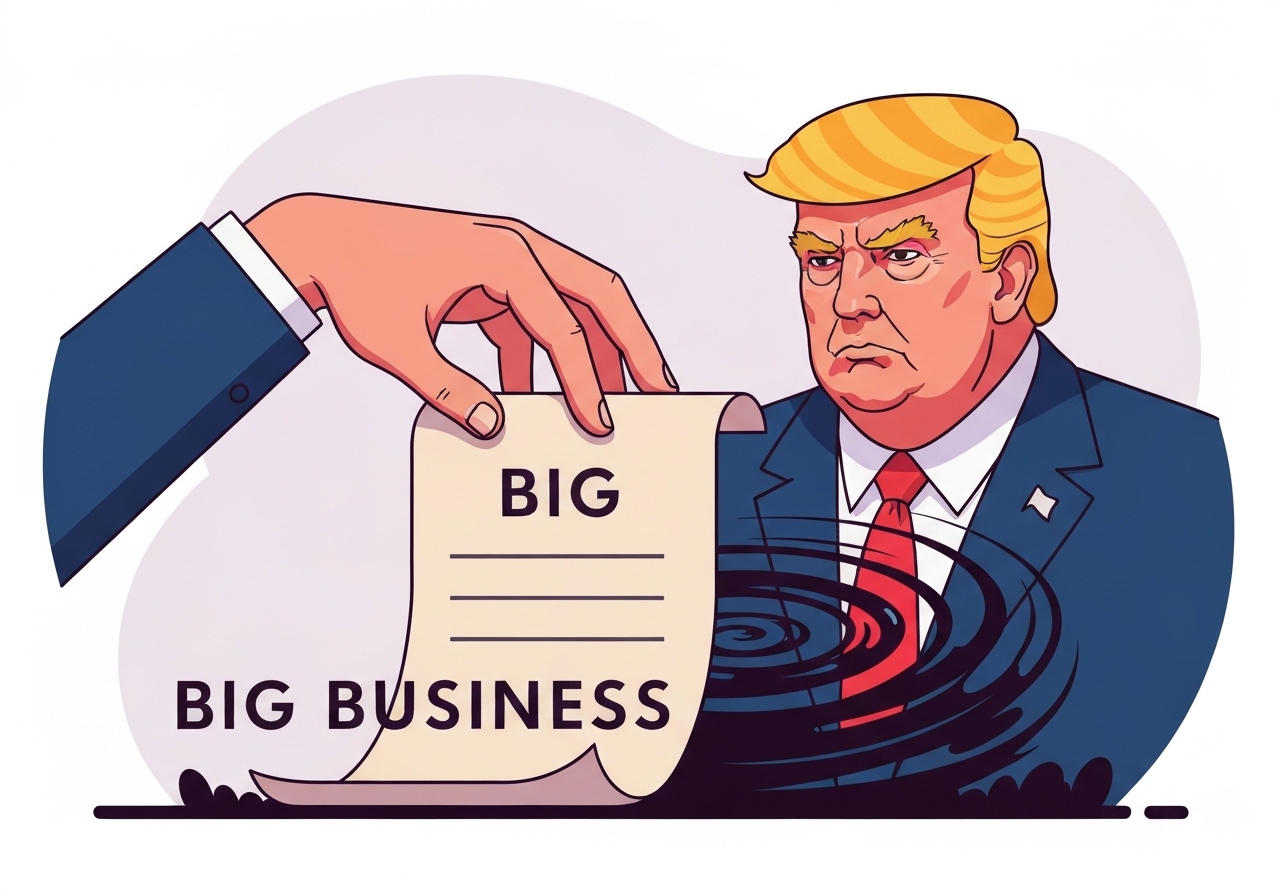
When Donald Trump returned to power, many of America’s largest companies and wealthiest individuals quickly sought to placate his administration, hoping influence and deals would preserve profits and avert disruption. Some executives openly welcomed a rollback of cultural restraints; others privately judged Trump unfit for office but gambled that accommodations, campaign donations and the presence of figures like Scott Bessent would contain his worst impulses. That calculation has begun to unravel as recent policy moves — from tariff threats to public attacks on corporate leaders and institutions — show escalation rather than retrenchment. The result: increasing financial risk for U.S. firms and growing pressure on corporate leaders to choose between complicity and resistance.
Key takeaways
- Corporate leaders who publicly distanced themselves from Republicans after January 6 largely resumed donations within months after threats of retaliation, reversing earlier commitments.
- U.S. equity markets rose about 16% over the past year, but advanced-market peers climbed roughly 33% in 2025, highlighting relative underperformance.
- U.S. firms have roughly $4 trillion invested in Europe; escalating economic conflict with European partners risks exposing that capital to significant political and financial harm.
- Scott Bessent, a close Trump adviser, defended sweeping tariff authority as a pre-emptive tool, framing emergency powers as a way to avoid emergencies rather than responding to them.
- High-profile CEOs who voiced caution — for example, ExxonMobil’s Darren Woods calling Venezuelan oil “uninvestable” — have faced public rebuke from the president, signaling personal as well as corporate vulnerability.
- Appeasement strategies assume Trump can be managed; recent actions show repeated escalation and a widening playbook of pressure and punitive rhetoric.
- Businesses retain agency: collective refusal to subsidize or normalize authoritarian overreach could protect reputations and reduce long-term political and financial exposure.
Background
After Trump’s return to the presidency, many business leaders moved quickly to curry favor — publicly and privately — hoping to secure regulatory relief, tax advantages and expanded market latitude. In some quarters, relief took an unvarnished cultural form: a senior banker told the Financial Times that the administration made him feel “liberated,” expressing relief at escaping perceived constraints on coarse language. That sentiment underscored how some executives prioritized short-term comfort and potential policy gains over democratic norms.
Others recognized the risks. The January 6 attack and subsequent polarization prompted a wave of corporate signaling — pledges to halt donations to certain Republicans and promises to reassess political spending. Yet those commitments were often short-lived; after threatened reprisals, many companies quietly renewed political contributions and outreach. The calculus was often pragmatic: if you flatter and pay enough, and if practical actors like Bessent occupy key advisory roles, the reasoning went, you can steer the administration back toward familiar pro-business policies.
Main event
Recent weeks have exposed flaws in that gamble. The administration’s rhetoric and actions on tariffs and foreign policy have intensified, not softened. Threats to use emergency tariff authority in disputes over Greenland and other strategic moves prompted concern from both European partners and corporate investors with sizable holdings overseas. Treasury and White House advisors framed these moves as leverage or bargaining tactics, but the implications for multinational investment are concrete.
Scott Bessent — once portrayed by some as a stabilizing, grown-up presence in the administration — delivered public defenses of broad executive authority that left many corporate observers unsettled. Asked to justify tariff threats tied to national emergencies, he described the approach in a way that framed pre-emption as prevention: using emergency powers to avoid emergencies, a rationale critics called circular and dangerous for rule-based commerce.
Corporate executives who have pushed back, even gently, have been singled out. ExxonMobil CEO Darren Woods drew a sharp presidential retort after calling Venezuelan oil “uninvestable,” and JPMorgan Chase CEO Jamie Dimon drew ire after suggesting care around attacks on Fed independence. Those incidents illustrate that disagreement can invite personal and institutional reprisals — including threats of legal or regulatory action — not just market consequences.
Analysis & implications
The business case for appeasement rests on assumptions that recent behavior contradicts. First, accommodation presumes a stable bargain: you pay or flatter, and politics stays predictable. But when an administration weaponizes trade policy and public denunciation, predictability dissolves and the cost of doing business rises. Firms face direct exposure through disrupted supply chains, retaliatory measures by foreign governments, and a politicized enforcement environment at home.
Second, reputational risk compounds financial risk. Major firms that bend to authoritarian pressure jeopardize brand trust with consumers, employees and investors who value governance norms. In sectors where intangibles like trust and regulatory credibility matter — finance, energy, technology — erosion of reputation can translate into capital flight, regulatory scrutiny and talent loss.
Third, the international dimension is material: with roughly $4 trillion of U.S. corporate investment in Europe, trade or diplomatic spats that escalate into sanctions or tariff wars could imperil asset values and operational footprints. Even limited market disruptions can trigger multi-year impacts on investment returns and cross-border partnerships.
Comparison & data
| Metric | U.S. (past year) | Peer advanced markets (2025) |
|---|---|---|
| Stock market total return | +16% | +33% |
| U.S. corporate investment in Europe | ~$4 trillion | |
These data show U.S. equity underperformance relative to peers in 2025 and the sheer scale of exposure U.S. firms have in Europe. That combination raises the economic stakes of any cross-Atlantic confrontation. Even if direct confiscation is unlikely, protracted policy friction will weigh on valuations and strategic planning.
Reactions & quotes
“We can say ‘retard’ and ‘pussy’ without the fear of getting cancelled… it’s a new dawn.”
Anonymous senior banker, Financial Times (reported)
The remark, reported by the Financial Times after Trump’s election, was cited by corporate critics as evidence of a shift in boardroom tone toward emboldened coarse behavior.
“The national emergency is avoiding a national emergency.”
Scott Bessent, Trump adviser
Bessent used that line defending broad tariff authority; critics argue it rationalizes pre-emptive executive action and blurs legal boundaries for trade policy.
“Venezuelan oil is uninvestable.”
Darren Woods, CEO, ExxonMobil
Woods’ blunt assessment of Venezuelan assets prompted a public presidential rebuke, signaling that firms speaking plainly about geopolitical risks may face political consequences.
Unconfirmed
- Whether President Trump holds specific compromising information on Scott Bessent remains unverified; no public evidence has been produced.
- Claims that the Department of Justice’s investigation into Federal Reserve officials is legally groundless are contested and legally unresolved.
- The precise scale and timing of any coordinated plan to extract corporate funds for political favors remain unclear and have not been independently corroborated.
Bottom line
Corporate America faces a strategic choice: continue a pattern of accommodation that increasingly demands public humiliation and private concessions, or collectively recalibrate toward principled distance and defensive measures that protect long-term value. The short-term incentives for appeasement can be powerful, but they also risk transforming controllable policy relationships into precarious dependencies.
Given the scale of U.S. corporate exposure abroad and the rising political costs at home, business leaders would be better served by organizing collectively — through industry groups, shareholder actions and public statements that defend institutions — rather than relying on individualized bargains. The stakes are not merely reputational; they are material, affecting investment, operations and the long-run health of both firms and democratic norms.
Sources
- Paul Krugman, Substack (opinion)
- Financial Times (news) — report of banker remark and coverage of corporate reactions
- Penn Wharton Budget Model (research) — charts on policy scenarios cited
- Minnesota Star Tribune (news) — reporting on domestic responses to dissent
- The New York Times (news) — broader coverage of tariffs and administration moves
- U.S. Department of Justice (official) — referenced for investigative actions
- ExxonMobil (corporate) — public statements from company leadership
- JPMorgan Chase (corporate) — public statements from company leadership