
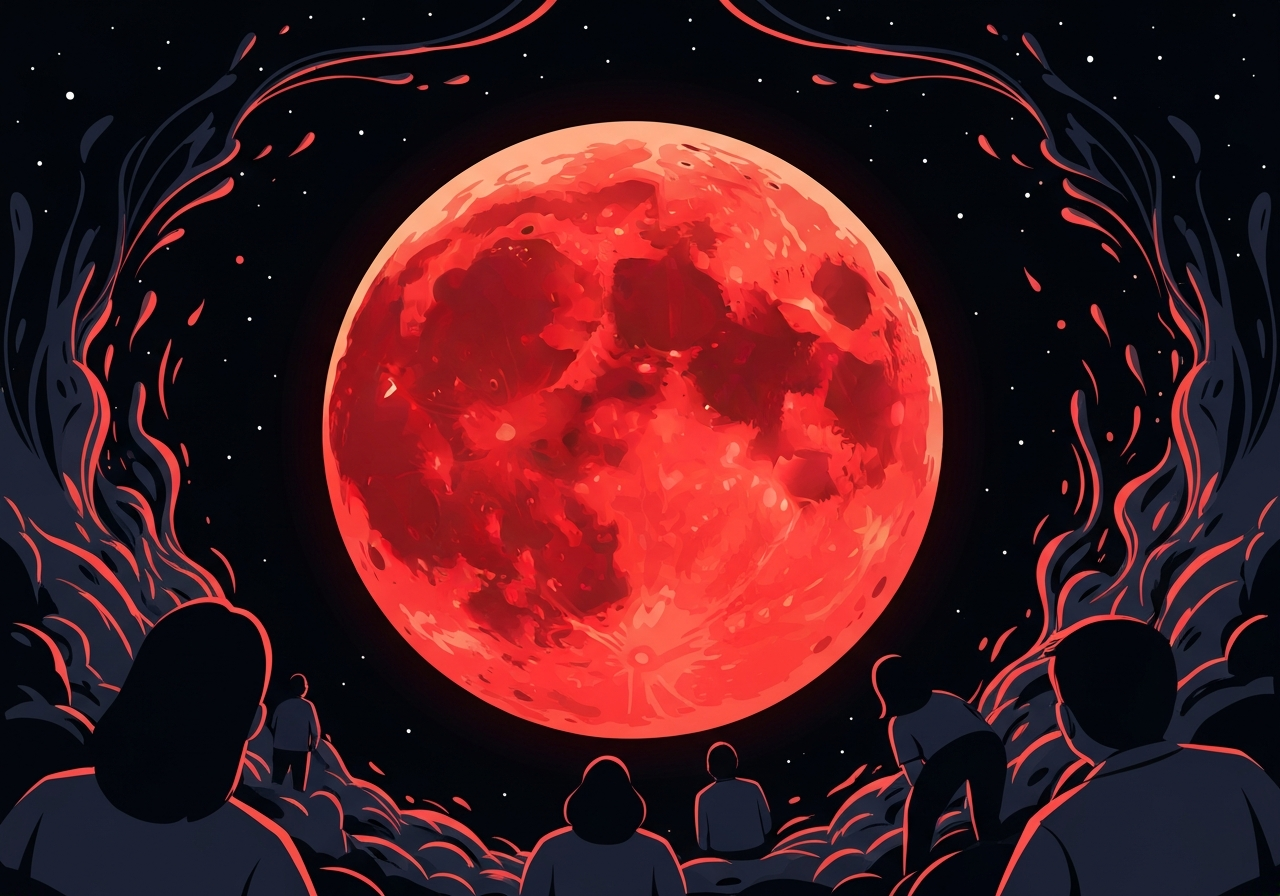
Stargazers worldwide can watch a total lunar eclipse—the so‑called “blood moon”—during the early hours of March 3, 2026, as Earth’s shadow fully engulfs the lunar disk and the Moon glows a coppery red. Free livestreams from major observatories and skywatching projects will carry live views and expert commentary, offering coverage timed for viewers across the Americas, Asia and Oceania. The event’s peak totality will be visible to an estimated 3.3 billion people across those regions, with online feeds ensuring access even where local skies are cloudy. Several groups, including Time and Date, the Virtual Telescope Project, Griffith Observatory and the Auckland Astronomical Society, will host coordinated streams beginning between 3:00 and 4:30 a.m. EST.
- Visibility: The total lunar eclipse on March 3, 2026, will be at least partly visible across the Americas, Asia and Oceania; an estimated 3.3 billion people are in regions that will see the blood‑moon phase.
- Time and Date livestream: Starts at 4:30 a.m. EST (09:30 GMT) with live views from Los Angeles, Western Australia and other sites and commentary by Anne Buckle and Graham Jones.
- Virtual Telescope Project: Global feed begins at 3:30 a.m. EST (08:30 GMT), with astrophotographers in Australia, the U.S. and Canada; Gianluca Masi will provide live commentary.
- Griffith Observatory: West‑coast coverage begins at 3:37 a.m. EST (08:37 GMT) and will track the eclipse from penumbral phases through totality from Los Angeles.
- Auckland Astronomical Society: Stream starts at 3:00 a.m. EST (08:00 GMT) from northern New Zealand, showing the rising Moon from the local horizon.
- Access and gear: All listed livestreams are free and hosted on YouTube; photographers are advised to consult astrophotography guides for exposure and lens recommendations.
- Community contributions: Space.com invites readers to submit eclipse photos to [email protected] for possible publication.
Background
A lunar eclipse occurs when the Moon passes through Earth’s shadow at full Moon, and a total lunar eclipse—when the entire lunar disk enters Earth’s umbra—can produce a reddish hue known as a blood moon. That color comes from sunlight scattered and refracted through Earth’s atmosphere; shorter blue wavelengths are filtered out while longer red and orange wavelengths illuminate the Moon. Lunar eclipses are visible to anyone on the night side of Earth who has an unobstructed view of the sky; unlike solar eclipses, they are safe to view with the naked eye. Scientific and public interest in total lunar eclipses remains high because they are accessible events for outreach and for simple atmospheric observations using calibrated photometry.
Organized livestream coverage has become standard for wide events like this, enabling global audiences to watch even when local weather or horizon obstructions would otherwise prevent a sighting. Major observatories and volunteer networks coordinate camera feeds and commentary to provide continuous coverage across time zones, often combining ground‑based imagery with expert interpretation. In recent years, these live broadcasts have also served as platforms for amateur astrophotographers to share high‑resolution stills and for educators to explain the eclipse mechanics in real time.
Main Event
The first feeds for the March 3 eclipse begin in the pre‑dawn hours Eastern Time. The Auckland Astronomical Society will start streaming at 3:00 a.m. EST (08:00 GMT) from northern New Zealand, showing the lunar disk as it rises above the northeastern horizon. The Virtual Telescope Project follows at 3:30 a.m. EST (08:30 GMT) with a multinational set of cameras and commentary intended to give a continuous global perspective.
Griffith Observatory’s Los Angeles feed goes live at 3:37 a.m. EST (08:37 GMT), positioning the observatory to monitor the event across the U.S. west coast as the eclipse progresses through penumbral, partial, and total phases. Time and Date’s YouTube stream begins at 4:30 a.m. EST (09:30 GMT), collecting imagery from Los Angeles, Western Australia and other sites and offering live science commentary aimed at a general audience.
During totality the lunar surface will appear dimmer and take on a copper‑red tint; exact hue varies with global atmospheric conditions such as volcanic aerosols and tropospheric dust. The feeds are expected to remain live through the end of totality and the Moon’s emergence from Earth’s shadow, allowing viewers to observe the full sequence. Hosts will typically explain timing, what observers are seeing, and how to photograph the event.
Analysis & Implications
From a scientific viewpoint, total lunar eclipses are an opportunity to observe how Earth’s atmosphere scatters sunlight. The color and brightness of the eclipsed Moon can provide qualitative information about particulate levels in the stratosphere; exceptionally dark or deeply red eclipses often reflect recent volcanic injections into the atmosphere. While professional atmospheric studies use calibrated instruments, aggregated observations and imagery from multiple sites can still offer useful contextual data.
For public outreach, livestreams multiply the audience and lower barriers to participation. They let educators add commentary, invite questions in real time, and link viewers to explanatory resources—strengthening public interest in planetary science. The coordinated international coverage also highlights the collaborative nature of modern skywatching, combining professional observatories, nonprofit projects and enthusiastic amateur communities.
Astrophotography interest will be high: total lunar eclipses present accessible targets for a wide range of equipment, from DSLR cameras on tripods to telescopes with tracking mounts. Live broadcasts and guides that pair exposure suggestions with live examples help beginners capture usable images and encourage them to learn photometric basics. The event also underscores how social and digital platforms are now integral to disseminating scientific experiences to mass audiences.
Comparison & Data
| Host | Starts (EST / GMT) | Primary Coverage Location |
|---|---|---|
| Time and Date (YouTube) | 4:30 a.m. EST / 09:30 GMT | Los Angeles, Western Australia, additional sites |
| Virtual Telescope Project (YouTube) | 3:30 a.m. EST / 08:30 GMT | Australia, U.S., Canada |
| Griffith Observatory (YouTube) | 3:37 a.m. EST / 08:37 GMT | Los Angeles, California (west coast view) |
| Auckland Astronomical Society (YouTube) | 3:00 a.m. EST / 08:00 GMT | Northern New Zealand (Moon rise) |
The table summarizes scheduled start times and principal vantage points for each stream; because the eclipse spans several hours and geographic zones, overlap ensures near‑continuous coverage for most viewers. These coordinated windows are designed so audiences in different time zones can join at convenient local times or watch edited highlights later.
Reactions & Quotes
“The stream will feature live views from Los Angeles, Western Australia and potentially more, with expert commentary provided by journalist Anne Buckle and astrophysicist Graham Jones.”
Time and Date (livestream announcement)
“Gianluca Masi and the Virtual Telescope Project will provide live commentary alongside feeds from astrophotographers in Australia, the United States and Canada.”
Virtual Telescope Project (event briefing)
“From its vantage point on the west coast of America, the observatory will be perfectly positioned to provide coverage throughout the eclipse.”
Griffith Observatory (stream description)
Unconfirmed
- The estimated 3.3 billion people figure reflects the number of people living in regions with potential visibility and is an approximation rather than a precise live audience forecast.
- Additional camera sites and backup streams may be added last‑minute by host organizations; final lineups and viewing angles could change depending on logistics and weather.
- Local cloud cover and horizon obstructions will affect on‑site viewing even when online coverage is available; stream providers may substitute alternative feeds if clouds block a primary camera.
Bottom Line
On March 3, 2026, a total lunar eclipse will produce a blood‑tinted Moon visible across large parts of the globe; free YouTube livestreams from Time and Date, the Virtual Telescope Project, Griffith Observatory and the Auckland Astronomical Society will offer continuous coverage for early‑morning viewers in Eastern Time and audiences elsewhere. Those who cannot view the sky directly can still experience the event in real time, hear expert commentary, and use the broadcasts as a learning resource or as reference imagery for their own photography attempts.
Photographers planning to shoot the eclipse should consult exposure guides and prepare for changing brightness through the penumbral, partial and total phases; viewers who capture compelling images are invited to submit them to [email protected] for possible sharing. The event is both a public outreach moment and a reminder that coordinated global networks—professional and amateur alike—can bring transient celestial phenomena to millions in ways that advance science literacy and community engagement.
Sources
- Space.com — Media report summarizing livestreams and event details (original coverage)
- Time and Date — Event livestream and public outreach (media/organizer)
- Virtual Telescope Project — International observing project and livestream organizer (project/official)
- Griffith Observatory — Observatory livestream and public education (official)
- Auckland Astronomical Society (YouTube) — Local society livestream (community/organization)