
Lead
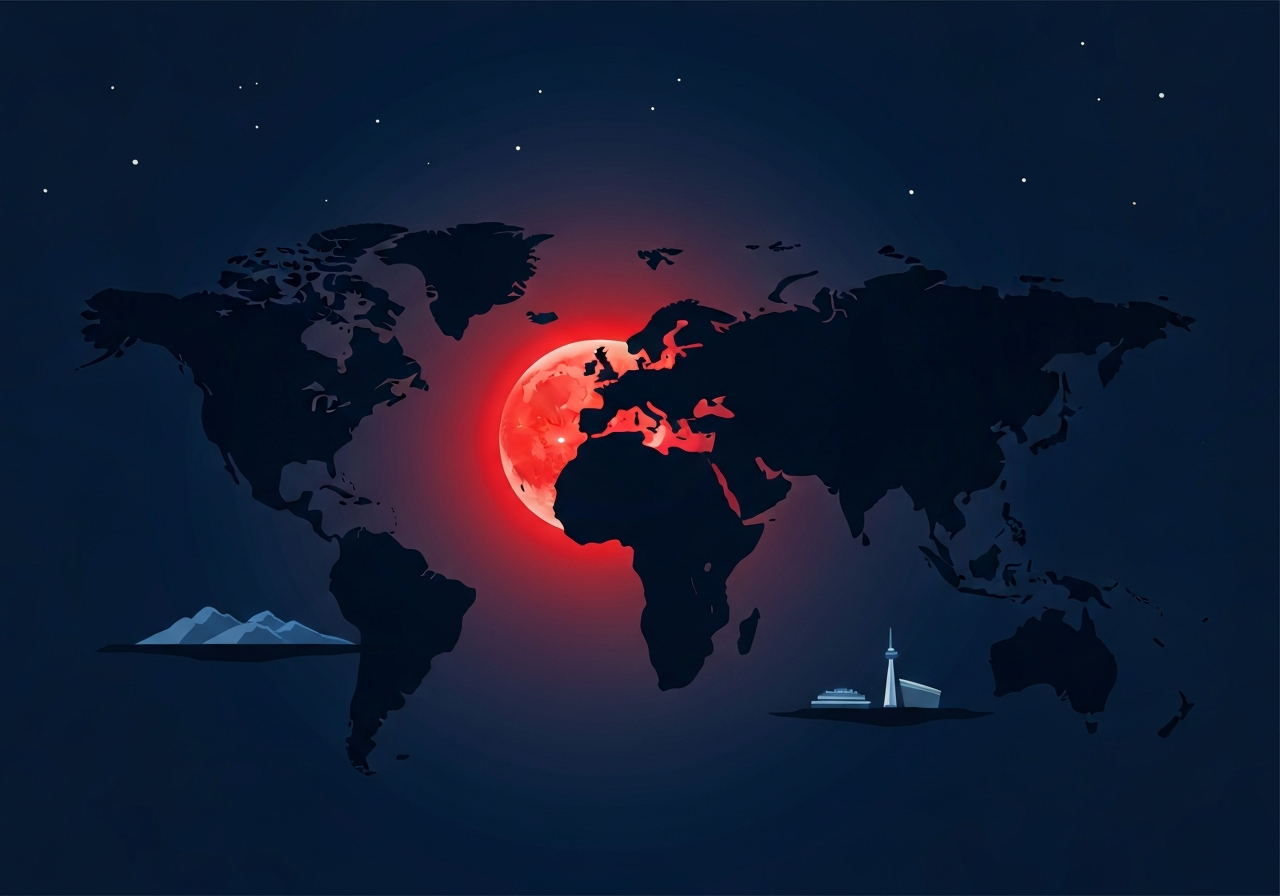
This coming Tuesday (early March 2026), a total lunar eclipse will turn the full moon a coppery red for observers across large parts of the globe. The event will be visible in the morning from North America, Central America and western South America, and again that night for Australia and eastern Asia; Africa and Europe will not see totality. Totality—the interval during which the moon is wholly in Earth’s shadow—will last about one hour, and no special equipment is required beyond a clear sky. Skywatchers should check a local astronomical timetable for exact start and end times in their time zone.
Key Takeaways
- The event is a total lunar eclipse visible in whole from North America, Central America and western South America, and in whole from Australia and eastern Asia (Tuesday local times).
- Totality will run for roughly one hour, while the entire eclipse sequence unfolds over several hours as Earth’s shadow moves across the lunar disk.
- A partial eclipse phase will be observable from Central Asia and much of South America; Europe and Africa are expected to be outside the visibility zone.
- No telescope or solar filter is needed to view the eclipse—just a clear, unobstructed view of the sky and basic timing information from a forecasting app or online calendar.
- This total lunar eclipse follows a ring-of-fire solar eclipse roughly two weeks earlier and precedes a partial lunar eclipse scheduled for August 2026 that will be visible across the Americas, Europe, Africa and western Asia.
- According to NASA and eclipse trackers, another total lunar eclipse will not occur until late 2028, making this a relatively rare opportunity for many regions.
Background
Lunar and solar eclipses are natural outcomes of the repeated alignments among the Sun, Earth and Moon. A lunar eclipse occurs only at full moon, when Earth sits between the Sun and Moon and casts a shadow on the lunar surface. The deep red appearance during totality—often called a “blood moon”—is caused by longer-wavelength sunlight refracting through Earth’s atmosphere and illuminating the Moon with reddish-orange light.
Eclipses come in series because of orbital resonances: the Moon’s orbit, Earth’s orbit and the tilt of Earth’s axis create windows when alignments recur. There are typically four to seven eclipses (solar and lunar combined) in a calendar year, but total lunar eclipses that are visible from densely populated regions remain less common. Amateur and professional astronomers routinely use these events for public outreach and, occasionally, for scientific measurements of Earth’s atmospheric properties.
Main Event
The eclipse will develop across several stages. Observers should first notice the Moon taking on a subtle bite as it enters Earth’s penumbral shadow, then a darker curved shadow progressing across the face as it moves into the umbra. Over the course of hours the umbral phase deepens until totality, when the Moon appears reddish as refracted sunlight through Earth’s atmosphere reaches the lunar surface.
For those in North and Central America and western South America, the sequence will occur during the pre-dawn hours; residents of Australia and eastern Asia will see the same totality later that night. In Central Asia and broad swaths of South America the eclipse will be partial—observers will see part of the Moon darkened but not the full red disk. Weather and local horizon obstructions (trees, buildings) will determine how dramatic the view is in any specific location.
Because lunar eclipses are safe to watch with the naked eye, viewers are encouraged to step outside at several key moments to observe the progressing shadow rather than remaining stationary the entire time. Photographers often use a tracking mount or long-exposure stacking techniques to capture color and detail, but casual observers will still enjoy a vivid, slowly changing display with no special gear required.
Analysis & Implications
Scientifically, lunar eclipses are less about new discoveries than about applied observation: they offer a simple way to study how Earth’s atmosphere scatters and filters sunlight. Variations in color and brightness during totality can reflect aerosol loads, dust or volcanic particulates in the stratosphere; professional teams periodically analyze eclipse photometry to infer atmospheric conditions. Because totality will span roughly an hour, there is sufficient time for coordinated measurements across time zones.
Publicly, lunar eclipses remain effective tools for outreach and science communication. Planetaria, university observatories and amateur astronomy clubs often stage viewing events that attract families and students, boosting public interest in astronomy and basic science. The absence of necessary protective eyewear—unlike solar eclipses—lowers barriers for attendance and encourages spontaneous skywatching in urban areas where skyline views permit.
Economically and culturally, the event can drive local tourism around organized viewing sessions, particularly in regions where clear, elevated vantage points are scarce. For photographers and social media, a blood-red moon provides a shareable, attention-grabbing image that often drives broader engagement with astronomical content—something science communicators use to promote longer-term interest in STEM topics.
Comparison & Data
| Date (2026) | Type | Primary Visibility | Totality Duration |
|---|---|---|---|
| This coming Tuesday (early March 2026) | Total lunar eclipse | North/Central America, western South America; Australia & eastern Asia (local night) | ~1 hour |
| August 2026 | Partial lunar eclipse | Americas, Europe, Africa, western Asia | Partial phases only |
| Late 2028 | Total lunar eclipse | Next total visible globally in late 2028 (per NASA forecasts) | Varies by location |
The table summarizes the immediate eclipse schedule and relative visibility. Local observers should consult an online eclipse calculator or mobile forecasting app for minute-by-minute timing at their coordinates, because the exact second when the Moon enters or leaves umbra depends on longitude and latitude.
Reactions & Quotes
Astronomers and outreach coordinators emphasize the relaxed, accessible nature of lunar eclipses compared with total solar eclipses, and they encourage the public to use the event as a learning opportunity. Below are brief comments from observers who study and share such events.
“The lunar eclipse is a little more of a relaxed pace,” observed Catherine Miller, who directs public observing programs at Middlebury College’s Mittelman Observatory. She encouraged viewers to step outside intermittently to watch the shadow progress.
Middlebury College (academic)
Observational tips stress that viewers need not remain outdoors for the whole event; moving away from light pollution and checking weather forecasts will improve the experience.
“You don’t have to be out there the whole time to see the shadows moving,” said astronomer Bennett Maruca of the University of Delaware, recommending a few timed visits outside during key eclipse phases.
University of Delaware (academic)
Unconfirmed
- Any local report claiming an unusual Moon color beyond the typical reddish-orange (for example, green or deep purple) should be treated as anecdotal until confirmed by multiple observers and calibrated photography.
- Short-term weather predictions for specific cities can change; assertions about visibility for a particular neighborhood should be checked against up-to-date meteorological forecasts.
Bottom Line
This total lunar eclipse offers a broadly accessible astronomical spectacle: no special equipment is needed, and large parts of the world will see at least part of the event. For many viewers it represents the next clear opportunity to watch a full lunar eclipse until the late 2028 total, and the event dovetails with outreach and educational activities planned by observatories and amateur clubs.
To make the most of the spectacle, check a reliable local timing source, pick a dark site with a clear horizon, and plan to observe at several intervals as Earth’s shadow progresses. If clouds inhibit viewing in one location, social feeds and astronomy organizations will typically stream live coverage from clearer sites.
Sources
- NBC News / Associated Press (news media: article syndicate)
- NASA Eclipse Web Site (official: NASA/Goddard Space Flight Center)
- Middlebury College (academic: observer quoted)
- University of Delaware (academic: observer quoted)