
Lead
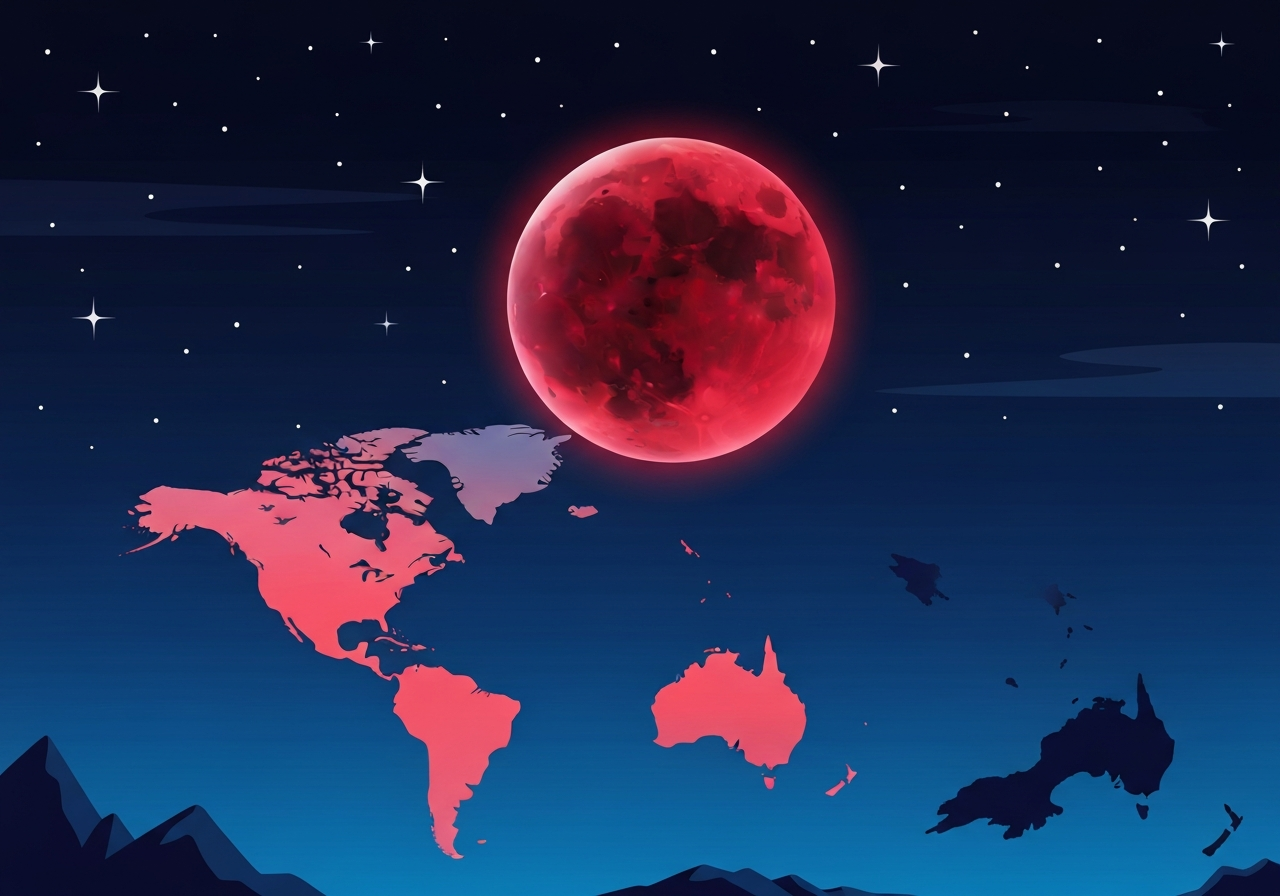
On Tuesday 3 March 2026 a rare total lunar eclipse — commonly called a ‘blood moon’ — will be visible from large parts of North America, Australia and New Zealand. During totality the full moon will pass into Earth’s shadow and take on a deep, copper-red hue, a change astrophysicists attribute to sunlight refracting through Earth’s atmosphere. Astronomers say this will be the last total lunar eclipse visible in these regions for nearly three years. Observers are advised to seek dark sites and allow their eyes to adapt for the best view.
Key Takeaways
- The total lunar eclipse occurs on 3 March 2026 and will be visible across North America, Australia and New Zealand at local times listed below.
- Leading Australian astrophysicists Dr Rebecca Allen (Swinburne University) and Dr Brad Tucker (Australian National University) describe the colour as a deep copper-red produced by sunlight refracted through Earth’s atmosphere.
- Australian viewing windows: Sydney/Canberra/Melbourne/Hobart about 22:04–23:02 AEDT; Brisbane 21:04–22:02 AEST; Adelaide 21:34–22:32 ACDT; Darwin 20:34–21:32 ACST; Perth 19:04–20:02 AWST.
- North American windows vary by longitude: New York/Washington DC roughly 03:44–06:30 EDT; San Francisco/Los Angeles roughly 00:44–06:23 PST; some observers near the visibility edge may see only partial phases.
- Jupiter will be prominent in the sky during the eclipse, providing an attractive pairing for skywatchers.
- The next total lunar eclipse visible from most of the world will fall on New Year’s Eve 2028; North America’s next total after 2026 is in June 2029.
Background
A lunar eclipse happens when Earth moves between the Sun and the Moon, casting a shadow over the lunar surface. If the Moon passes through Earth’s umbra, sunlight reaching it has been filtered and bent by Earth’s atmosphere, favouring longer red wavelengths and producing the characteristic ‘blood’ colour. Astronomers distinguish between penumbral, partial and total lunar eclipses depending on how deeply the Moon enters the shadow.
Total lunar eclipses are not annual events; global geometry and orbital cycles mean totality for a given region recurs every 18 months to three years. Local visibility depends on where on Earth the Moon is above the horizon during the eclipse, so eastern and western longitudes may see different portions or miss totality entirely. Historically, eclipses have carried cultural meaning across societies, and today they provide routine opportunities for public engagement with astronomy.
Main Event
The eclipse sequence begins with the Moon entering Earth’s penumbra and proceeds into the umbra where totality occurs. Observers in Australian capital cities should see the deepest shading late on Tuesday night local time; for New Zealand the deepest point arrives shortly after midnight, when the Moon is high in the sky. In parts of the Americas the eclipse arrives in the early hours of Tuesday 3 March, and for some western observers the Moon will set before the event ends.
Dr Rebecca Allen at Swinburne University notes that the reddening is a result of sunlight ‘skimming’ Earth’s atmosphere and being refracted onto the lunar surface. Dr Brad Tucker of the Australian National University emphasizes similar physics, comparing the effect to the colours of sunrise and sunset but projected onto the Moon. Skywatchers are advised to move away from artificial light, allow 10–15 minutes for dark adaptation, and consider binoculars or a modest telescope for enhanced detail.
Jupiter will be visible high in the sky during the eclipse window over much of Australia and New Zealand, creating a visually appealing conjunction though the planets will not be physically related to the lunar shadow event. Event timing is precise to the minute for central locations, but local topography and horizon obstructions can alter an observer’s practical view.
Analysis & Implications
Scientifically, lunar eclipses offer straightforward demonstrations of atmospheric optics: the exact hue and brightness of the eclipsed Moon are sensitive to aerosols, volcanic dust and large-scale atmospheric conditions. A heavily polluted or dust-laden stratosphere tends to produce a darker, more muted eclipse. That sensitivity has allowed researchers to use historical eclipse descriptions as proxies for past volcanic activity and atmospheric changes.
For public science engagement the eclipse is an accessible event requiring no special equipment and offering clear educational moments about orbital mechanics and light scattering. Planetariums and astronomy clubs frequently use such events to attract new audiences, and universities named in coverage are scheduling outreach activities. The presence of Jupiter alongside the eclipsed Moon gives educators an easy narrative to explain planetary motion and scale.
Economically the effect is modest but measurable for local tourism in areas marketing dark-sky experiences; clear skies can draw visitors to parks and reserves. Conversely, cloud and weather remain the primary constraints on turnout. From a risk perspective, there are no physical dangers to viewers; the event poses no hazard to health, satellites or infrastructure beyond routine observational planning.
Comparison & Data
| City | Start | End |
|---|---|---|
| Sydney / Canberra / Melbourne / Hobart | 22:04 | 23:02 |
| Brisbane | 21:04 | 22:02 |
| Adelaide | 21:34 | 22:32 |
| Darwin | 20:34 | 21:32 |
| Perth | 19:04 | 20:02 |
| New York / Washington DC | 03:44 | ~06:30 |
| San Francisco / Los Angeles | 00:44 | ~06:23 |
| Tokyo | 17:44 | 23:23 |
The table above presents representative local start and end times for the main visibility centres quoted by astronomers and timing services. Times are local to each city and are rounded to the nearest minute; observers should consult local astronomical societies or an authoritative eclipse calculator for site-specific timings. Visibility near the edge of the eclipse region can truncate coverage if the Moon sets for a given observer.
Reactions & Quotes
Leading scientists expressed both a practical viewing tip and a reflective comment on the spectacle. Public interest is expected to be high in regions with clear skies.
Any light that does pass shines through our atmosphere and transforms the lunar surface into a deep, coppery red. Find a dark spot and give your eyes time to adjust.
Dr Rebecca Allen, Swinburne University (academic)
Context: Dr Allen highlights the refractive mechanism and offers practical guidance for viewers about dark adaptation and site selection.
It is like a little bit of sunlight skimming Earth’s atmosphere; the same process that reddens sunrises and sunsets lights up the Moon.
Dr Brad Tucker, Australian National University (academic)
Context: Dr Tucker compares the optical effect to familiar sunrise colours, underscoring the continuity between atmospheric optics and lunar eclipses.
It will be visible everywhere in the country. As an astronomer, I am excited by anything that encourages people to look up and experience the night sky.
Prof Richard Easther, University of Auckland (academic)
Context: Prof Easther emphasizes nationwide visibility for New Zealand and the public-engagement value of the event.
Unconfirmed
- The precise shade and brightness of the eclipsed Moon at any given site depends on local and global atmospheric conditions and cannot be predicted exactly in advance.
- Some social-media claims about immediate physical effects tied to the eclipse are unverified and unsupported by scientific evidence.
Bottom Line
The 3 March 2026 total lunar eclipse offers a widely visible celestial spectacle for millions across North America, Australia and New Zealand. The event is an ideal, low-barrier opportunity for public engagement with astronomy; no special eye protection is needed and basic optics like binoculars will enhance the view.
Weather will determine turnout in many places, and viewers near the visibility limits should check local timing calculators to know whether totality will be fully visible from their location. For many observers this will be the last chance to see a total lunar eclipse locally for nearly three years, making it worth planning an outing to a dark, unobstructed site.
Sources
- The Guardian — news report and quotes (media)
- Time and Date — eclipse timing and visibility tables (reference)
- NASA / GSFC — lunar eclipse science and global context (official space agency)
- Swinburne University — institutional affiliation of Dr Rebecca Allen (academic)
- Australian National University — institutional affiliation of Dr Brad Tucker (academic)
- University of Auckland — institutional affiliation of Prof Richard Easther (academic)