
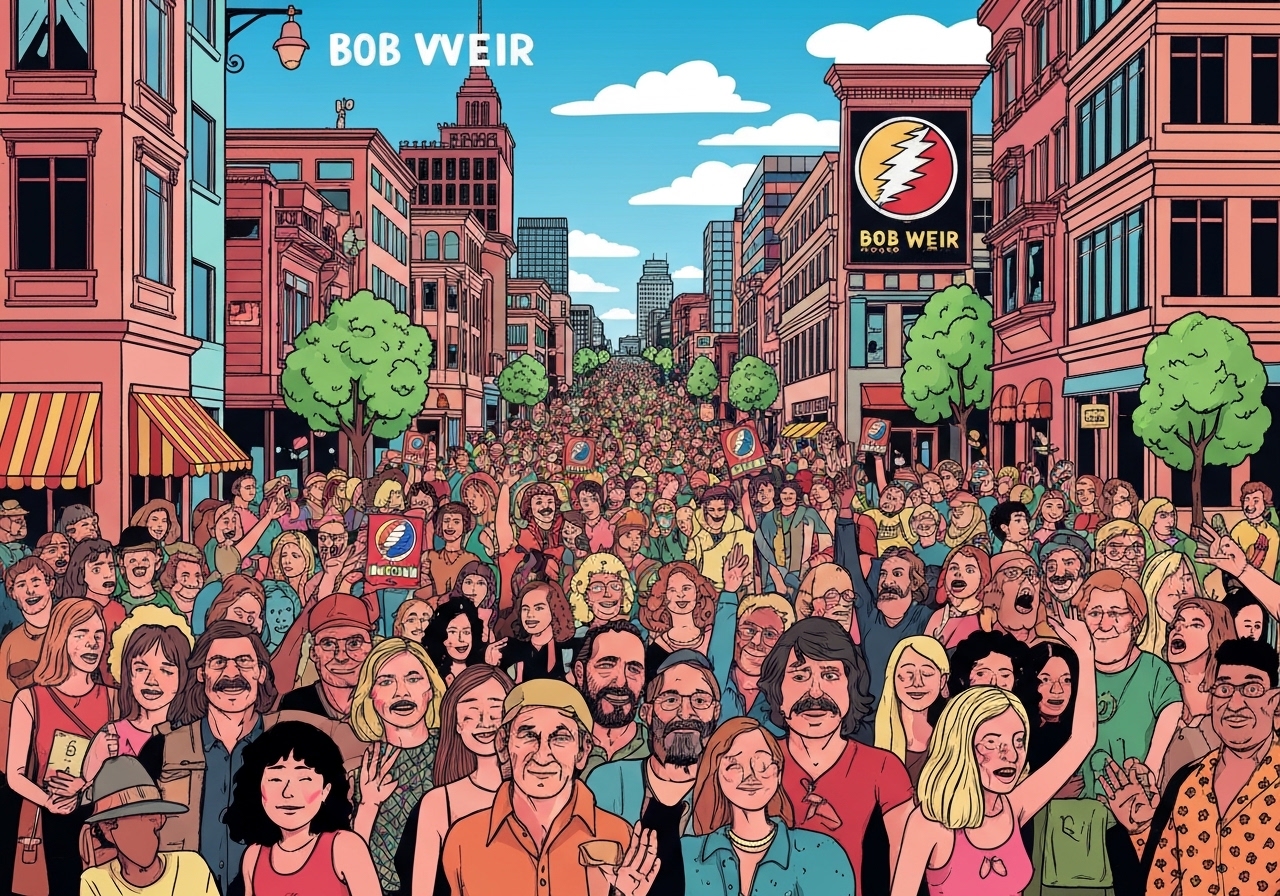
Lead: Thousands gathered Saturday at San Francisco’s Civic Center to honor Bob Weir, the Grateful Dead guitarist and founding member who died last week at age 78. A ceremony outside the Bill Graham Civic Auditorium opened with four Buddhist monks offering a Tibetan prayer, and musicians Joan Baez and John Mayer spoke from a makeshift stage. Fans carried long-stemmed red roses, left photos and candles at an altar and wrote notes pledging thanks and remembrance. The event drew multiple generations of Deadheads and underscored vows to sustain the band’s musical legacy.
Key Takeaways
- Thousands attended a public memorial Saturday at San Francisco’s Civic Center, gathered near the Bill Graham Civic Auditorium.
- Four Buddhist monks opened the service with a Tibetan prayer; Joan Baez and John Mayer spoke onstage to the crowd.
- Fans left red roses, photos, candles and handwritten notes; some asked that Weir be remembered alongside Jerry Garcia (died 1995) and Phil Lesh (died 2024).
- Weir joined the band—then called the Warlocks—in San Francisco in 1965 at age 17 and wrote or co-wrote classics including “Sugar Magnolia,” “One More Saturday Night” and “Mexicali Blues.”
- A statement on Weir’s Instagram announced his passing on Jan. 10, saying he had beaten cancer but died of underlying lung issues; he is survived by his wife and two daughters.
- Attendees ranged from longtime Deadheads with tie-dye and dreadlocks to young couples and a father bringing his 6-year-old to inherit the tradition.
- Several fans, including visitors who flew in from other states, described the gathering as both mourning and a celebration of a life tied to a decades-long musical community.
Background
Robert C. Weir, a Bay Area native, joined the group that would become the Grateful Dead in 1965 when he was 17. Over the following decades he emerged as a key songwriter and vocalist for the band, contributing enduring songs that became staples of the Dead’s repertoire. The Grateful Dead blended blues, jazz, country, folk and psychedelic rock in lengthy improvisational jams that fostered a dedicated following known as Deadheads. That community often traveled to hear the band live and preserved its music and culture across generations.
After the death of founding guitarist Jerry Garcia in 1995, former members continued performing in various formations; the tradition recently included Dead & Company, featuring John Mayer among others. Weir remained a visible figure in Bay Area music life and in the broader American live-music scene, with fans noting his role in sustaining the band’s spirit. His career spanned more than half a century and tied into local cultural identity in San Francisco and beyond.
Main Event
The public gathering began with a Tibetan prayer led by four Buddhist monks, setting a solemn tone before speakers took the stage in front of the Bill Graham Civic Auditorium. Joan Baez and John Mayer gave brief remarks reflecting on Weir’s musical influence and the communal nature of the Dead’s concerts. Attendees placed long-stemmed red roses at a makeshift altar filled with photographs and candles, and many left handwritten notes on colored paper expressing gratitude and farewell.
The crowd included a visible mix: older Deadheads using walkers and wearing tie-dye stood alongside young adults and families. A father who brought his 6-year-old son described the visit as passing on a love of live music and community. Ruthie Garcia, who has been a fan since 1989, said she was there to help celebrate Weir and to see him “go home,” emphasizing the ritual aspect for many attendees.
Some fans traveled long distances for the event. Darla Sagos said she caught an early flight from Seattle after noticing an unusual gap in Weir’s public schedule following a set of shows in San Francisco the previous summer. Family members attended publicly: his wife and two daughters were present, and daughter Monet Weir described his death as sudden and unexpected while saying he had long hoped the music would outlast him.
Analysis & Implications
Weir’s passing crystallizes a moment for the Grateful Dead’s extended community to reassess continuity and memory. The Dead’s decentralized, participatory culture—rooted in live improvisation rather than studio hits—means legacy stewardship rests with musicians, archivists and fans who keep recordings, set lists and stories alive. Public memorials that blend ritual and performance reinforce those transmission pathways and strengthen fan networks that have historically sustained the music’s circulation.
For the live-music economy and Bay Area cultural institutions, the gathering highlights the persistent draw of legacy artists. Events like this mobilize tourism, concert promoters and archival projects; they also shape how younger audiences discover and reinterpret the music. Promoters and surviving members face decisions about how to present the band’s repertoire respectfully while responding to market demand for tribute events, reissues and curated performances.
Politically and socially, the Dead’s history—emerging from 1960s San Francisco—signals how local culture can have national resonance. Weir’s role in that history reinforces the Bay Area’s identity as a locus of musical innovation, communal ritual and cross-generational exchange. Expect continued releases, tribute concerts and preservation efforts as stakeholders channel public interest into archival and live programming.
Comparison & Data
| Name | Role | Joined/Noted Year | Noted Death Year |
|---|---|---|---|
| Bob Weir | Guitarist, founding member | 1965 (joined at 17) | Instagram announcement: Jan. 10 |
| Jerry Garcia | Guitarist, founding member | 1965 | 1995 |
| Phil Lesh | Bass guitarist, founding member | 1965 | 2024 |
The table summarizes foundational dates and recent deaths among principal Grateful Dead members cited at the memorial. It underscores how the group’s original lineup and subsequent generations of collaborators have shaped a continuing canon, even as the founding cohort has diminished.
Reactions & Quotes
Longtime fans framed the gathering as both mourning and ritual farewell. Many described the altar-building, rose-laying and note-writing as personal acts of closure and celebration.
“I’m here to celebrate Bob Weir,”
Ruthie Garcia, longtime fan
Ruthie Garcia—no relation to Jerry Garcia—has followed the band since 1989 and said attending was a way to honor Weir’s life and to help him metaphorically ‘go home.’
“The show must go on,”
Monet Weir, daughter
Monet Weir told attendees that her father viewed American music as a unifying force and expressed hope that the music and its communities would endure beyond his life.
“We were hoping that everything was OK and that we were going to get more music from him,”
Darla Sagos, fan who traveled from Seattle
Sagos said the lack of new scheduled dates after summer shows in San Francisco raised concerns among fans; she and others framed their trip as both tribute and an affirmation that the music will continue through new listeners and family traditions.
Unconfirmed
- The precise medical details beyond the Instagram statement—specifically how prior cancer and the referenced lung issues combined to cause death—have not been independently confirmed by medical records released to the public.
- No official attendance figure was released at the event; descriptions of “thousands” are based on on-site reporting and participant accounts rather than a formal headcount.
- Plans for any future official tours, reunions or posthumous archival projects involving surviving members and collaborators have not been announced publicly beyond statements of intent from family and attendees.
Bottom Line
Saturday’s public memorial in San Francisco turned a private loss into a communal moment, reflecting the Grateful Dead’s unusual blend of artist, audience and cultural movement. The ceremony emphasized continuity: relic-like altar offerings, intergenerational attendance and public remarks signaled a commitment to keep the music and community alive. Fans, family and fellow musicians framed the event as both goodbye and an affirmation that the Dead’s repertoire and rituals will persist.
Looking ahead, expect a mixture of archived releases, tribute performances and community-led events to shape Weir’s posthumous presence. For the Bay Area and the wider network of Deadheads, the practical work of preservation—curating recordings, organizing concerts and documenting memories—will determine how the band’s legacy is experienced by future listeners.
Sources
- AP News — National news agency reporting the memorial and related statements