
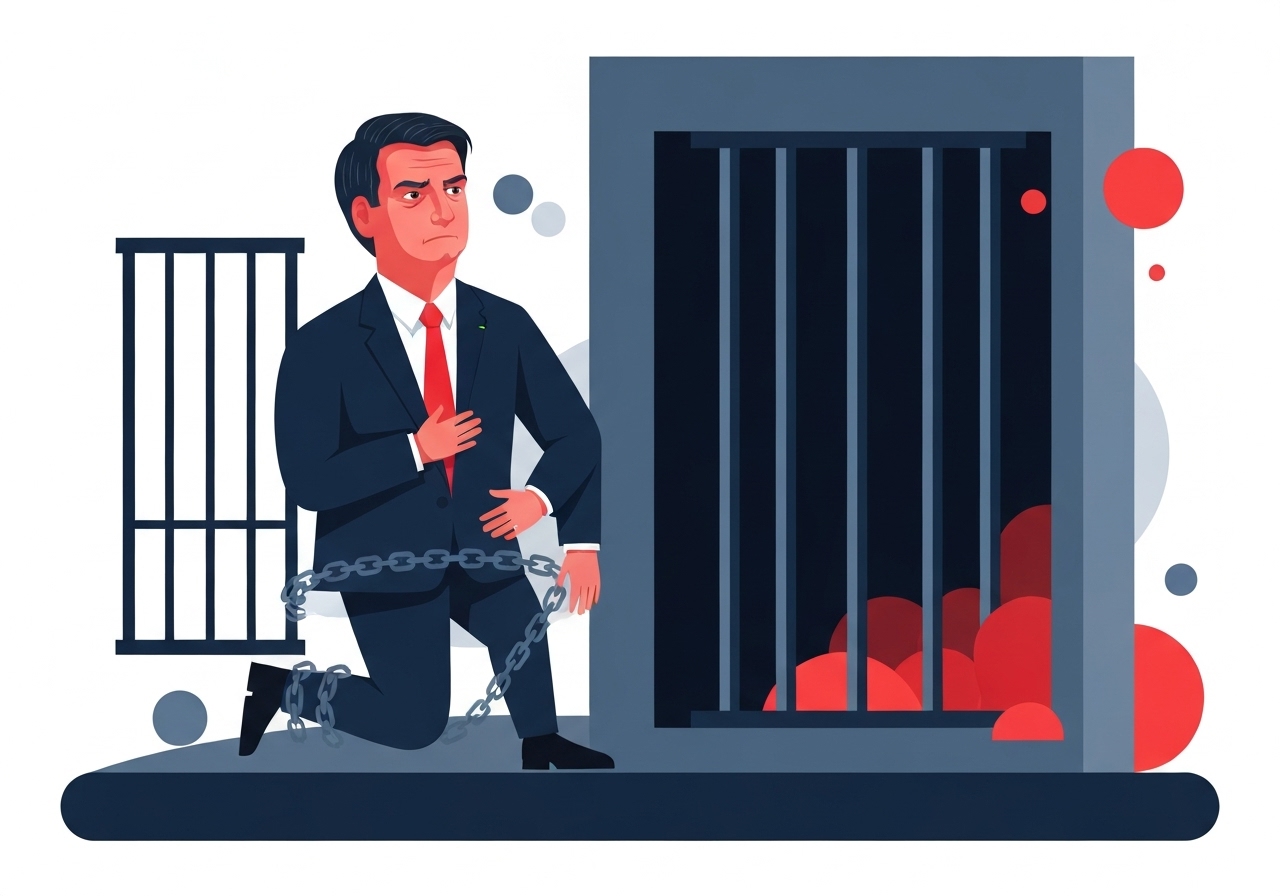
Brazil’s Supreme Court has ordered former president Jair Bolsonaro to begin serving a prison term of 27 years and three months after finding him guilty of leading a conspiracy to remain in power following his 2022 election defeat. Justice Alexandre de Moraes ruled on Tuesday that the case has reached final judgment and that no further appeals are possible. Bolsonaro, 70, will start his sentence in a federal police cell in Brasília, where he has been held since Saturday after being removed from home detention as a flight risk. The court also mandated full-time medical care for the former president amid reports of worsening health.
Key Takeaways
- Sentence ordered: Bolsonaro was ordered to begin a prison term of 27 years and three months for plotting to overturn the 2022 election result.
- Detention location: He will serve the sentence in a federal police jail cell in Brasília, where he has been detained since Saturday as a flight risk.
- Appeals closed: Justice Alexandre de Moraes declared the judgment final on Tuesday, saying no further appeals remain.
- Political consequences: Bolsonaro was barred from holding public office until 2060, which is reported to be eight years after the end of his sentence.
- Co-defendants: The ruling requires other convicted co-conspirators, including Gen Augusto Heleno and Gen Paulo Sérgio Nogueira de Oliveira, to start serving their sentences.
- Violence link: The court found Bolsonaro had incited supporters whose 8 January riots led to about 1,500 arrests after government buildings were stormed.
Background
The legal actions stem from Bolsonaro’s defeat in the 2022 presidential race by Luiz Inácio Lula da Silva and the turbulent transfer of power that followed. Lula was sworn in on , and a week later, on , thousands of Bolsonaro supporters attacked public buildings in Brasília, prompting a heavy security response and roughly 1,500 arrests. Supreme Court prosecutors and justices opened investigations into plots to obstruct the democratic transition, including alleged plans to involve military commanders and other officials.
Prosecutors and the court judged that the conspiracy had aimed to keep Bolsonaro in power despite the electoral loss, and that portions of the plan included proposed arrests and alleged assassination plots against political rivals. The court documented evidence and witness testimony over months, culminating in a conviction announced in September. The case has been framed by supporters and critics as a defining test of Brazil’s democratic institutions and civil-military relations.
Main Event
On Tuesday Justice Alexandre de Moraes concluded that the judicial procedures had reached finality and ordered Bolsonaro to begin serving the 27-year, three-month sentence. The court determined that the legal avenues for further ordinary appeals were exhausted, and directed that the former president be held in a federal police facility in the capital. Authorities had removed Bolsonaro from home detention on Saturday after judges deemed him a flight risk following an ankle-monitor incident recorded in court papers.
Court documents released in connection with detention proceedings say Bolsonaro admitted attempting to tamper with his ankle monitor with a soldering iron until he “came to his senses,” and he has said the damage resulted from medicine-induced paranoia. The court also specifically ordered that Bolsonaro receive continuous medical attention while incarcerated, citing reports from his medical team about deteriorating health.
In its September finding, the Supreme Court said Bolsonaro knew of plans that included plotting to arrest and execute the justice overseeing parts of the trial and that rioters had been incited to pressure a military intervention. The court found the conspiracy did not gain backing from army and air force commanders, and the planned intervention therefore failed to materialize. Several high-profile figures who served in Bolsonaro’s government have also been ordered to start sentences following their convictions.
Analysis & Implications
The immediate political impact is clear: with the sentence ordered to begin and a ban from public office until 2060, Bolsonaro’s ability to contest the 2026 presidential election is effectively blocked. That restriction is reported to last eight years beyond the end of his prison term, removing him from the competitive field for the foreseeable future and reshaping the opposition landscape. Allies may seek to rally around alternative leaders, but fragmentation and legal risks will complicate unified electoral strategy.
Institutionally, the ruling underscores the Brazilian judiciary’s willingness to hold a former head of state accountable for actions tied to democratic subversion. Internationally, the decision will be watched as a marker of how democracies manage accountability for leaders who contest election results and mobilize mass protests. The case may set legal and political precedents for future prosecutions of high-level officials across Latin America.
Security and civil-military relations are central long-term considerations. The court’s finding that the conspiracy failed for lack of military support highlights limits within the armed forces but also exposes fault lines that could be exploited by political actors. The government’s capacity to prevent further unrest will depend on credible law enforcement, transparent prosecutions, and efforts to defuse extremist mobilization among supporters.
Comparison & Data
| Event | Date or timing |
|---|---|
| Election loss and transfer of power | 2022 — Lula wins; sworn in on |
| Capitol-style riots in Brasília | — ~1,500 arrests |
| Supreme Court conviction announced | September (court ruling month) |
| Removed from home detention | Detained since Saturday (preceding Tuesday ruling) |
| Final judgment and imprisonment ordered | Tuesday (court order date) |
Putting the sentence in context: 27 years and three months is among the more severe penalties imposed on a political figure in modern Brazilian history, reflecting combined counts and the court’s assessment of harms to democratic order. The ban through 2060 further amplifies political consequences beyond pure incarceration.
Reactions & Quotes
Supporters and opponents reacted quickly after the ruling, with public statements framed along partisan and institutional lines. The following extracts capture the immediate rhetoric and documented admissions that shaped the court’s decision.
“This is a witch hunt designed to stop me running in 2026.”
Jair Bolsonaro
Bolsonaro used the remark to denounce the proceedings and portray the trial as politically motivated; the comment has been repeated by supporters as evidence of bias.
“I came to my senses.”
Court documents (Bolsonaro’s statement during a hearing)
The court filing records Bolsonaro saying he had attempted to tamper with his ankle monitor until he “came to his senses,” an admission that informed the decision to revoke home detention.
“No further appeals are possible.”
Justice Alexandre de Moraes
Justice Moraes framed the Tuesday order as enforcement of a final judgment, signaling the judiciary’s position that ordinary appellate options had been exhausted and custodial measures should begin.
Unconfirmed
- Whether Bolsonaro intended to flee after removing the ankle monitor remains contested; he denies intent to escape and attributes the damage to medication-induced paranoia.
- Some specific operational details about alleged assassination plots cited by the court have not been fully disclosed in public evidence summaries.
- The full extent and medical prognosis of Bolsonaro’s reported health decline are not independently verified beyond statements from his medical team and the court’s precautionary orders.
Bottom Line
The Supreme Court’s order to begin a 27-year, three-month sentence marks a decisive moment in Brazil’s post-2022 political crisis: a former president has been convicted for plotting to subvert an election and taken into custody. The ruling consolidates judicial accountability and removes a major polarizing figure from the electoral field for decades, reshaping the opposition ahead of 2026.
Key questions going forward include the government’s ability to maintain public order, how Bolsonaro’s allies will reorganize politically, and whether the case will prompt legislative or institutional reforms to strengthen democratic safeguards. Observers should watch for further legal motions, the health and treatment of the former president in custody, and any renewed efforts to mobilize supporters in the streets or at the ballot box.
Sources
- BBC News — news report (BBC)