
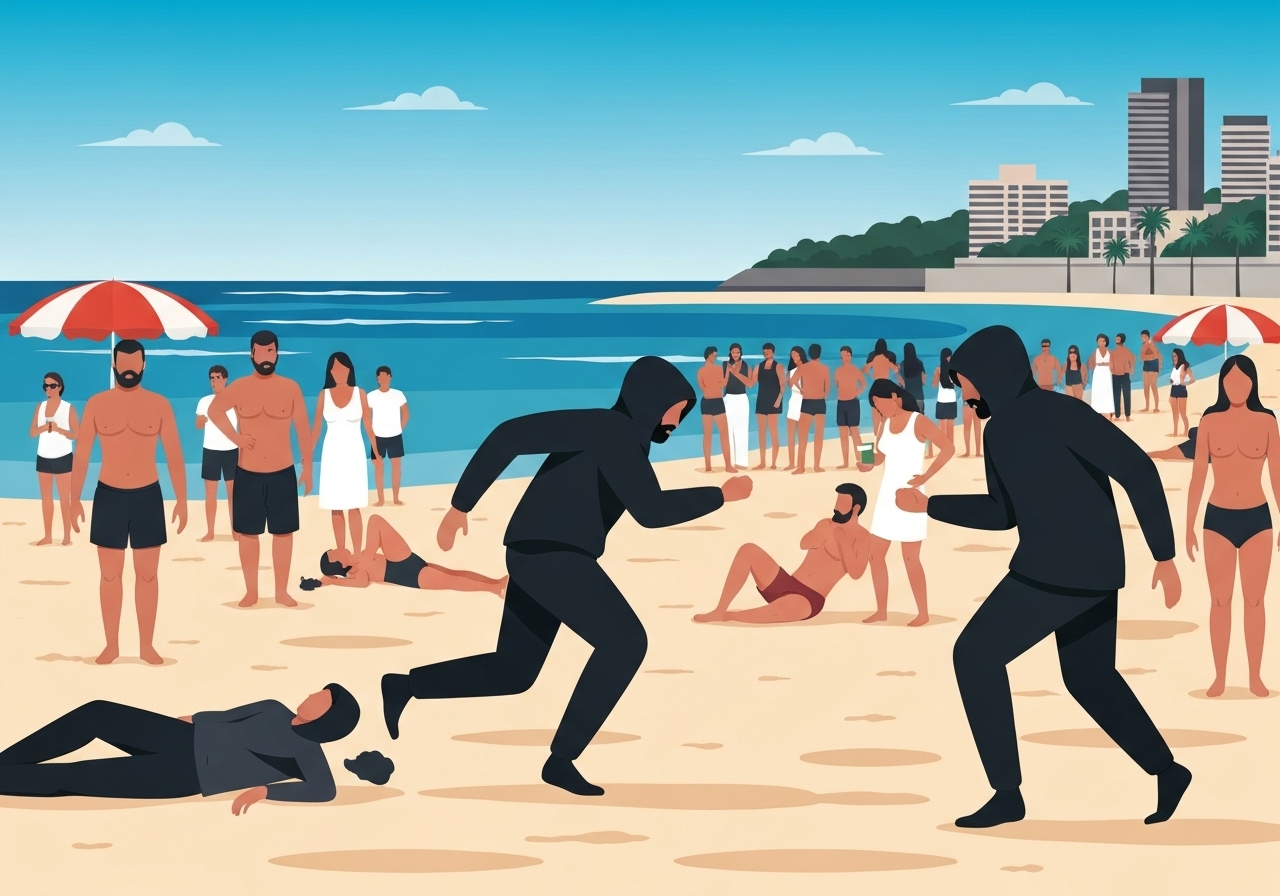
On Dec. 14, 2025, two gunmen opened fire at a Hanukkah gathering on Bondi Beach in Sydney, killing at least 11 people and wounding 29. New South Wales police described the incident as a terrorist attack targeted at the city’s Jewish community. Officers shot one suspect dead at the scene and arrested a second, who was taken to hospital in critical condition. Emergency teams recovered an improvised explosive device in a vehicle linked to one of the suspects and continue to examine suspicious items in the area.
Key takeaways
- At least 11 people were killed and 29 wounded in the shooting at a Chanukah by the Sea event at Bondi Beach on Dec. 14, 2025.
- New South Wales Police labeled the incident a terrorist attack, citing the target and the weapons used.
- Police shot one attacker dead at the scene; a second suspect was arrested and remained in critical condition.
- Two policemen were among the injured; victims were transported to multiple Sydney hospitals.
- An improvised explosive device was found in a suspect’s car and is under forensic examination by specialist officers.
- Eyewitnesses reported sustained gunfire for several minutes and footage showed a bystander apparently disarming an attacker.
Background
Sydney’s Bondi Beach is a major public venue and attracts large crowds for both local events and tourism. The gathering targeted on Sunday evening was a community celebration called Chanukah by the Sea, marking the start of the Jewish festival of Hanukkah. Australia has rarely experienced mass shootings since sweeping gun-law reforms that followed the 1996 Port Arthur massacre, which killed 35 people and led to strict national firearm controls.
The Jewish community in Sydney is one of the country’s largest, with a history of communal events across the city. Authorities and community leaders have warned in recent years about rising threats against minority groups globally, but large-scale attacks remain uncommon in Australia. Local emergency services and police have established protocols for major incidents, but the scale and public nature of this attack prompted an unusually large, multi-agency response.
Main event
Emergency services received reports of shots fired on Campbell Parade at about 6:45 p.m. Police and paramedics converged on Bondi Beach, where hundreds had gathered for the Hanukkah event. Witnesses described scenes of panic as people dropped possessions and fled. Some footage broadcast by local channels showed a bystander apparently tackling and disarming one of the shooters before pointing the weapon at him.
Police Commissioner Mal Lanyon said investigators treated the massacre as a terrorist act because the attack targeted a religious community and because of the weapons and devices located. Officers engaged with the attackers at the scene; one suspect was shot dead by police and a second was arrested and taken to hospital in critical condition. Specialist bomb technicians are examining suspicious items, including an improvised explosive device discovered in a vehicle linked to a suspect.
Hospitals in Sydney received multiple casualties; authorities described the death toll as fluid while more injured people continued to arrive for treatment. Two police officers were among the wounded, and emergency crews worked through the night to treat victims and secure the area. Local media filmed distressed and bloodied bystanders; community groups mobilized to offer shelter and support to those displaced by the incident.
Analysis & implications
The attack represents a sharp escalation in the use of targeted violence against a religious minority in Australia and is likely to reshape security discussions around public ethnic and religious gatherings. Because Australian mass shootings are rare, the incident may prompt renewed debate over weapons access, intelligence-gathering on domestic extremist threats, and protective measures for vulnerable communities. Authorities will face pressure to explain how the suspects acquired weapons despite existing firearm controls.
Politically, officials must balance rapid operational responses with careful, evidence-based public communication to avoid inflaming tensions or spreading unverified claims. Calling the incident a terrorist attack signals an intent to pursue counterterrorism resources and specialist investigators, which could lead to expanded surveillance or legal measures. That approach risks community concern about civil liberties if extended without transparent oversight.
Economically and socially, the immediate impact will be concentrated in Sydney’s Jewish community and in the Bondi precinct, where tourism and local businesses may see short-term disruption. Longer term, communal events nationwide may adopt heightened security protocols, increasing costs and altering the character of public celebrations. Internationally, the attack may trigger statements of solidarity from allied governments and closer cooperation on investigating cross-border extremist links, if any are found.
Comparison & data
| Incident | Year | Fatalities | Context |
|---|---|---|---|
| Bondi Beach shooting | 2025 | 11 | Hanukkah public event, Sydney |
| Port Arthur massacre | 1996 | 35 | Lone gunman, prompted national gun reforms |
| Family murder-suicides | 2014 & 2018 | 5; 7 | Domestic incidents with multiple fatalities |
| Queensland police killings | 2022 | 2 | Attack by extremist individuals in rural property |
The table places the Bondi attack in recent Australian context: while smaller in absolute scale than Port Arthur, the Bondi shooting is notable for its public, communal target and for occurring after decades of stricter firearm regulation. Analysts will examine whether gaps in enforcement, illegal firearm markets, or radicalization pathways contributed to the incident.
Reactions & quotes
Government and community leaders responded rapidly with statements of condemnation and sympathy. The New South Wales premier framed the attack in terms of targeted violence against a faith community and pledged support for victims and families.
“This attack was designed to target Sydney’s Jewish community.”
Chris Minns, Premier of New South Wales (official)
Police emphasized the operational details and investigative posture, describing the scene responses and the discovery of explosive material while noting casualty figures remained subject to change.
“We have treated this incident as a terrorist act and specialist teams are examining suspicious items in the vicinity.”
Mal Lanyon, Police Commissioner, New South Wales Police (official)
The prime minister offered national condolences and underscored the work of first responders, urging Australians to await verified information as the investigation proceeds.
“The scenes in Bondi are shocking and distressing; police and emergency responders are working to save lives.”
Anthony Albanese, Prime Minister of Australia (official)
Unconfirmed
- Any foreign or organized extremist group affiliation for the suspects has not been confirmed and remains under investigation.
- Complete identities, backgrounds and motives of the attackers beyond targeting the Jewish community have not been publicly verified.
- Reports of additional devices or accomplices beyond the items and suspects already disclosed are still being checked by authorities.
Bottom line
The Bondi Beach shooting on Dec. 14, 2025, is a rare and grave act of violence in Australia that targeted a religious community during a public festival, leaving at least 11 dead and dozens wounded. Authorities have labeled the incident a terrorist attack, one suspect was killed by police and another taken into custody; an IED was found and remains under forensic examination. Investigators face urgent tasks: establishing motive, identifying any networks involved, and determining how weapons were obtained in a country with strict gun laws.
For the Jewish community and for wider Australian society, the attack will likely prompt new security measures at communal events and renewed public discussion about preventing radicalization and illegal arms trafficking. Officials have called for calm and patience as evidence is collected; the coming days and weeks will be crucial for answers, policy responses and community healing.
Sources
- NPR (media)
- The Associated Press (media)
- New South Wales Police (official law enforcement)
- Office of the Prime Minister of Australia (official)