
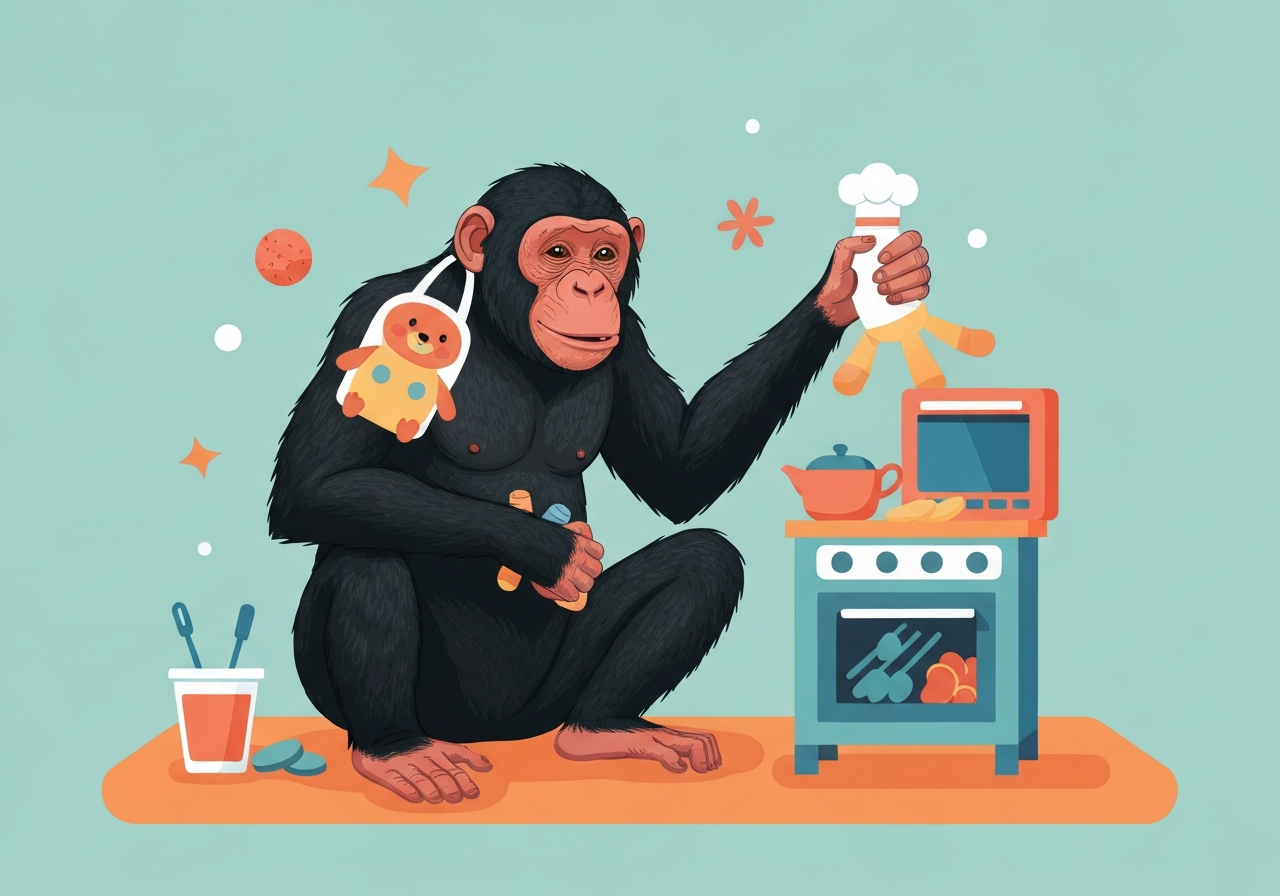
Researchers report experimental evidence that a bonobo named Kanzi demonstrated pretend play behaviors previously considered distinctively human. In controlled tests at Johns Hopkins researchers used juice, grapes and empty containers in 2024 when Kanzi was 43, a year before his death. Across multiple tasks he repeatedly identified locations of imaginary items above chance, and in separate trials distinguished real from pretend foods. The authors conclude these results indicate the capacity to represent pretend objects may not be unique to humans.
Key takeaways
- Kanzi, a language-trained bonobo, took part in controlled experiments run by Amalia Bastos and Christopher Krupenye at Johns Hopkins in 2024.
- In an 18-trial object-choice task with two squirt bottles (one with juice), Kanzi chose the bottle containing juice in all 18 trials (100%).
- When an experimenter pretended to pour imaginary juice into two clear cups and then emptied one, Kanzi selected the cup with the remaining imaginary juice 68% of the time—above chance.
- In 18 trials pitting a real cup of juice against a cup containing only imaginary juice, Kanzi chose the real cup 14 out of 18 times, showing he differentiates real from pretend.
- In a grape-based task he identified the jar with a fictitious grape 68.9% of the time and responded faster than in the initial juice task.
- The study was published in Science and is framed by prior anecdotal reports of simulated play in apes, though this is the first controlled experimental demonstration of represented pretend objects in a great ape subject.
Background
Pretend play—using objects or actions to represent something that is not immediately present—is a common developmental behavior in human children and linked to imagination and social learning. Researchers have long noted anecdotal instances of apes behaving as if treating objects as stand-ins: captive chimpanzees have been seen dragging invisible blocks, and wild chimpanzees in Uganda were observed carrying sticks like infants.
Those observations, however, left open alternative explanations: apes might be mimicking human behavior, misperceiving photographs as real objects, or repeating actions because the physical activity itself is rewarding. To move beyond anecdotes, Bastos and Krupenye designed controlled choice tasks with clear, countable outcomes and verbal prompts that a language-trained bonobo could reliably understand.
Main event
The study’s core experiments were run in 2024 with Kanzi, a bonobo familiar with spoken prompts and a lexigram board of more than 300 symbols. First, experimenters presented two squirt bottles—one filled with juice and one empty—over 18 trials; Kanzi chose the juice bottle every time, confirming his comprehension of the basic object-choice setup.
Next, researchers poured imaginary juice from an empty pitcher into two transparent cups, then pretended to remove the liquid from one cup. When asked, “Where’s the juice?” Kanzi indicated the cup that still contained the pretended juice on 68% of trials, a rate higher than expected by random guessing and interpreted as tracking an unseen, represented substance.
To test whether Kanzi treated the empty-but-pretend cup as actually containing juice, the team ran 18 trials offering a real cup of juice versus a cup with only imaginary juice. Kanzi selected the real juice in 14 of 18 trials, indicating he could distinguish real from pretended items rather than simply preferring the acted motion.
Finally, the researchers repeated a similar procedure using a grape as the target item. Kanzi identified the jar containing the fictitious grape 68.9% of the time, and his response times were faster in that task than in the initial juice scenario. The authors interpret the pattern as evidence that Kanzi represented absent objects in play-like contexts while retaining an understanding of reality versus make-believe.
Analysis & implications
If replicated, these results would narrow the cognitive gap between humans and our closest relatives by showing a representational basis for pretend play in at least one bonobo. Pretend play in children is tied to symbolic thinking, episodic simulation and social cognition; evidence that apes can represent absent objects suggests some precursor cognitive architectures may be shared across hominids.
However, the study’s single-subject design limits how far we can generalize. Kanzi’s decades of exposure to human caretakers and language-training could have shaped his performance in ways that wild or untrained apes would not exhibit. The authors and outside commentators stress the need for further testing across individuals and species to determine prevalence and developmental pathways.
Methodologically, the experiments balance demonstration and verification: the real-vs-imaginary control (14 of 18) is key to ruling out simple perceptual or reward-driven explanations. Still, alternative accounts—such as Kanzi’s unusually extensive cognitive training or subtle unintentional cues from experimenters—remain plausible and must be systematically excluded in follow-up work.
Comparison & data
| Task | Trials | Correct | Success rate |
|---|---|---|---|
| Bottle-choice (real juice vs empty) | 18 | 18 | 100% |
| Imaginary-juice cup (where’s the juice?) | — | — | 68% |
| Real vs imaginary juice cup | 18 | 14 | 77.8% |
| Imaginary grape jar | — | — | 68.9% |
The table summarizes reported outcomes. Where trial counts were specified by the researchers we list them; for some tasks the public summary gave percentages without a trial total. The pattern shows consistent above-chance selection of represented items and intact discrimination between real and pretend rewards.
Reactions & quotes
This finding adds experimental weight to anecdotal reports and pushes us to rethink ape cognition.
Nicholas E. Newton-Fisher, University of Kent (Evolutionary Anthropologist)
Kanzi’s lifetime of cross-species communication made him an especially suitable subject for tests of imagined objects.
Amalia Bastos, lead author (University of St. Andrews, quoted on study)
Unconfirmed
- Whether Kanzi’s performance generalizes to other bonobos or ape species is not yet established and requires replication with additional subjects.
- The role of Kanzi’s extensive human exposure and language training in producing these results remains uncertain; it may have enhanced his ability to follow prompts or adopt human-like representational strategies.
- Subtle, unconscious cues from experimenters (cueing) cannot be fully ruled out without further double-blind protocols.
Bottom line
The experiments with Kanzi present the strongest controlled evidence to date that a great ape can represent pretend objects and act on that representation in ways that are not reducible to simple perception or reward-seeking. This narrows a putative cognitive gap between humans and other apes on at least one dimension—symbolic representation in a play-like context.
Yet important caveats remain. The sample is a single, highly unusual individual with decades of cross-cultural training; robust conclusions about species-wide capacities will depend on replication across more subjects, blinded methods, and studies of development and ecological context. For now, the work invites a cautious reassessment of imagination’s evolutionary roots.
Sources
- CNN coverage of the study — (news)
- Science journal — (peer-reviewed journal)
- Johns Hopkins University — (research institution)