
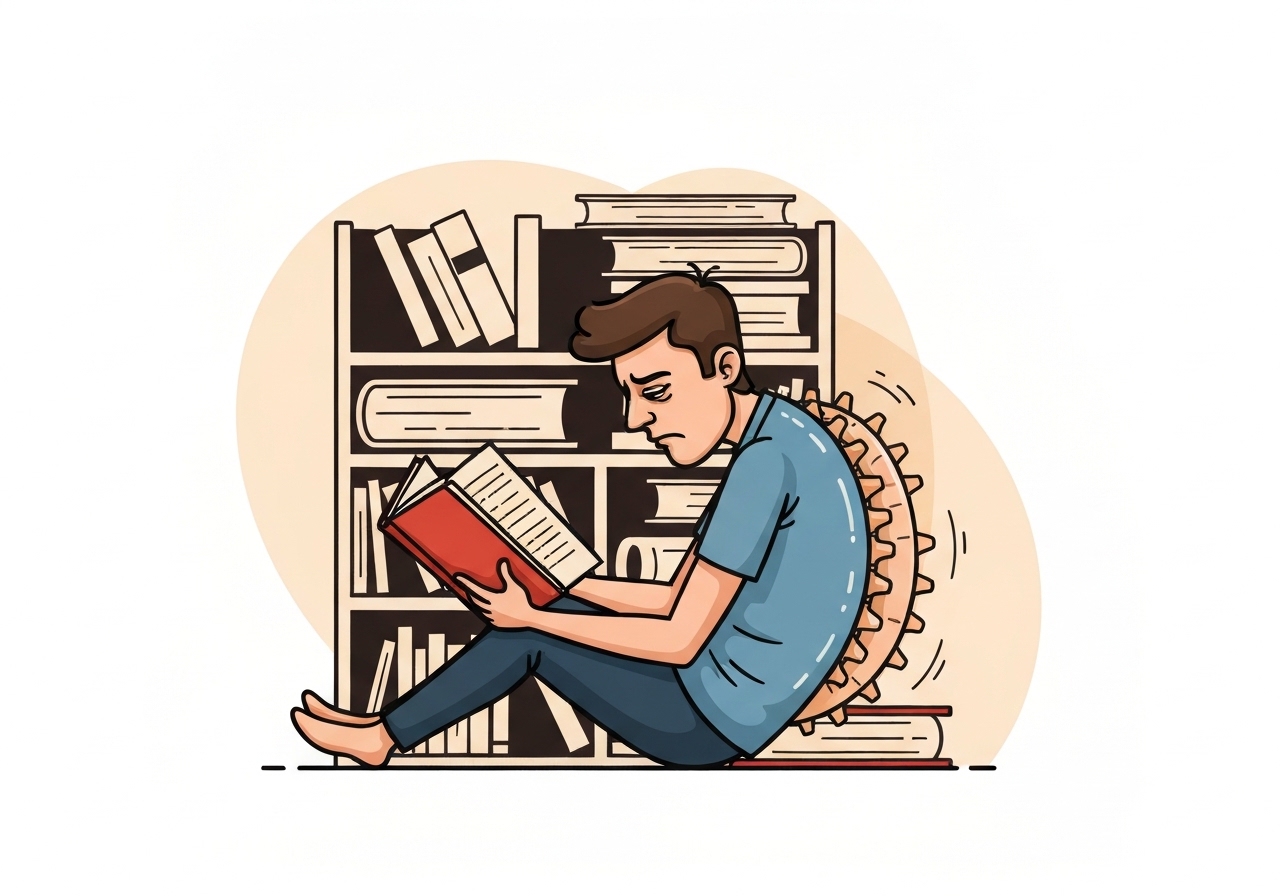
Lead: On Jan. 17, 2026, writer Luke Winkie described a common, overlooked problem: routine book reading often produces real, recurring physical discomfort at home and on the go. Across bedrooms, couches and commuter seats, readers report aching necks, sore arms and general fatigue that interrupt their reading goals for the year. Medical specialists say the body’s sensors and the static postures readers adopt explain much of the pain, while a growing gadget market promises ergonomic fixes. The result: some readers adopt mounts and remotes, others accept pain as part of the ritual.
Key Takeaways
- Author Luke Winkie published the piece on Jan. 17, 2026, describing persistent pain while reading in ordinary domestic settings.
- Cleveland Clinic physical therapist Ryan Steiner explains mechanoreceptors drive discomfort; even small forces held in front of the face can become intolerable over time.
- A 3-pound object may be manageable at one’s side for hours but becomes tiring within minutes when held in front of the face, illustrating posture-dependent load.
- Readers reported makeshift solutions: Slate associate editor Bryan Lowder stacked three pillows to prop a hardcover, and designer Laura Grasso adopts a diagonal couch pose to balance the book.
- Some users adopt technology: CNN’s Chelsea Stone uses a modular silicone mount and Bluetooth remote to keep an e-reader suspended in front of her eyes while lying down.
- Experts recommend frequent position changes and short breaks rather than remaining static for prolonged reading sessions.
- Despite ergonomic fixes, many readers retain a preference for the tactile, ritualistic aspects of paper books that can make discomfort socially or personally meaningful.
Background
Reading in some form has been a human practice for centuries, with The Tale of Genji from the late 11th century often cited as the first novel. Over generations, people have adapted spaces and furniture to fit reading habits, but a truly ergonomic posture for long-form reading has not become universal. Modern life layers new variables—screens, e-readers and busier schedules—that change when and how people read, but the basic difficulty of finding a comfortable, sustained posture persists.
Culturally, endurance of discomfort while reading is sometimes valorized: some readers see slight physical strain as a sign of serious engagement. At the same time, the growth of consumer accessories—bookstands, tablet mounts, neck cradles and Bluetooth page-flippers—reflects a market response to a simple mechanical problem. Medical professionals increasingly field questions about neck and upper-back strain related to reading posture, particularly from regular commuters and people who spend lengthy leisure hours with books or tablets.
Main Event
Winkie recounts attempting classic reading positions—lying on his back holding a book aloft, sitting with the book on his lap, lying on a stomach propped by elbows—only to find each posture produces a different kind of fatigue. He polled friends and colleagues and gathered anecdotes: Bryan Lowder stacked three pillows to prop a hefty hardcover; Laura Grasso devised a diagonal couch orientation to keep a book in her eyeline; Tony Ho Tran says a modest amount of discomfort helps him concentrate on text while commuting.
Ryan Steiner, a physical therapist at the Cleveland Clinic, described the physiology behind these complaints. Mechanoreceptors—tiny sensors in muscle and soft tissue—inform the brain about static tension and unusual angles. When readers hold a book in front of their face or maintain an odd neck angle for long stretches, those receptors trigger adjustments and ultimately signal discomfort, prompting people to shift position or stop reading.
Technology provides a counterpoint. Chelsea Stone of CNN tested a modular silicone mount that suspends an e-reader above a mattress using an articulating arm; a Bluetooth remote let her turn pages without touching the device. Stone said the mount eliminated the sudden wake-up of a book smacking her forehead and allowed her to fall asleep mid-chapter without physical disturbance. Yet she, like others, still values holding a physical book for its ritual qualities.
Analysis & Implications
Physically, reading is a static activity that asks the human body—designed for movement—to remain in positions that concentrate strain on the neck, shoulders and forearms. Even light loads create significant moment forces when held away from the body, which is why a three-pound item feels far heavier when balanced at arm’s length or in front of the eyes. That has implications for how long readers can comfortably engage with long-form fiction and nonfiction without scheduled movement breaks.
Economically, there is a clear market opportunity for ergonomic reading accessories: stands, mounts, adjustable lighting rigs and remote page-turners address real pain points and can be marketed to heavy readers, students and commuters. Publishers and device makers might highlight ergonomics as a selling point, and public-health messaging could incorporate simple posture guidance for leisure reading similar to guidance for screen use at work.
Clinically, the problem rarely requires invasive treatment, but chronic poor posture can aggravate preexisting neck and shoulder conditions. Health professionals may increasingly advise readers to rotate positions, strengthen postural muscles and use lightweight supports. Employers and libraries could adopt seating designed to support reading postures rather than only upright office ergonomics.
Comparison & Data
| Common Reading Position | Typical Discomfort | Minutes Tolerated | Simple Fix |
|---|---|---|---|
| Back, book held overhead | Arm fatigue, shoulder ache | 10–30 | Use a pillow prop or stand |
| Sitting, book in lap | Neck flexion strain | 20–60 | Raise book closer to eye level |
| Lying on side | Hip/neck pressure | 15–45 | Place pillow under hip and neck |
| Commute, upright seat | Forward head/upper back | 5–30 | Short breaks, neck mobility |
The table summarizes typical complaints and pragmatic fixes gathered from interviews and expert comment. It is not exhaustive but gives readers a quick map of where pain tends to emerge and which low-cost interventions can extend comfortable reading time.
Reactions & Quotes
Several readers and specialists offered pithy observations that reveal how personal and practical this issue is.
“I had to stack three pillows against my headboard and one on my abdomen to read the Earthsea collection without pain.”
Bryan Lowder (Slate associate editor)
Lowder’s workaround illustrates the improvisation many readers use when standard furniture fails to support a book.
“After a while, mechanoreceptors tell your brain that something doesn’t feel natural and you need to move.”
Ryan Steiner (physical therapist, Cleveland Clinic)
Steiner’s compressed summary points to the physiological mechanism that explains why modest, sustained awkwardness becomes intolerable.
“The mount gives me freedom to read in any position I want at the moment.”
Chelsea Stone (CNN)
Stone’s experience with a suspended e-reader highlights how technology can remove specific mechanical triggers for discomfort, though it may not satisfy readers who prize the tactile pleasures of a paper book.
Unconfirmed
- Whether long-term, low-level reading postures often lead to permanent structural damage is not conclusively established for otherwise healthy adults.
- Claims that a single accessory will eliminate all reading-related discomfort for every reader lack robust comparative evidence.
- The idea that readers who accept discomfort are demonstrably more concentrated or virtuous is subjective and unsupported by hard data.
Bottom Line
Reading is an activity that asks the human body to stay still in ways evolution did not prepare it for; mechanoreceptors will eventually prompt discomfort. Practical steps—move every 20–30 minutes, use lightweight supports, raise reading material to eye level, and consider a mount for e-readers—reduce the likelihood that a beloved book becomes a literal source of pain.
At the same time, many readers value the ritual of holding a physical book and the incidental pleasures that come with searching out an ideal nook. For most people the solution will be hybrid: preserve the tactile experience when it matters, and use ergonomic tools or position changes when it does not. As demand for comfortable reading grows, expect more design-minded accessories and clearer guidance from health professionals and device makers.
Sources
- Slate (media) — original feature by Luke Winkie, Jan. 17, 2026.
- Cleveland Clinic (medical institution) — professional background on physical therapy and posture concepts referenced in expert comments.
- CNN (media) — reference to device testing and reporting on consumer e-reader mounts.