
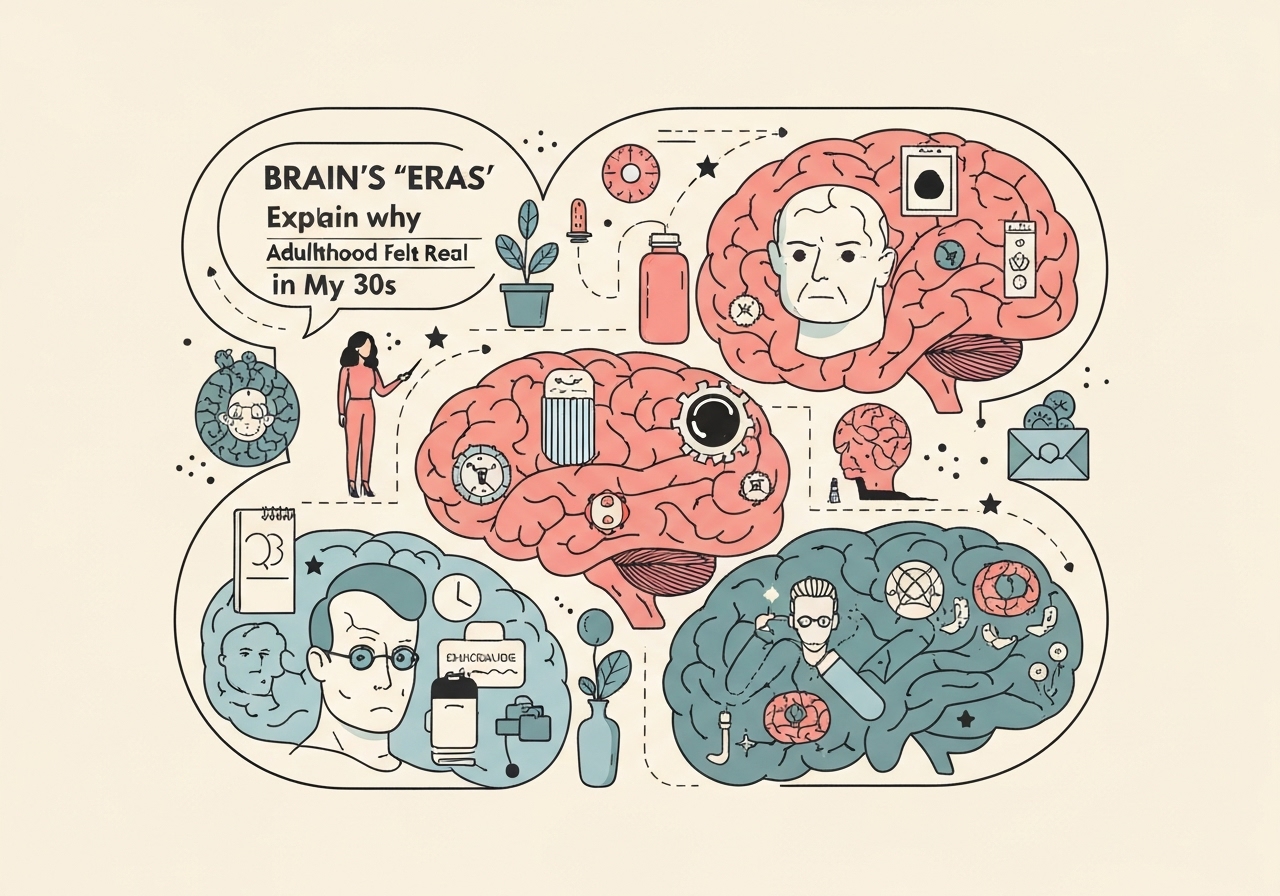
New brain-imaging research using scans from nearly 4,000 people identifies five distinct neural “eras”, with transition points at ages 9, 32, 66 and 83, and suggests the brain settles into an “adult mode” in the early thirties. The study mapped changing patterns of connectivity rather than focusing on single regions, and its authors report a stabilization of architecture and a plateau in measures of intelligence and personality around age 32. That finding helps explain why many people, including this writer, report feeling properly grown-up only after their twenties. This piece combines the study’s key results with social context, personal observation and implications for policy and culture.
Key Takeaways
- The study analysed brain scans from nearly 4,000 participants to chart evolving neural connections and identified five broad developmental epochs with breakpoints at ages 9, 32, 66 and 83.
- Researchers report that measures tied to cognitive stability and personality show a plateau around age 32, implying a neurological settling into adult patterns in the early thirties.
- Traditional legal milestones in Britain occur at 16 and 18, with a symbolic further marker at 21; none of these ages align precisely with the neurological breakpoint identified at 32.
- Neuroscience prior to this research has emphasised the prefrontal cortex reaching maturity near 25, but the new mapping highlights wider network reorganisations that continue into the early thirties.
- The authors caution against simplistic readings: the findings describe patterns of change rather than asserting that people in their late twenties behave like teenagers.
- The research sample size is nearly 4,000 scans, but generalisability across different populations and cultural contexts remains to be fully tested.
Background
Societies mark the transition from childhood to adulthood with legal and cultural milestones that vary by country. In Britain, for example, age 16 brings permissions such as full-time work and sexual consent, while 18 grants electoral rights, independent housing and alcohol purchase, and 21 has been treated in some places as a final social marker. These thresholds are administrative and social, not direct reflections of brain development.
Neuroscientific work over recent decades has repeatedly shown that the prefrontal cortex, which supports impulse control, planning and complex decision-making, does not reach full maturity until the mid-20s for many people. The new study shifts perspective from single regions to whole-brain network architecture, tracking how connectivity patterns reorganise across the lifespan. Lead researcher Alexa Mousley and colleagues framed their results as epochal transitions rather than discrete flips from immaturity to maturity.
Main Event
The research team processed nearly 4,000 brain scans, using methods that map how different regions communicate as people age. Rather than searching for one moment when the brain becomes “adult”, they identified phases in which the global pattern of connections moves through distinct configurations. Those configurations cluster into five epochs, with relatively abrupt changes near ages 9, 32, 66 and 83, according to the authors.
The most socially consequential breakpoint, age 32, corresponds to a period when many network measures stabilise and when population-level indicators of intelligence and personality show a plateau. The authors emphasise that these are average trends across the sample and that individual paths vary substantially. They explicitly caution that late-twenties behaviour should not be equated with adolescence; instead, the data indicate shifting rates of change in connectivity patterns.
The study complements existing findings about the prefrontal cortex maturing around the mid-20s by showing that broader network-level maturation and consolidation can continue into the early thirties. Methodologically, the project relied on longitudinal and cross-sectional imaging data combined to characterise typical trajectories, although the precise weighting of those sources and demographic composition of the nearly 4,000 participants affect interpretation.
Analysis & Implications
If the brain’s network architecture stabilises around 32, as the paper reports, there are implications for how societies think about legal ages, workplace expectations and educational design. Laws set at 16, 18 and 21 reflect political and cultural choices rather than neural milestones; policymakers should be cautious about conflating administrative ages with cognitive readiness. That said, legal thresholds serve practical needs, so neuroscience should inform but not dictate policy.
For millennials and younger generations, the finding helps explain widely observed patterns of later household formation, delayed marriage and extended education. Economic and structural factors certainly contribute to those trends, but a neurodevelopmental pattern in which the brain consolidates in the early thirties provides an additional, nonjudgmental frame for understanding why many people report feeling settled only after their twenties.
Clinically and in workforce development, recognising that higher-order decision-making networks continue to reorganise into the thirties suggests benefits from flexible career pathways, ongoing training and mental-health supports that acknowledge ongoing maturation. Conversely, the identification of later-life breakpoints at 66 and 83 flags periods when neural reorganisation could interact with cognitive aging, with implications for elder care and preventive interventions.
Comparison & Data
| Age | Common Legal/Social Marker | Neural Breakpoint Reported |
|---|---|---|
| 16 | School leaving, employment, consent (UK) | No major network breakpoint reported |
| 18 | Voting, alcohol in some contexts, legal adulthood (UK) | No major network breakpoint reported |
| 25 | Common neuroscience milestone for prefrontal maturation | Continued network change; not the final plateau |
| 32 | Typical social settling and career consolidation for many | Major network stabilisation and intelligence/personality plateau |
| 66, 83 | Later-life transitions in health, retirement in many countries | Additional network reconfigurations identified |
The table summarises how everyday legal and cultural milestones align imperfectly with the study’s neural breakpoints. The early-thirties plateau the authors report is distinct from the mid-20s prefrontal maturation widely discussed in prior literature, indicating multi-level developmental timelines.
Reactions & Quotes
“We’re not saying people in their late twenties will behave like teenagers; we’re describing a pattern of change in network organisation,”
Alexa Mousley, lead researcher (research team)
The research team emphasised pattern and nuance rather than deterministic labels; their comment seeks to prevent misreading the data as a binary arrest of maturity. That caveat is important in public discussions where simple age cut-offs are often weaponised.
“I only began to feel I had my life in hand after my early thirties, when career direction, housing choices and relationships looked markedly different,”
Writer’s personal reflection
Personal accounts like this one resonate with the study’s suggestion that many people describe a subjective turning point in their early thirties. Public responses on social platforms have mixed tones, with some readers relieved by a scientific explanation and others pointing to economic barriers as the main cause of delayed milestones.
Unconfirmed
- Whether the five epochs and specific ages generalise across different ethnic, socioeconomic or geographic populations remains to be verified.
- Causal claims linking the neural breakpoints directly to real-world behaviours such as home-buying or relationship stability are not established by this observational study.
- The effect of cohort differences, such as changes in education, nutrition or technology exposure, on the reported epoch boundaries has not been fully ruled out.
Bottom Line
The study adds an important layer to our understanding of human development by mapping whole-brain network trajectories and identifying a notable consolidation around age 32. This does not invalidate legal or cultural age thresholds but challenges simplistic cues about when adulthood begins and suggests that subjective readiness often emerges later than social milestones imply.
For individuals and institutions, the practical takeaway is to treat early adulthood and the twenties as formative and flexible rather than a hard test of maturity. Policies and social expectations that allow space for continued development into the early thirties are more consistent with the neural patterns described by the research.
Sources
- The Independent — news report covering the study and researcher comments (news)
- National Institute of Mental Health — overview of brain development across adolescence and early adulthood (government health agency)