
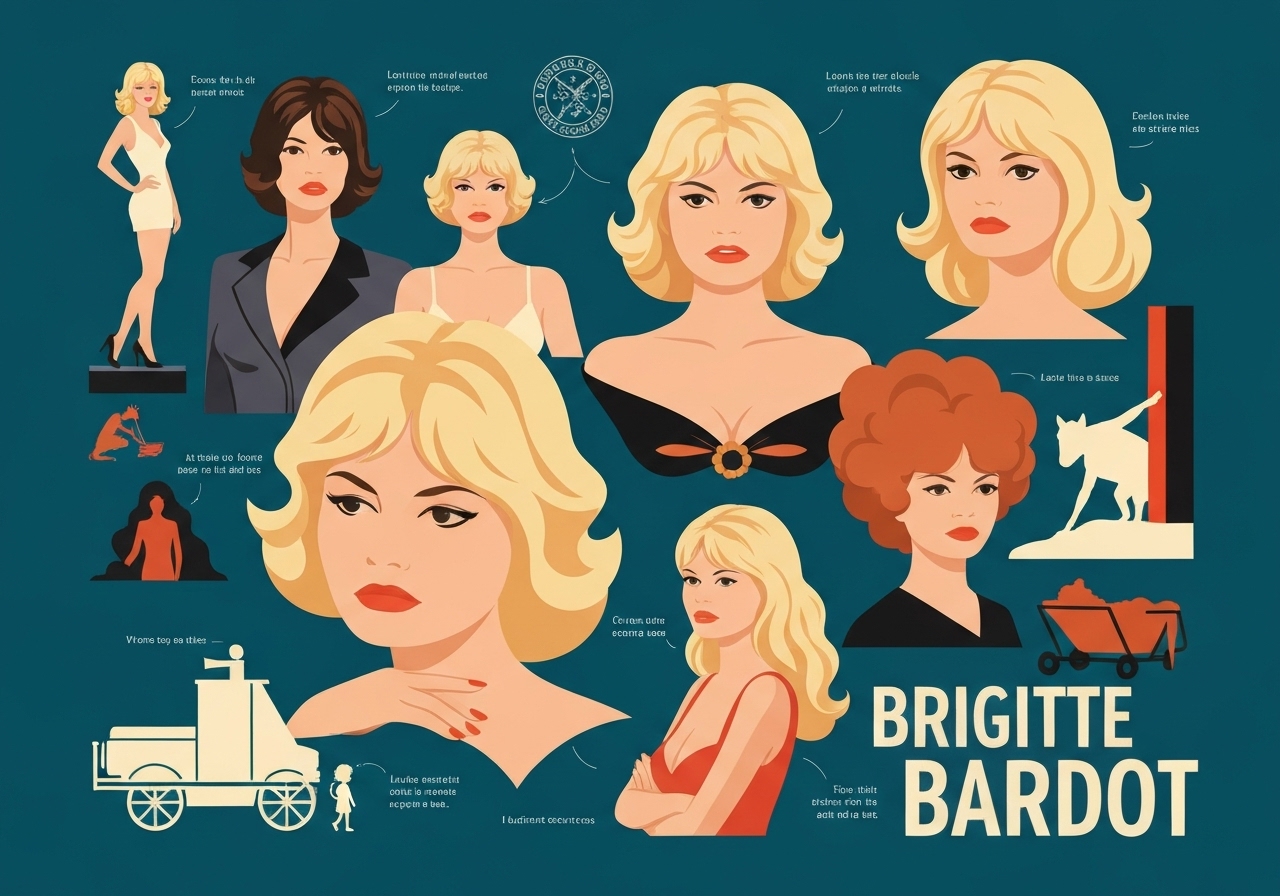
Lead: Brigitte Bardot, the French actress turned animal-rights campaigner whose death was announced on Dec. 28, 2025, became as well known for single frames as she was for motion pictures. Photographs taken across three decades helped shape and fix her public persona, even as she later redirected public attention toward environmental and animal-welfare causes. This gallery and review trace key images and moments—from Cannes and Paris to Mexico and New York—that illustrate how still photography both celebrated and constrained her public life.
Key Takeaways
- Bardot’s death was publicly reported on Dec. 28, 2025; the images assembled here date mainly from 1956 through 1995, charting her career and activism.
- Photographs captured Bardot at major film and public events: Cannes (1956), the set of Babette Goes to War (1959), Roland Garros (1961), and Viva Maria in Mexico (1965).
- Personal milestones visible in the archive include her marriages and family life: marriage to Jacques Charrier in 1959 and the birth of her son Nicolas; their divorce in 1963; honeymoon with Gunter Sachs in 1966 and divorce in 1969.
- Airport and publicity images document international stardom—arrivals at Orly and JFK in 1965 are among the most circulated photographs.
- From 1976 onward Bardot’s public role shifted toward advocacy with the founding of the Brigitte Bardot Foundation and visible activism on issues such as seal hunting by 1978.
- The photographic record spans studio portraits, candid press shots, on-set coverage and protest imagery, reflecting different media practices and photographers’ agendas.
Background
Brigitte Bardot emerged as a central figure of postwar French cinema and international celebrity culture in the 1950s and 1960s. During this era, photographers and news agencies expanded their reach, and press images became the primary means by which film stars were consumed by global audiences. For Bardot, that photographic infrastructure—photo agencies, wire services and magazine shoots—both amplified her acting career and generated an enduring visual shorthand of her persona.
Her life story, as visible in the photographic record, also reflects the evolving relationship between publicity and privacy. Marriages, film shoots and premieres were documented by an increasingly intrusive press; later, Bardot deliberately used public appearances and images to advance animal-protection campaigns. By the 1970s and 1980s, she had moved from cinematic subject to public advocate, a transition visible in the changing content of surviving images.
Main Event
The selection of photographs assembled here runs chronologically and thematically, beginning with early festival and studio shots that framed Bardot within the French film milieu. Images from Cannes (mid-1950s) and studio portraits alongside directors and co-stars present her in the context of filmmaking and fashionable celebrity life. These early photos helped establish the visual identity that would be widely circulated by news agencies.
By the late 1950s and early 1960s, press images show Bardot in both cinematic and social settings: on film sets, alongside spouses and colleagues, and at sporting events such as Roland Garros in 1961. Several photographs document family life—most notably images of Bardot with Jacques Charrier and the couple’s newborn son Nicolas in 1960—offering a counterpoint to her public image as a screen icon.
The mid-1960s record international travel and high-profile premieres. Photographs note her arrival at Orly and JFK airports in 1965 following work on Viva Maria, and on-set coverage in Mexico from the same period. Personal milestones such as the 1966 honeymoon with Gunter Sachs in Las Vegas are documented alongside continuing professional activity, including work on films through the late 1960s.
From the 1970s onward, the imagery shifts: Bardot appears at exhibitions of her photos, in public debates such as the 1978 European Council discussion on seal hunting in Strasbourg, and at events connected to the Brigitte Bardot Foundation after its 1976 founding. Later images include scenes of animal-rescue activity on northern beaches in 1990 and public protests in the 1990s, signaling the trajectory from film star to activist.
Analysis & Implications
Photography played a dual role in Bardot’s career: it magnified her star power while delimiting the ways the public could understand her. The still image distilled a complex person into recognizable motifs—pose, costume, gaze—that were easy for international media to reproduce. That reproducibility created a durable visual shorthand that often outlived particular films or public statements.
At the same time, the photographic record reveals shifting public priorities and media practices. Early studio and festival images align with midcentury star-making conventions; later press coverage reflects the tabloids’ appetite for personal details and the newswires’ focus on mobility and spectacle. By the 1970s, those practices intersected with advocacy journalism as Bardot used photographed appearances to promote animal-welfare causes.
The archive also raises questions about authorship and power: who framed Bardot, and for what audiences? Photographers, wire services and event organizers shaped what moments were captured; editors and syndicators decided which images traveled globally. That chain of mediation matters for how future historians read Bardot’s public life and how celebrity itself is understood in visual culture studies.
Comparison & Data
| Year | Notable Image/Event |
|---|---|
| 1956 | Cannes appearance (early international profile) |
| 1959–1965 | On-set and airport photographs (Babette Goes to War; Viva Maria; international premieres) |
| 1960 | Photo with newborn son Nicolas; domestic life enters press coverage |
| 1976–1995 | Founding of Bardot Foundation (1976) and activism-focused imagery |
The table above samples how photographic emphasis shifted from film-related appearances in the 1950s–1960s to advocacy and personal moments by the 1970s–1990s. This pattern mirrors wider trends in celebrity coverage: an initial focus on professional milestones and fashion, followed by increased attention to personal biography and cause-based activism.
Reactions & Quotes
Photographers’ captions and agency credits in the archive underline the variety of sources contributing to Bardot’s visual record; these captions often functioned as short judgments about what the image represented.
“Brigitte Bardot in Cannes, France, in 1956.”
George W. Hales / Hulton Archive
This caption reflects an early archival framing: festival attendance as a site of star-making. The photographer and archive name point to the institutional pathways—photo agencies and picture libraries—through which these images were distributed.
“Bardot on the set of ‘Viva Maria,’ Mexico, 1965.”
Jean-Claude Delmas / Agence France-Presse
Agency captions like this emphasize location and production context, anchoring images to specific films and moments in Bardot’s international career. Agency attributions show the roles wire services played in circulating her image globally.
Unconfirmed
- Some precise photographer credits and original negative dates for a subset of circulated images require direct archive confirmation; agency captions occasionally differ across repositories.
- Private conversations and off-camera interactions suggested by candid photos cannot be independently verified from images alone.
Bottom Line
Brigitte Bardot’s photographic archive offers a concise visual biography: early star-making portraits, midcareer international visibility, and a later public identity tied to animal-protection activism. The images are both record and instrument—documents of events and devices that shaped how she was remembered.
Future assessments of Bardot’s legacy will need to weigh the dynamic between image-making and action: photographs preserved her celebrity, but they can also obscure nuance. Researchers and readers should treat the visual archive as primary evidence that requires contextual corroboration from agency records, film documentation and institutional statements.
Sources
- The New York Times (news media; photo gallery and original reporting)
- Agence France-Presse (AFP) (news agency; credited photo material)
- Associated Press (AP) (news agency; credited photo material)
- Getty Images / Hulton Archive (photo archive; credited image sources)
- Fondation Brigitte Bardot (nonprofit/official foundation)