
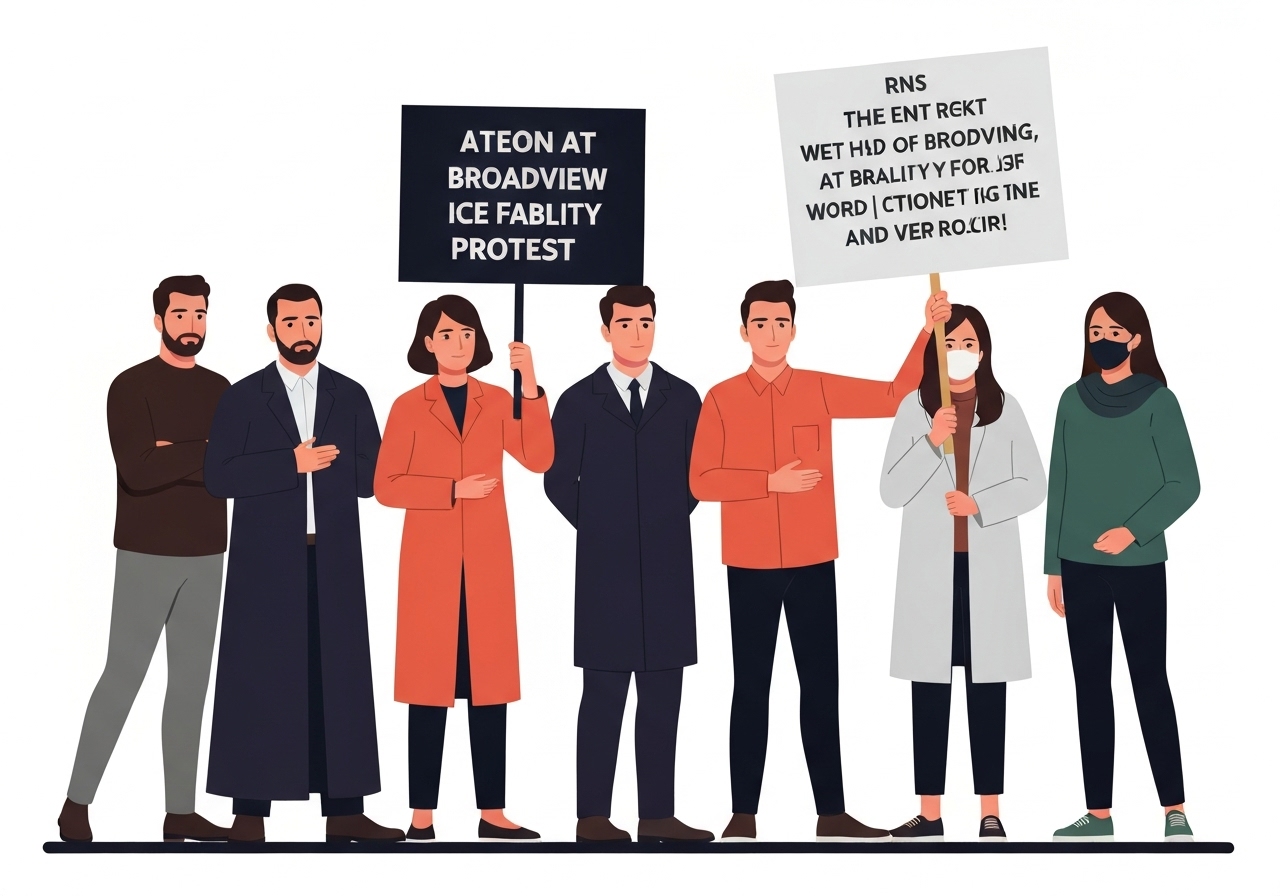
Lead: On Friday, Nov. 14, outside the U.S. Immigration and Customs Enforcement (ICE) detention center in Broadview, Illinois, at least seven clergy were among 21 people arrested after a large multi-faith demonstration, organizers and police say. Protesters, including more than 100 faith leaders by organizers’ estimate, gathered to challenge “Operation Midway Blitz,” a deportation effort launched in September that advocates say has rounded up hundreds of immigrants in the Chicago area. Video of the arrest of the Rev. Michael Woolf, who said he was injured and later held about seven hours, circulated widely online and intensified scrutiny of law enforcement tactics at the site. DHS issued a statement and social posts criticizing demonstrators; organizers framed the action as religious witness and an effort to secure detainees’ rights.
Key Takeaways
- 21 people were arrested at the Nov. 14 Broadview demonstration, Cook County police said; organizers said at least seven of those arrested were clergy from Presbyterian, Lutheran, Baptist, Unitarian Universalist and Jewish traditions.
- Organizers said roughly 100 faith leaders of varied traditions attended the protest, staging a multi-faith service and presenting a clergy letter offering spiritual care to detainees.
- The Rev. Michael Woolf, an American Baptist pastor from Evanston, reported bruises and numb hands after about seven hours in custody; he described plastic restraints that caused his hands to go numb.
- The demonstration protested “Operation Midway Blitz,” launched in September, an enforcement campaign that advocates say has rounded up hundreds of people in the Chicago region.
- DHS posted mocking commentary on X and called demonstrators “violent rioters”; DHS Assistant Secretary Tricia McLaughlin said video shows rioters attacking police and reaffirmed condemnation of lawlessness.
- Faith leaders say repeated offers of pastoral care and sacraments at Broadview have been refused; religious freedom concerns are part of an ongoing class-action lawsuit related to treatment of detainees.
Background
The Broadview ICE processing center has been a focal point of protests since federal enforcement activity around Chicago intensified following the launch of “Operation Midway Blitz” in September. Advocates and religious leaders contend that the operation has led to the detention of hundreds of undocumented immigrants and others in the metro area, prompting legal challenges and sustained public pressure. Religious groups have repeatedly organized outside the facility to offer pastoral care, hygiene supplies and public witness, framing the actions as both humanitarian and constitutional advocacy.
Local and federal law enforcement have increasingly guarded the facility; in recent weeks state and local police presence has grown, according to protesters and local reporting. Organizers and some clergy say prior interactions with agents have included the use of crowd-control munitions and force; those claims are part of litigation now pending in federal court. At the same time, DHS officials maintain their actions respond to enforcement needs and have rejected characterizations that agents acted improperly.
Main Event
On Nov. 14, faith leaders gathered outside Broadview for a planned multi-faith service and a symbolic delivery of daily hygiene products, bread and water intended to highlight unmet needs inside the detention center. Organizers say they gave DHS officials a letter offering spiritual care for detainees a week earlier; on Friday they attempted to present the same letter in person. Witnesses say clergy formed linked arms and moved forward in a peaceful procession before police intervened.
Video widely shared on social platforms shows the Rev. Michael Woolf standing near police before officers take hold of his wrist, wrest him to the ground and handcuff him. Woolf told Religion News Service he spent about seven hours in custody at the Cook County Sheriff’s Office in Maywood and returned with visible bruises. Several clergy and participants described being pushed, grabbed or struck by projectiles during earlier protests at the site.
Cook County police confirmed 21 arrests and said most were charged with obstruction, disorderly conduct or pedestrian violations; organizers countered that many present were clergy offering pastoral care. Participants reported that at least five local clergy have been hit by pepper balls fired by DHS forces in recent demonstrations; footage of one Presbyterian minister struck in the head circulated online. The protest ended with multiple arrests and heightened tensions between organizers and federal authorities.
Analysis & Implications
The Broadview demonstrations reflect a convergence of religious advocacy, immigration policy disputes and local politics. Clergy-led actions invoke both moral language and legal claims—highlighting alleged deprivation of religious rites and basic needs inside the facility—while federal officials prioritize enforcement objectives. That clash complicates oversight: courts may be asked to balance detainees’ access to religious practice against security and operational claims by DHS.
Legally, the presence of a class-action lawsuit over detainee treatment and a separate case that produced a temporary restraining order limiting use of force against religious practitioners create an uncertain operational environment for ICE and local law enforcement. If courts expand protections for clergy access or constrain certain crowd-control methods, future protests and facility operations could change. Conversely, rulings favoring broader enforcement discretion would likely harden police responses to demonstrations.
Politically, the protests place pressure on elected officials in Illinois, including Gov. J.B. Pritzker, who has been publicly critical of federal deportation policies but is now accused by activists of enabling ICE through state and local policing. Nationally, the episode feeds debates over immigration enforcement tactics and the role of faith communities in civil disobedience. Media attention to viral video and social posts amplifies public scrutiny and may influence administrative responses and congressional oversight.
Comparison & Data
| Date | Event | Reported Arrests |
|---|---|---|
| Sept. 2025 | Launch of “Operation Midway Blitz” (Chicago area enforcement) | Hundreds detained (advocates) |
| Nov. 14, 2025 | Multi-faith protest at Broadview ICE facility | 21 arrested (Cook County police); ≥7 clergy (organizers) |
The table above summarizes key public figures: organizers say Operation Midway began in September and led to hundreds of detentions; the Nov. 14 protest resulted in 21 arrests, with organizers identifying at least seven clergy among those detained. While exact totals for detentions tied to the operation vary by source, the numerical framing helps compare enforcement scale with the size of the organized religious response.
Reactions & Quotes
Organizers and clergy framed the protest as a moral and religious obligation to detainees and criticized the force used by authorities.
“I’ve got bruises all over my body… It’s part of the dehumanizing nature of it, and it gives me a lot of clarity around what’s happening here.”
Rev. Michael Woolf, American Baptist pastor (participant)
Woolf described being handcuffed and held for about seven hours and connected his treatment to broader claims about conditions inside the facility.
“We will always condemn lawlessness and violence against our law enforcement… We urge faith leaders across the country to do the same.”
Tricia McLaughlin, DHS Assistant Secretary (official statement)
McLaughlin rejected protesters’ characterizations and said video footage shows attacks on police, though she did not specify which clip. DHS also posted critical messages on X, drawing denunciations from clergy.
“Why does DHS feel threatened by clergy praying? What are they hiding?”
Rev. Kristina Sinks, United Methodist pastor (organizer)
Sinks helped organize the worship service and said offers of pastoral care and communion were previously rebuffed. She called the clergy action an effort to bear witness to detainees’ suffering.
Unconfirmed
- Which specific video DHS referred to when asserting rioters attacked police was not identified by DHS in its statement and therefore remains unspecified.
- Reports that many Border Patrol officers in Chicago are being transferred to Charlotte, North Carolina were described as “recent reports” in coverage but lack a single confirmed federal release in the materials reviewed here.
- Claims about the exact number of detainees affected by denied sacramental access and the full scale of force inside Broadview are contested and subject to verification through ongoing litigation and inquiries.
Bottom Line
The Nov. 14 Broadview protest crystallized a conflict between faith-based advocates demanding access and humane treatment for detainees and federal authorities defending enforcement operations tied to “Operation Midway Blitz.” Video of forceful arrests and heated social posts by DHS elevated the episode into a broader national conversation about immigration enforcement, the role of clergy in public protest, and the limits of permissible law-enforcement response to religious witness.
Pending court decisions and continued public attention will shape what protections clergy and detainees can expect at Broadview and similar facilities. For now, the arrests and viral footage have intensified scrutiny on both detention conditions and the tactics used by agents and local police when confronting peaceful religious demonstrations.
Sources
- Religion News Service (news outlet; original reporting and update with DHS statement)
- Department of Homeland Security (official X account) (official social-media statement referenced in coverage)
- Cook County Sheriff’s Office (official; detention and arrest authority for Maywood processing)