
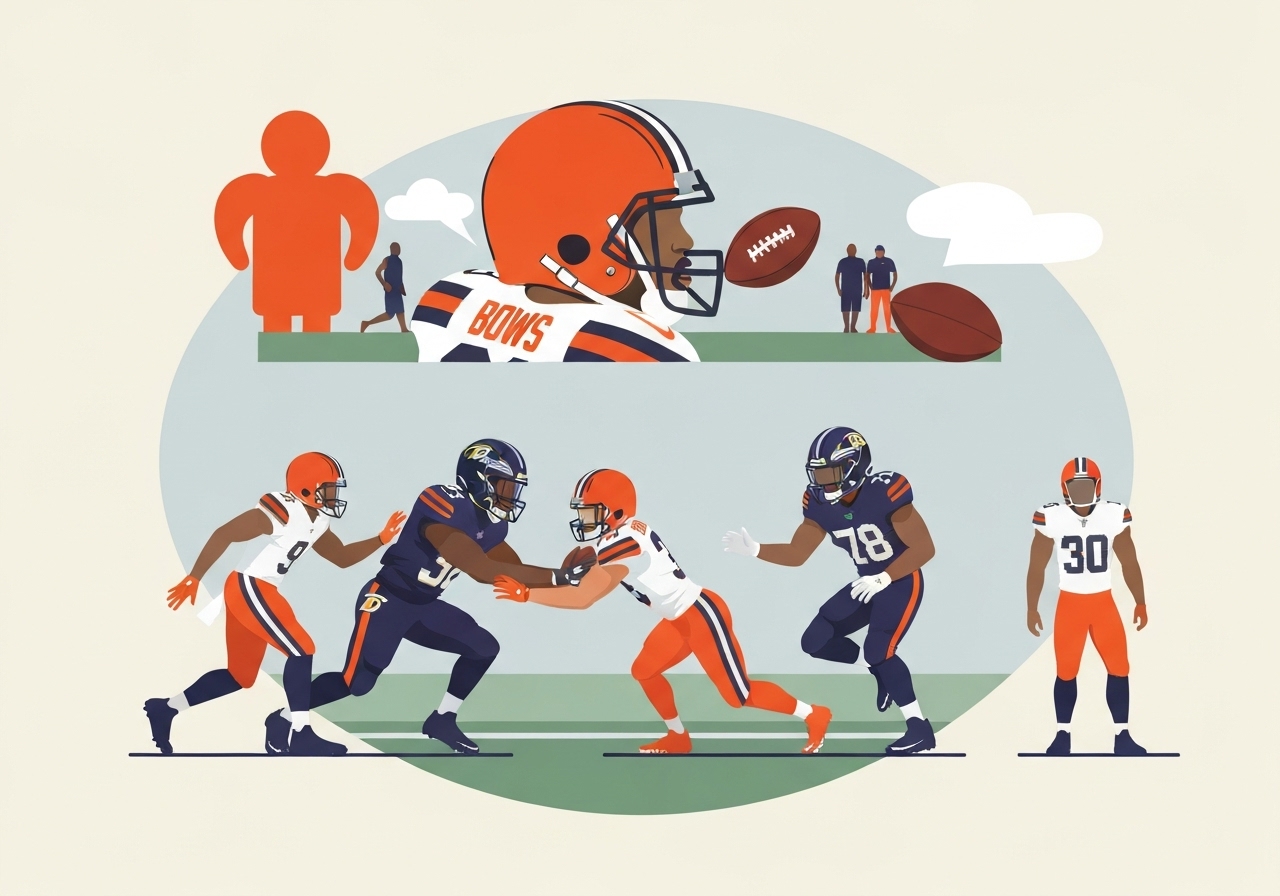
Lead: On Nov. 16, 2025 in Cleveland, the Browns fell 23-16 to the Baltimore Ravens, failing to score an offensive touchdown. Cleveland’s only touchdown came on a pick-six by linebacker Devin Bush, while kicker Andre Szmyt accounted for three field goals. The result intensified scrutiny of the Browns’ offense after another shortfall in a divisional matchup. Players and coaches acknowledged the performance as insufficient in postgame comments.
Key Takeaways
- The Browns lost 23-16 to the Ravens on Nov. 16, 2025 in Cleveland, Ohio; Cleveland produced no offensive touchdowns.
- Cleveland’s 16 points came from Devin Bush’s interception return for a touchdown and three field goals by Andre Szmyt.
- Wide receiver Cedric Tillman recorded catches including a first-down reception in the first half but the offense could not convert drives into TDs.
- Special teams contributed 9 points via Szmyt’s three successful field-goal attempts.
- Defensive scoring was the Browns’ only touchdown, underscoring offensive inefficiency against Baltimore.
- The result deepened immediate questions about Cleveland’s offensive execution and red-zone production.
Background
The Browns and Ravens meet as AFC North rivals with a history of physical, defense-first games. Divisional matchups often magnify weaknesses because teams are familiar with one another’s schemes and personnel, increasing the value of opportunistic plays such as turnovers and special-teams points. Entering this game, both clubs prioritized defensive stops; Cleveland’s inability to convert pressure into offensive touchdowns became the defining storyline of the evening. Coaching staffs routinely stress complementary football—balancing offense, defense and special teams—but this game saw the Browns’ offense fail to deliver that balance.
In modern NFL play, sustained offensive drives and red-zone efficiency are key indicators of a unit’s health. When an offense fails to score a touchdown in a full game, the burden shifts to defense and special teams to produce points, as happened in Cleveland. Fan and media attention typically follows such outcomes, prompting scrutiny of play-calling, quarterback performance and receiver execution. For a team seeking consistent wins in a competitive division, repeated offensive stagnation can carry tangible consequences in standings and locker-room morale.
Main Event
At FirstEnergy Stadium on Nov. 16, Cleveland’s offense struggled to finish drives despite periodic progress between the 20s. Cedric Tillman made notable receptions, including a catch that secured a first down in the first half, but drives stalled before reaching the end zone. The Browns’ only touchdown resulted not from an offensive series but from linebacker Devin Bush’s interception return, which flipped momentum briefly but could not offset offensive shortfalls.
Andre Szmyt converted three field-goal attempts, supplying the team’s kicking game as the primary source of planned points. Those field goals kept Cleveland within a one-score margin for parts of the second half, but the absence of any offensive touchdown forced the team into higher-risk decisions late in the game. Baltimore capitalized on key possessions and preserved enough advantage to win 23-16.
Postgame, players were blunt about the outcome. The lack of offensive touchdowns dominated the narrative, with leaders emphasizing accountability and the need for cleaner execution. Coaches also highlighted missed opportunities in critical moments and signaled the necessity of corrective work before the next game. The loss leaves Cleveland to address schematic and execution gaps while preparing for upcoming opponents.
Analysis & Implications
Failing to produce an offensive touchdown in a full game is a clear red flag for any NFL offense and often reflects a combination of schematic predictability, execution errors, and opponent preparedness. For the Browns, the immediate implication is pressure on play-calling and on players asked to convert in short-yardage and red-zone situations. Repeated occurrences could force schematic adjustments or personnel changes depending on how coaches evaluate the underlying causes.
Economically and competitively, poor offensive output hurts more than the scoreboard. Sustained offensive struggles reduce time of possession, increase strain on the defense, and can limit a team’s ability to control game tempo—factors that compound over a season. In a division like the AFC North, where margin for error is slim, single-game lapses can have outsized effects on playoff positioning and organizational decision-making.
Looking ahead, Cleveland will need to prioritize two areas: converting third-down opportunities and improving red-zone play design and execution. Film study and targeted practice work are likely to focus on route timing, blocking assignments, and situational quarterback reads. If the offense cannot produce touchdowns consistently, the team will continue to rely on defense and special teams, an unsustainable long-term blueprint for postseason success.
Comparison & Data
| Scoring Breakdown | Cleveland | Baltimore |
|---|---|---|
| Offensive TDs | 0 | Multiple |
| Defensive TDs | 1 (Devin Bush pick-six) | 0 |
| Field Goals | 3 (Andre Szmyt) | 2+ |
| Total Points | 16 | 23 |
The table highlights that Cleveland’s scoring depended on defense and special teams rather than offensive drives. That distribution—zero offensive touchdowns versus points from a defensive score and field goals—illustrates a structural imbalance that teams rarely sustain over a long stretch if they aim for postseason success.
Reactions & Quotes
“It’s embarrassing.”
Cedric Tillman, Browns wide receiver
“There wasn’t much to elaborate on about the Browns offense following the loss,”
Ashley Bastock, cleveland.com (reporter observation)
“We have to execute better in key moments and finish drives.”
Postgame team comments (summarized)
The first quote captures the blunt assessment from a player directly involved. The reporter’s observation contextualizes the postgame tone, while the summarized team comment reflects common coaching messages after a performance where the offense failed to reach the end zone.
Unconfirmed
- Any immediate roster or play-calling changes have not been publicly confirmed by the Browns organization as of Nov. 16, 2025.
- Internal evaluations about whether game performance will prompt long-term personnel moves have not been released by team management.
Bottom Line
The Nov. 16, 2025 loss to the Ravens, a 23-16 result in which the Browns failed to score an offensive touchdown, spotlights urgent offensive issues—particularly in finishing drives and converting in the red zone. Defensive scoring and field goals kept the game competitive, but they are not a sustainable foundation for a team that seeks divisional success.
Immediate priorities for Cleveland should include diagnosing whether this was an execution lapse, schematic problem, or both, and implementing targeted corrections. Fans and analysts will watch upcoming games for signs of adjustment; without clearer offensive production, the Browns risk continued volatility in a tightly contested AFC North.