
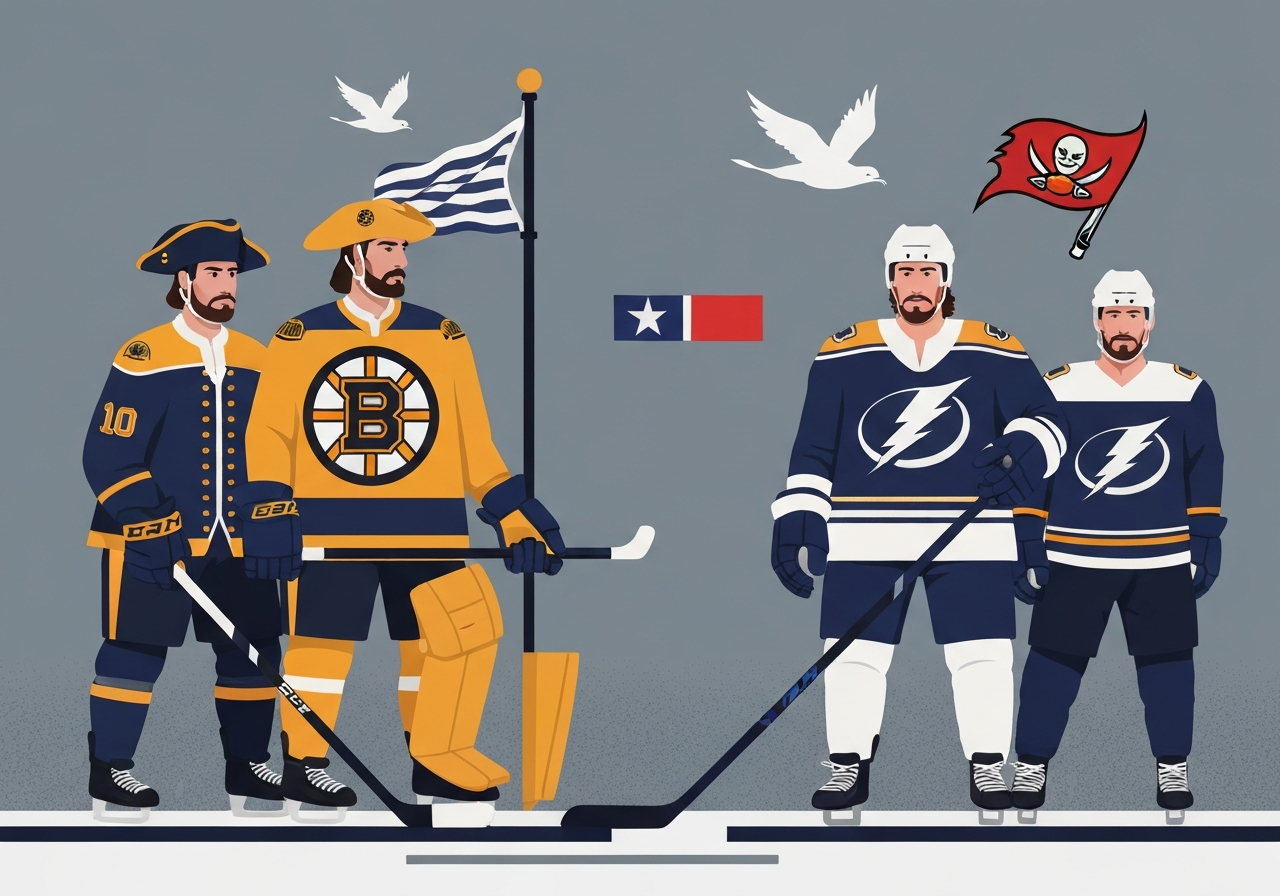
On Feb. 1, 2026, at Raymond James Stadium in Tampa, the Boston Bruins and Tampa Bay Lightning staged themed arrivals ahead of the Navy Federal Credit Union NHL Stadium Series, dressing to honor local history and the host NFL franchise. The Lightning embraced Tampa Bay Buccaneers heritage by wearing the orange “creamsicle” throwback uniforms and vintage helmets, while the Bruins appeared in Revolutionary War–era patriot outfits that echoed their city’s founding-era identity and the New England Patriots. The maneuvers were visible fan-facing gestures and media moments that tied hockey, local culture and the approaching Super Bowl into a single, high-profile spectacle. The event also featured local NFL figures joining the Lightning arrival and drew complimentary remarks from players and coaches on both teams.
Key Takeaways
- The Stadium Series game took place Feb. 1, 2026, at Raymond James Stadium in Tampa, Florida, as part of the NHL’s outdoor game schedule.
- The Tampa Bay Lightning wore the orange “creamsicle” uniforms first used by the Buccaneers from 1976–1996 and revived periodically since 2009.
- Lightning players arrived via trolley and were escorted by Buccaneers quarterback Baker Mayfield and tackle Tristan Wirfs; Wirfs carried a 1990s–style boombox and wore a black Lightning throwback jersey from the 1992–93 to 2006–07 era.
- Boston Bruins players dressed as Revolutionary War–era patriots, linking the look to Boston’s colonial history and the New England Patriots entering Super Bowl LX one week later.
- Lightning defenseman Ryan McDonagh and captain Victor Hedman both framed the tribute as gratitude toward the host city and franchise, while Bruins coach Marco Sturm praised his players’ preparation on the outfits.
- Photographers and broadcast coverage amplified the themed arrivals, turning pregame logistics into marketing and local-engagement moments for both clubs.
Background
The NHL Stadium Series is one of the league’s marquee outdoor events, pairing high-profile matchups with site-specific presentations that often lean on local color and cross-sport partnerships. For years, teams have used arrival outfits, coordinated entrances and on-site pageantry to create viral content and deepen ties with host cities. Those creative arrivals can range from formalwear to costume-driven homages, and they are intentionally photographed and amplified across social and broadcast platforms.
The Tampa Bay Buccaneers’ original orange uniforms—nicknamed “creamsicle”—were worn from the franchise’s 1976 inception through 1996; the club changed to red-and-pewter in 1997 and has intermittently used the orange throwbacks since 2009. The Lightning, founded in 1992, have several throwback styles in their wardrobe archive, including the black alternate worn early in the franchise’s history. Boston, by contrast, leaned on its Revolutionary era identity: city landmarks, historical tours and the Patriots NFL brand make colonial imagery especially resonant for Bruins fans.
Main Event
The Lightning arrived in full Buccaneers–styled gear, wearing orange jerseys and white-striped helmets bearing the older pirate logo. Players rode a trolley to the stadium entrance, where they were led in by Baker Mayfield, who wore a Stadium Series Lightning jersey, and Tristan Wirfs, who chose a black Lightning throwback and hoisted a large retro boombox as a prop. The visual was explicitly framed as a mutual nod: the NHL club honoring its NFL hosts while creating a memorable arrival moment.
On the Boston side, Bruins players stepped out in topcoats, breeches and tricorne hats, a clear callback to colonial patriots. The choice tied into the city’s Revolutionary War history and echoed aesthetic links to the New England Patriots, who were preparing for Super Bowl LX on Feb. 8, 2026. Boston’s ensemble was discussed by players as both a local homage and a playful connection to their NFL counterparts.
Players and coaches offered short remarks after the arrivals. Lightning defenseman Ryan McDonagh described the presentation as an expression of thanks to the host franchise and fanbase, while captain Victor Hedman noted the novelty of watching NFL players handle pads and equipment. Bruins defenseman Nikita Zadorov and coach Marco Sturm highlighted the effort teammates put into the costumes and the way the look represented Boston’s identity.
Analysis & Implications
Themed arrivals at high-visibility games serve several functions: they generate immediate media-friendly imagery, reinforce local ties between franchises and can lift merchandise interest for both clubs. By wearing Buccaneers throwbacks, the Lightning tapped into nostalgia that has proven lucrative in pro sports merchandising, while aligning with the host city’s football culture on a weekend without an NFL game at the stadium.
For Boston, the Revolutionary-era presentation works on multiple levels. It references civic history, offers a tasteful link to the city’s NFL brand, and provides a distinct visual contrast to Tampa’s bright orange. The timing—one week before Super Bowl LX featuring the Patriots—magnified those connections, turning a pregame ritual into timely cross-sport storytelling.
There are risks to costume-driven moments: teams must balance creativity with cultural sensitivity and avoid alienating parts of their fanbase. In this case the tributes were broadly celebratory and tied to team histories, reducing immediate controversy. From a promotional standpoint, these arrivals are low-cost activations that typically yield high social engagement and earned media value.
Comparison & Data
| Team | Uniform Era Referenced | Original Years |
|---|---|---|
| Tampa Bay Buccaneers (Lightning tribute) | Orange “creamsicle” | 1976–1996 (revivals since 2009) |
| Tampa Bay Lightning | Black throwback | 1992–93 to 2006–07 |
| Boston Bruins | Revolutionary-era/colonial | Historical reference (17th–18th century) |
The table summarizes the eras that inspired each team’s look and provides quick context for fans tracking uniform lineage. These visual callbacks are part of a broader merchandising strategy: nostalgic uniforms and throwbacks frequently return as limited-run jersey sales, game-night giveaways or social-media tie-ins, driving short-term revenue spikes and sustained brand engagement.
Reactions & Quotes
Media and fans reacted quickly on social platforms, sharing images and applauding the theatrical arrivals. Team leaders framed the moments as respectful nods rather than publicity stunts, and broadcasters highlighted the cross-sport collaboration as an example of local franchises working together to stage a memorable event.
“It meant the world to us that those guys wanted to lead us in,”
Ryan McDonagh, Tampa Bay Lightning defenseman
McDonagh’s remark contextualized the Lightning’s choice as gratitude toward the host community and franchise rather than mere costume play. The short quote was used by broadcasters as soundbite material during pregame coverage.
“The obvious would have been pirates with Gasparilla weekend. We get to use [the Buccaneers’] stadium so we want to return the favor,”
Victor Hedman, Tampa Bay Lightning captain
Hedman explained the practical impulse behind the tribute and noted how the team viewed the arrangement as reciprocal goodwill. He also observed aspects of NFL preparation—specifically how players manage pads—that caught his attention.
“Bring something Bostonian… give the respect to the Founding Fathers,”
Nikita Zadorov, Boston Bruins defenseman
Zadorov summarized the Bruins’ decision as an effort to display regional pride and connect with the city’s historic image, while coach Marco Sturm complimented the squad for the effort invested in the presentation.
Unconfirmed
- Whether NFL players Baker Mayfield and Tristan Wirfs received any payment or formal compensation for participating in the Lightning arrival has not been disclosed.
- The full internal decision process for selecting the exact costumes and any vendor or branding agreements tied to the outfits has not been publicly detailed.
Bottom Line
The pregame arrivals at the Feb. 1, 2026 Stadium Series turned a routine team entry into a coordinated cultural moment linking hockey, local tradition and professional football. Tampa’s creamsicle tribute and Boston’s colonial outfits each accomplished the event’s dual aims of entertaining fans and generating shareable imagery that transcended the skate-drop.
Looking ahead, these kinds of cross-sport and nostalgia-driven activations will likely remain staples of outdoor games: they are inexpensive ways to deepen local relationships, create merchandising opportunities and produce content that networks and fans amplify. For teams and leagues, the challenge will be to keep such moments fresh, respectful and tightly aligned with community expectations.