
Lead
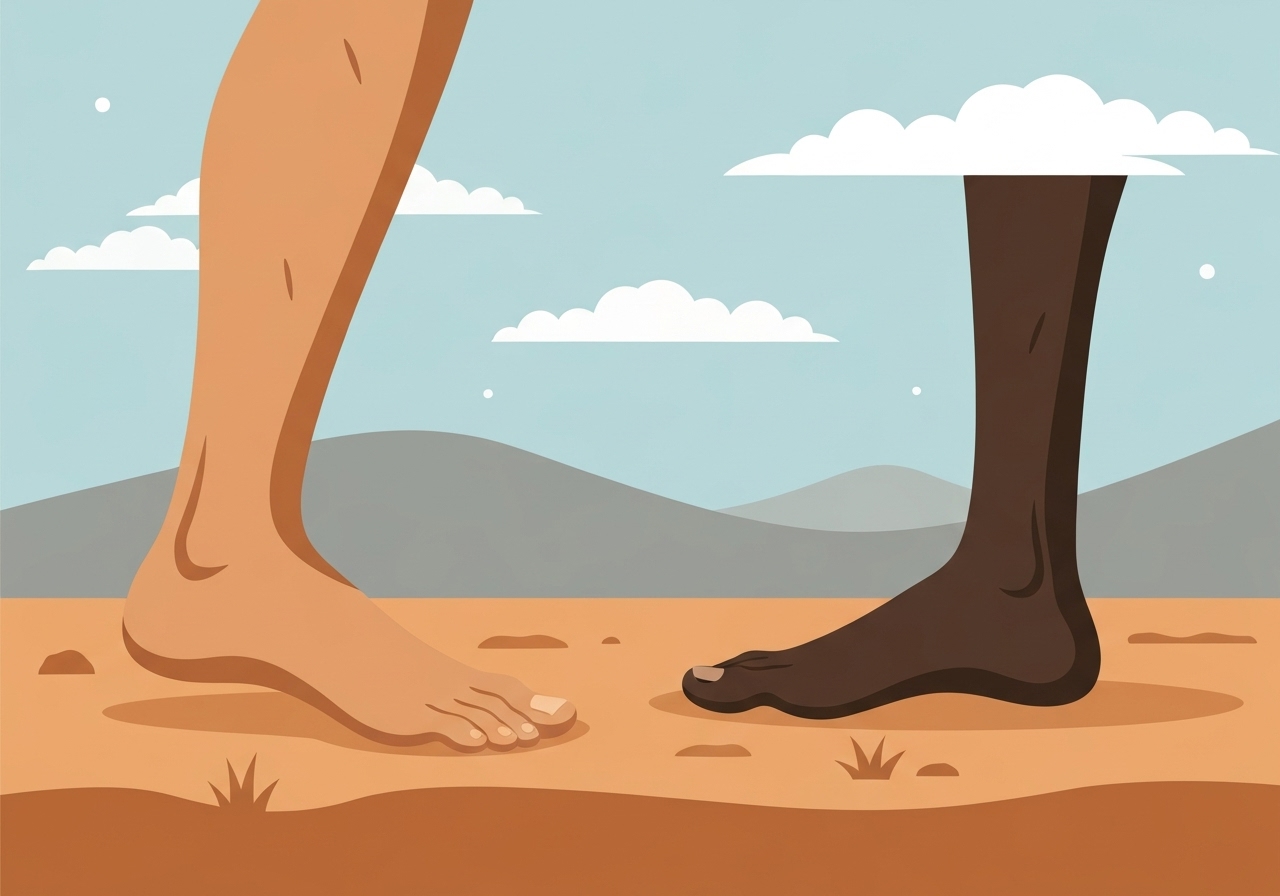
Scientists report that a distinctive fossil foot from northeastern Ethiopia belongs to a previously unrecognized early hominin that lived about 3.4 million years ago alongside the famed specimen Lucy. Found at the Burtele site in 2009, the foot has an opposable big toe unlike Lucy’s, suggesting a lifestyle more adapted to climbing. New material from the same layer — including a jaw with 12 teeth — allowed researchers to assign the remains to a species named Australopithecus deyiremeda. The study, led by Yohannes Haile-Selassie and published in Nature, argues these two species shared the region but used it differently.
Key Takeaways
- The Burtele foot was discovered in 2009 in northeastern Ethiopia and is dated to about 3.4 million years ago, contemporaneous with Australopithecus afarensis (Lucy).
- Researchers identified a jaw with 12 teeth at the same site and, together with other fossils, named the species Australopithecus deyiremeda in the new study published in Nature.
- The foot shows an opposable hallux (big toe) that resembles a thumb, indicating strong climbing ability and frequent time spent in trees compared with Lucy.
- Dental wear and morphology from the newly recovered teeth suggest A. deyiremeda consumed leaves, fruit and nuts, a diet described as more primitive than that of A. afarensis.
- Lead author Yohannes Haile-Selassie and colleagues conclude the two species occupied overlapping landscapes but exploited different ecological niches, reducing direct competition.
- Independent experts — including John Rowan and Ashleigh Wiseman — call the species identification reasonable but caution more cranial or associated material would strengthen taxonomic claims.
Background
The discovery revives a long-running debate in paleoanthropology about how many hominin species coexisted in eastern Africa during the Pliocene. For decades, Australopithecus afarensis, best known from the partial skeleton called Lucy, was often treated as the primary hominin in the Afar region around 3 to 4 million years ago. That view painted early hominin evolution as a relatively linear sequence, but repeated finds over recent decades have hinted at greater diversity.
The Burtele locality, in northeastern Ethiopia, produced a curious foot in 2009 whose morphology did not match A. afarensis expectations. Without associated skeletal material, the bone’s significance remained debated. Over the last several years, excavations at the same stratigraphic levels recovered additional elements, including a lower jaw with 12 teeth, enabling a more confident assessment of whether the foot and dental remains belonged to a single, distinct species.
Main Event
The research team led by Yohannes Haile-Selassie examined the Burtele foot alongside new jaw and tooth fossils recovered from the same deposits. Morphological analysis showed the foot preserved an abductable, opposable big toe capable of grasping branches — a feature markedly different from the more human-like, adducted big toe of A. afarensis. The authors interpret this anatomy as evidence that the Burtele individual climbed regularly and spent substantial time in forest canopy or wooded habitat.
Dental metrics and microscopic wear patterns on the 12 teeth indicate a diet dominated by foliage, fruits and nuts rather than the broader dietary signals inferred for Lucy’s species. Taken together, the postcranial and dental data led the team to assign the material to Australopithecus deyiremeda and to argue that at least two morphologically and behaviourally distinct hominin species lived in close geographic and temporal proximity at about 3.4 million years ago.
The study appears in Nature and includes comparative measurements against A. afarensis and other early hominins. The authors emphasize stratigraphic association and multiple anatomical contrasts as the basis for separating the Burtele material from Lucy’s species. They also discuss habitat reconstructions that place A. deyiremeda in more wooded environments, while A. afarensis is interpreted as more terrestrial.
Analysis & Implications
If the Burtele foot and the newly found dental material are correctly paired and taxonomically distinct from A. afarensis, the finding strengthens evidence that Pliocene hominin diversity was higher than once assumed. Greater species richness implies that hominin evolution was a branching process with multiple contemporaneous lineages experimenting with different locomotor and dietary strategies.
Niche partitioning — where two related species reduce direct competition by exploiting different resources or habitats — is the principal explanatory model offered by the authors. In this case, arboreal foraging by A. deyiremeda and more terrestrial habits by A. afarensis could have allowed both to occupy overlapping ranges without direct resource conflict, consistent with the dental and foot morphology reported.
The result complicates efforts to identify a single direct ancestor of later Homo species. As the count of well-documented hominin taxa increases, so do plausible scenarios for ancestral relationships and adaptive transitions. The authors and outside commentators caution that definitive statements about direct ancestry require more complete cranial and associated material from multiple individuals.
Comparison & Data
| Feature | Australopithecus deyiremeda (Burtele) | Australopithecus afarensis (Lucy) |
|---|---|---|
| Age | ~3.4 million years | ~3.2–3.9 million years |
| Key fossils | Burtele foot (2009), jaw with 12 teeth | Partial skeletons including Lucy |
| Big toe | Opposable/abductable (climbing-adapted) | Adducted/human-like (bipedal-adapted) |
| Inferred habitat | Wooded/forest | More terrestrial/open areas |
| Diet | Leaves, fruit, nuts (more primitive signals) | Mixed diet inferred from teeth and wear |
The table summarizes anatomical and ecological contrasts emphasized in the Nature paper. While dates overlap at roughly 3.4 million years, the combination of postcranial and dental differences underpins the authors’ argument for distinct species that partitioned the environment.
Reactions & Quotes
Several specialists not involved with the study described the identification as plausible but urged caution. The following short statements capture expert reactions and the paper’s broader reception.
“The evidence makes a very reasonable case for a closely related but adaptively distinct species.”
John Rowan, University of Cambridge (human evolution researcher)
Rowan called the study a meaningful advance, noting that better-documented comparisons among multiple individuals will be needed to resolve ancestry questions. He emphasized that growing species diversity in the fossil record increases the number of plausible evolutionary scenarios.
“These findings remind us that human evolution was not a straight ladder but a branching family tree.”
Ashleigh L.A. Wiseman, McDonald Institute for Archaeological Research
Wiseman highlighted the importance of well-preserved cranial material for firm species assignments and cautioned that alternative interpretations remain possible despite the strengthened case for A. deyiremeda.
“The anatomical signals point to frequent arboreal behaviour for the Burtele individual.”
Yohannes Haile-Selassie, lead author (Institute of Human Origins, Arizona State University)
Haile-Selassie and co-authors present the combined foot and dental evidence as a coherent picture of a climbing-adapted hominin living contemporaneously with a more ground-oriented A. afarensis.
Unconfirmed
- Whether A. deyiremeda and A. afarensis directly interacted with one another remains unknown and likely cannot be resolved from current material.
- The assignment of all Burtele-area fossils to a single species rests on stratigraphic association and morphology; without more associated skeletons, alternative taxonomic interpretations cannot be ruled out.
- The precise proportion of arboreal versus terrestrial activity inferred from the foot remains an estimate and depends on broader postcranial context that is not yet available.
Bottom Line
The Burtele foot and associated dental remains, dated to about 3.4 million years ago, provide compelling evidence that at least two different hominin species occupied parts of eastern Africa at the same time. One, represented by Lucy (A. afarensis), shows adaptations for more regular bipedal locomotion; the other, here named A. deyiremeda, preserves features consistent with habitual climbing and a leaf- and fruit-based diet.
These findings reinforce a model of early human evolution as a branching tree with multiple lineages experimenting with different ecological strategies. Resolving which of these lineages led to later Homo species will require more complete, associated cranial and postcranial material and further fieldwork in the region.
Sources
- NBC News — media report summarising the Nature study and expert reactions.
- Nature — scientific journal (original study published in Nature; article referenced by the reporting team).
- Institute of Human Origins, Arizona State University — academic research institute associated with lead author Yohannes Haile-Selassie.