
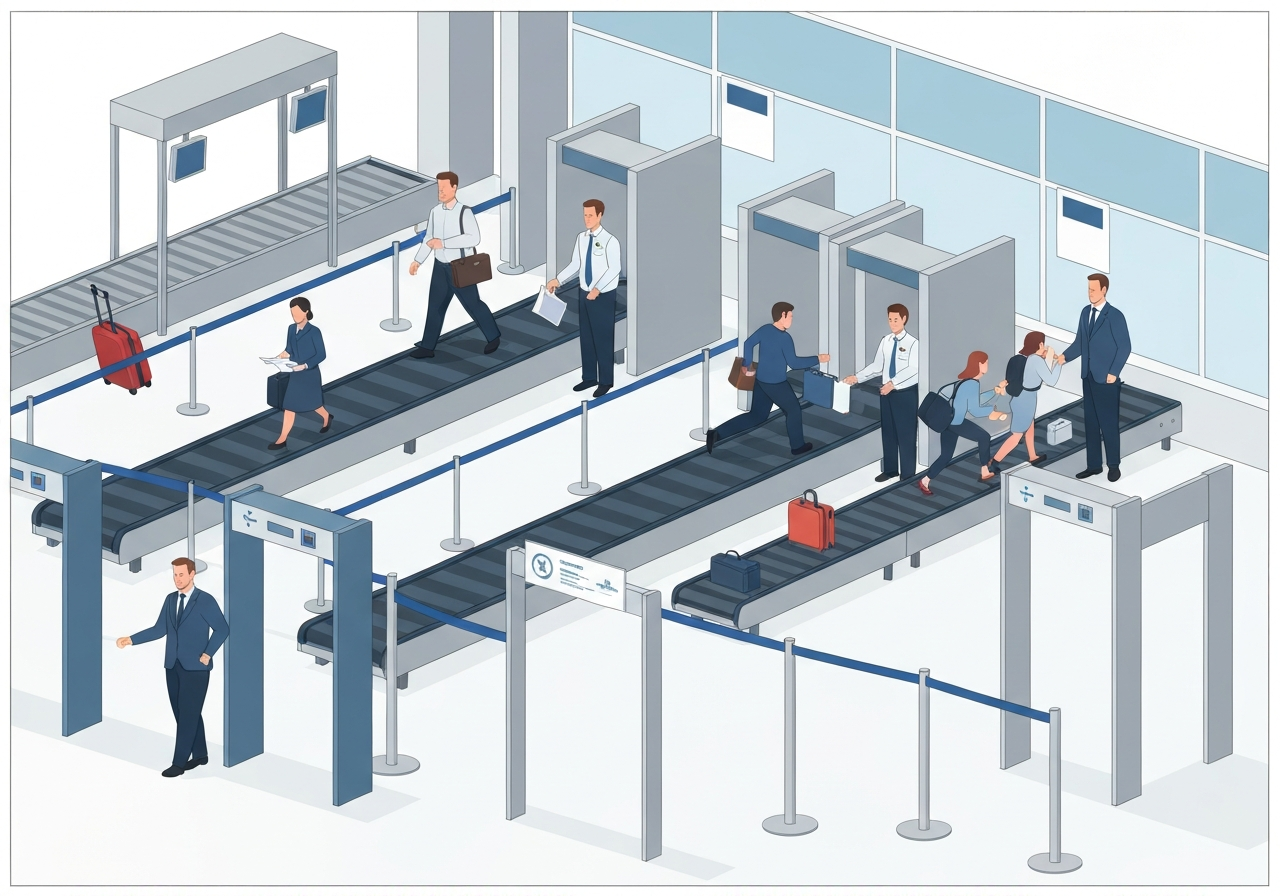
Lead: On Saturday, passengers at Baltimore-Washington International Thurgood Marshall Airport faced security waits that stretched as long as five hours; by Sunday the terminal returned to a more typical pace after Immigration and Customs Enforcement personnel were deployed to assist Transportation Security Administration checkpoints. Airport officials and on-the-ground reporting indicated lines moved far more smoothly on Sunday, though travelers were still urged to allow extra time. The Maryland Aviation Administration and TSA emphasized that TSA retains primary screening responsibility while DHS personnel provided operational support to speed processing.
Key Takeaways
- Wait times: Security queues peaked at up to five hours on Saturday at BWI-Marshall before shrinking markedly on Sunday.
- ICE deployment: ICE, including ERO and HSI components, began assisting TSA at BWI starting Saturday afternoon; the exact number of officers was not released.
- Staffing impact: At one point more than 100 of 140 TSA employees at BWI called out; nationwide, roughly 500 TSA staff have resigned amid the staffing crisis.
- Federal action: The president signed an executive order Friday to identify pay for TSA workers during the partial federal government shutdown; an estimate said about 50,000 employees could start receiving paychecks as soon as Monday.
- Airport guidance: After conditions eased, BWI recommended travelers arrive at least three hours before departure on Sunday but had urged up to five hours amid Saturday’s disruptions.
- Operational roles: MAA and TSA stated that primary passenger and baggage screening remains with TSA; ICE personnel provided operational support intended to speed clearance.
Background
The disruption at BWI-Marshall unfolded against a broader staffing emergency at the Transportation Security Administration tied to a partial federal government shutdown. Many TSA employees have either called out or quit, and union leaders report members struggling with pay and housing pressures that complicate attendance. Airports across the country have seen intermittent backups as agencies scramble to maintain checkpoint operations with reduced personnel.
Maryland Aviation Administration officials said additional Department of Homeland Security personnel, including Enforcement and Removal Operations (ERO) and Homeland Security Investigations (HSI), were sent to BWI starting Saturday afternoon to assist TSA checkpoints. Similar short-term deployments have occurred at other airports in recent weeks as managers try to restore throughput while TSA maintains responsibility for screening functions. The local scene in Linthicum reflected both operational stress and quick mitigation measures by airport and airline staff.
Main Event
Saturday’s lines at BWI became a visible bottleneck: passengers reported queuing inside and outside the terminal, with sidewalks forming multiple parallel lines extending down the concourse. Checkpoint C was frequently the only checkpoint open; B briefly reopened Saturday evening. At the worst points, people at the front of the line said they had waited as long as five hours to reach screening.
Airport officials and news crews observed a notable change by Sunday. Security lanes moved more steadily in the morning and evening, electronic signage still warned of intermittent longer-than-normal waits, and airline staff continued to assist passengers with rebookings and information. BWI advised travelers to give themselves three hours for departures as operations returned toward routine levels, acknowledging that checkpoint line lengths could still vary over the course of the day.
ICE officers were described by MAA as providing operational support to TSA, with the agency specifying that primary aviation security duties remain with trained TSA staff. Officials did not disclose how many DHS personnel were present. Several travelers told WBAL-TV they noticed ICE agents on-site but were reassured by airport statements that the deployment’s purpose was to assist screening operations, not to pursue immigration enforcement as the primary mission.
Analysis & Implications
The episode at BWI highlights how fragile checkpoint throughput can be when staffing drops and demand remains steady. With more than 100 of 140 local TSA employees reported absent at one point, the airport faced a steep shortfall that translated directly into longer lines and operational strain. Short-term deployments of DHS personnel can plug gaps, but they are a stopgap; sustained capacity requires stable TSA staffing levels and predictable payroll arrangements.
Politically and administratively, the event underscores pressure on federal leaders to resolve pay and staffing for TSA amid the partial shutdown. The executive order to find funds for TSA pay signals immediate priority, but uncertainty about who will report to work and how long retained staff can sustain extra hours remains. If absences persist, airlines and airports may continue to face delays, flight rebookings and customer frustration, with economic ripple effects for carriers and airport businesses.
Operationally, using ICE/ERO/HSI in a logistics-support role raises questions about appropriate role boundaries and public perception. MAA and TSA statements attempted to clarify that screening authority remains with TSA, but the presence of DHS law-enforcement personnel at checkpoints can prompt passenger concern. Clear, transparent communication about roles, numbers and goals is critical to restoring traveler confidence.
Comparison & Data
| Metric | Saturday (Peak) | Sunday (Typical) |
|---|---|---|
| Reported max wait | Up to 5 hours | Routine / substantially reduced |
| TSA callouts at BWI | ~100 of 140 workers | Lower; staffing improved |
| Nationwide TSA quits | ~500 total resignations | No major new surge reported |
| Federal pay action | Executive order signed Friday | ~50,000 employees estimated to start paychecks Monday |
The table summarizes locally reported peak congestion versus the following day’s improvement, alongside staffing figures cited by airport and union sources. While Sunday’s recovery was marked, the underlying staffing shortfall that produced the Saturday crisis — both local callouts and national resignations — remains a structural risk for near-term airport operations.
Reactions & Quotes
Officials and travelers offered sharply different perspectives on the on-the-ground experience, from gratitude for quick assistance to anger directed at federal leaders for the conditions.
“We thank our passengers for their patience as we work with stakeholders to support safe, efficient travel,”
BWI Executive Director and CEO Shannetta Griffin (airport statement)
Griffin’s remark framed the airport’s response and appreciation for staff efforts amid an operationally difficult period. The statement also acknowledged the cooperation of concessions and airline employees who helped keep terminals functioning.
“Southwest sent an alert advising four hours early at 6 a.m., then cut it to two hours later—seeing movement today gives me hope it’ll be smooth,”
Tim, traveler (on-site)
Passengers interviewed by local crews described relief as lines contracted Sunday, while some retained skepticism given the recent volatility in checkpoint wait times and guidance.
“I see ICE running around here, and I thank them for being here… other than that, this is not a happy place,”
Mary Stark, traveler
Comments like this reflect a mix of appreciation for extra hands on deck and unease about law-enforcement presence at screening areas, illustrating the sensitivity of deploying DHS personnel to passenger-facing roles.
Unconfirmed
- The exact number of ICE, ERO and HSI personnel deployed to BWI on Saturday has not been publicly released by DHS or MAA.
- Reports of any immigration enforcement detentions tied to the deployment during the Saturday–Sunday period were not corroborated by official arrest or detention records at the time of reporting.
Bottom Line
Saturday’s severe delays at BWI-Marshall exposed how acute staffing shortfalls at TSA can rapidly cascade into multi-hour lines and operational distress for travelers and airport services. The immediate infusion of DHS personnel helped restore steadier processing on Sunday, but that measure addresses symptoms rather than the underlying staffing and payroll uncertainties driving absences.
Travelers should plan extra time at airports while federal and airport authorities work to stabilize TSA staffing. Policymakers and agency leaders face near-term choices about funding, recruitment and retention; resolving those will determine whether short-term fixes hold or more persistent travel disruptions return as demand and staffing conditions change.
Sources
- WBAL-TV report (local TV reporting; on-site coverage)
- Maryland Aviation Administration (state aviation agency; official statements)