
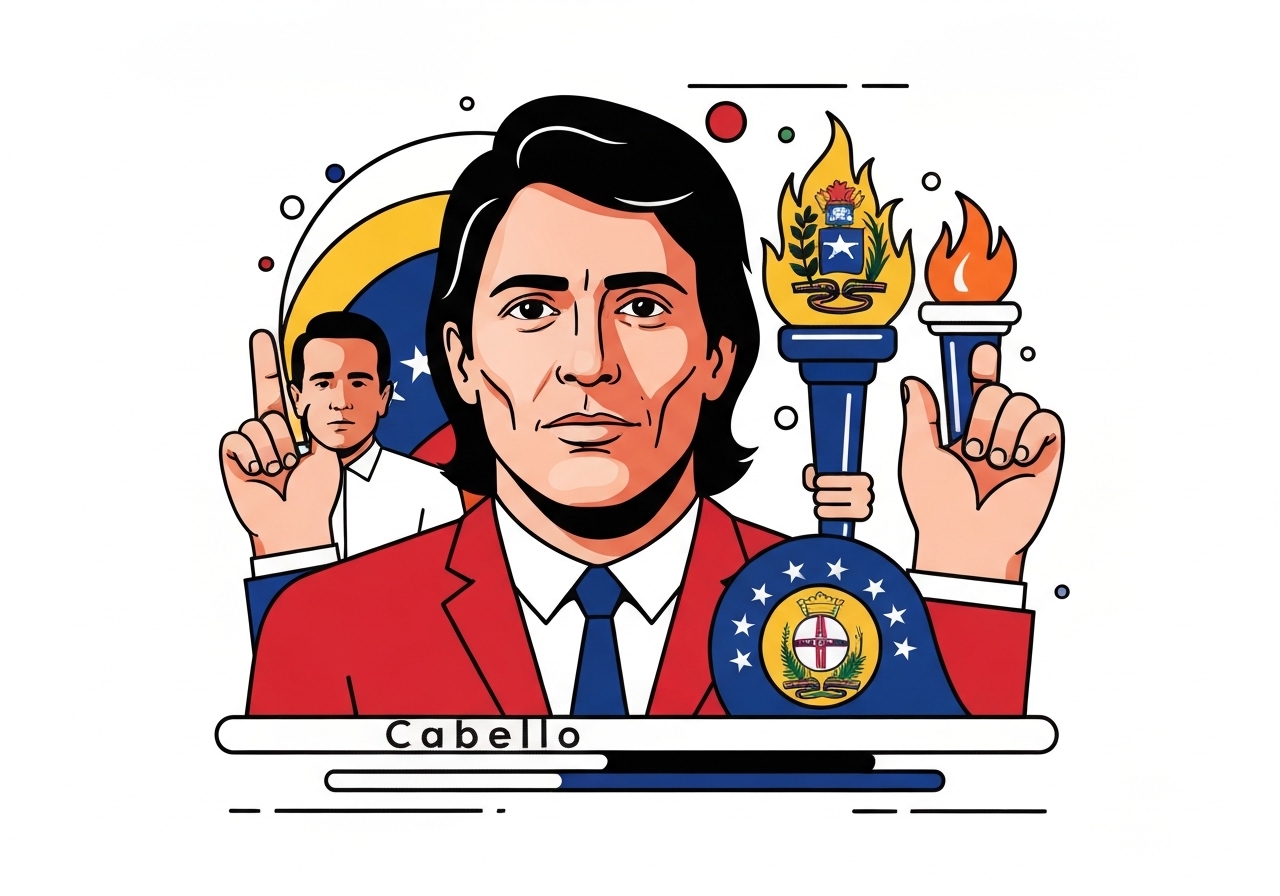
Since U.S. special forces captured President Nicolás Maduro in January 2026, hopes for a rapid democratic shift in Venezuela have dimmed as Diosdado Cabello, the 62‑year‑old interior minister, continues to command security forces and allied pro‑government groups from Caracas. Under interim President Delcy Rodríguez, Cabello has publicly rallied supporters, denounced the U.S. operation and warned opponents of consequences, signaling continuity of the Chavista security apparatus rather than an immediate opening. Washington has charged Cabello in the same indictment as Maduro and is offering up to a $25 million reward for information leading to his arrest, allegations Cabello denies. The persistence of Cabello and other hardliners complicates prospects for a stable transition, foreign investment and the safe return of exiled opponents.
Key takeaways
- Diosdado Cabello remains interior minister under interim President Delcy Rodríguez after Nicolás Maduro was taken by U.S. forces in January 2026, and has maintained public visibility in Caracas.
- The U.S. has indicted Cabello on drug trafficking and narco‑terrorism allegations and posted a reward of up to $25 million for information leading to his arrest.
- Human Rights Watch reports that a 2024 crackdown led by Cabello resulted in 24 deaths and more than 2,000 arrests during post‑election unrest.
- Cabello controls the national police and exerts influence over armed pro‑government colectivos, which analysts say deter opposition return and investment.
- Senior analysts and former officials warn that Cabello’s presence reduces the likelihood of an immediate political opening and raises the risk of further U.S. actions if Maduro holdovers resist transition.
Background
Diosdado Cabello rose to prominence as an early ally of Hugo Chávez, participating in the 1992 coup attempt and later joining Chávez’s inner circle after their release and Chávez’s election in 1998. Over two decades Cabello held a string of senior roles, including leading the National Assembly and the ruling Socialist Party, and briefly serving as interim president during the 2002 crisis. Although once viewed as a potential Chávez successor, Chávez named Nicolás Maduro his heir and Cabello’s rivalry with Maduro kept him out of the cabinet for many years.
Cabello’s return to the executive in 2024, amid protests and allegations of electoral fraud, marked a hardening of state security policy: as interior minister he directed a crackdown that rights groups say produced dozens of deaths and thousands of arrests. He has also been linked by U.S. authorities to the so‑called Cartel de los Soles, an alleged network of officials tied to drug shipments; Cabello has consistently denied criminal allegations. Those charges, together with a high U.S. reward, have made him a central target of international scrutiny while he retains domestic power.
Main event
The U.S. operation in January 2026 that resulted in President Maduro’s capture reshaped the immediate political terrain, but did not remove Cabello from influence. Within hours of the raid, Cabello appeared in the streets of Caracas in a helmet and flak jacket, flanked by armed security personnel, denouncing the U.S. action and urging citizens not to cooperate with what he called an external aggressor. He called on supporters to mobilize to defend national sovereignty and warned that those perceived as traitors would face reprisals.
Delcy Rodríguez, designated interim president after the operation, kept Cabello in the interior ministry portfolio, a decision that left him in operational control of police forces and oversight of colectivos. U.S. indictments naming Cabello alongside Maduro and others, and a $25 million reward, have not translated into an immediate domestic weakening of his position. Cabello continues to host a weekly television program where he attacks opposition figures and frames government actions as defense of the Bolivarian revolution.
On the diplomatic front, the Trump administration has publicly discussed further pressure and warned of potential additional military strikes if Maduro loyalists obstruct transition. At the same time, the White House has signaled a desire for stability to enable foreign companies to access Venezuelan oil — a goal analysts say is difficult to achieve while hardline actors retain street power. Inside Venezuela, opposition leaders and exiles uniformly describe the environment as unsafe for return while Cabello and other security chiefs remain entrenched.
Analysis & implications
Cabello’s survival at the center of power suggests that removal of Maduro alone is insufficient to dismantle long‑standing networks of influence. Control over police forces and colectivos gives him tools to intimidate, detain or fragment opposition activity, blunting political momentum and complicating negotiated transitions. For foreign investors, especially in the oil sector, the continued role of security hardliners creates legal and operational risks that are difficult to mitigate without credible guarantees of rule of law.
U.S. criminal charges and the financial reward raise the stakes for Cabello personally, but they also risk hardening his behavior if he perceives negotiation as likely to lead to extradition or prosecution. Analysts outline several possible paths: a negotiated exile with guarantees, tactical accommodation with Rodríguez to preserve status, or clandestine resistance and reliance on street forces to deter external intervention. Each scenario carries distinct regional and domestic consequences, including the potential for further U.S. measures or spillover instability.
Regionally, Latin American governments and multilateral bodies face a test: promote accountability and support democratic transition while avoiding escalation that could deepen humanitarian needs or fuel migration. Internally, the military’s posture—especially figures such as Defense Minister Vladimir Padrino López—will be decisive in determining whether hardliners hold together or fragment, a dynamic that will shape the timeline and safety of any political opening.
Comparison & data
| Item | Figure |
|---|---|
| U.S. reward for Cabello | $25 million |
| Cabello’s age | 62 |
| Reported deaths in 2024 crackdown | 24 |
| Reported arrests in 2024 crackdown | more than 2,000 |
| Key event | Maduro captured, January 2026 |
The table highlights central numerical facts cited by government statements and human rights monitors. The scale of arrests and the high reward figure encapsulate both domestic coercion and international legal pressure; together they explain the limits to a rapid political liberalization despite the removal of Maduro from power.
Reactions & quotes
Domestic and international actors offered sharply different readings of the situation. Former prosecutor Zair Mundaray warned that Cabello’s control of street forces and the police undermines prospects for legal stability and safe returns for exiles.
How can you have legal stability when you have this guy who has armed thugs in the streets and who can create chaos, and jail or kidnap people whenever he wants?
Zair Mundaray (former Venezuelan public prosecutor)
Atlantic Council analyst Geoff Ramsey has emphasized the political rivalry that shaped Cabello’s career and his potential incentives going forward, arguing that cooperation with interim authorities may be Cabello’s best route to avoid prosecution.
If he expects to stay out of prison and avoid Maduro’s fate his best opportunity lies in coordinating with Delcy Rodríguez, at least for now.
Geoff Ramsey (Atlantic Council analyst)
Economist Ricardo Hausmann, speaking in an academic forum, explained why many exiled opposition figures say returning is unsafe while Cabello and other hardliners retain security control.
You have the colectivos in the streets. You have Diosdado Cabello as head of the police. So, the government in Venezuela is the same Chavista government we saw before.
Ricardo Hausmann (economist)
Unconfirmed
- Whether Cabello is operationally running an international drug trafficking network at the transactional level remains a matter for criminal courts and investigative authorities to prove.
- It is unconfirmed whether Cabello has negotiated or will negotiate a formal exile deal that would shield him from prosecution or guarantee his safety.
- Reports of any imminent second wave of U.S. military strikes are contingent on policy decisions and have not been independently verified at the time of reporting.
Bottom line
Diosdado Cabello’s continued control of Venezuela’s security apparatus under interim President Delcy Rodríguez means that the capture of Nicolás Maduro has not produced an immediate political opening. The combined weight of domestic coercive capacity, alleged criminal exposure, and factional rivalries makes a fast transition to democratic governance unlikely without negotiated arrangements or decisive splits within the security elite.
For foreign policymakers and investors, the chief takeaway is that legal pressure from the United States and calls for accountability coexist with entrenched domestic power structures. Monitoring the behavior of the military, the stance of key ministers and any signals of negotiation will be critical in assessing whether Venezuela moves toward a durable transition or into a prolonged period of guarded continuity.
Sources
- NPR — U.S. news reporting and on‑the‑ground coverage of the January 2026 operation (news).
- Human Rights Watch — human rights organization reporting on the 2024 crackdown and arrests (human rights group).
- Atlantic Council — think tank providing analyst commentary on Venezuelan politics (think tank).
- White House Briefing Room — statements and press conference material referenced for U.S. policy posture (official).
- U.S. Department of Justice — repository for official indictments and rewards referenced in reporting (official).