
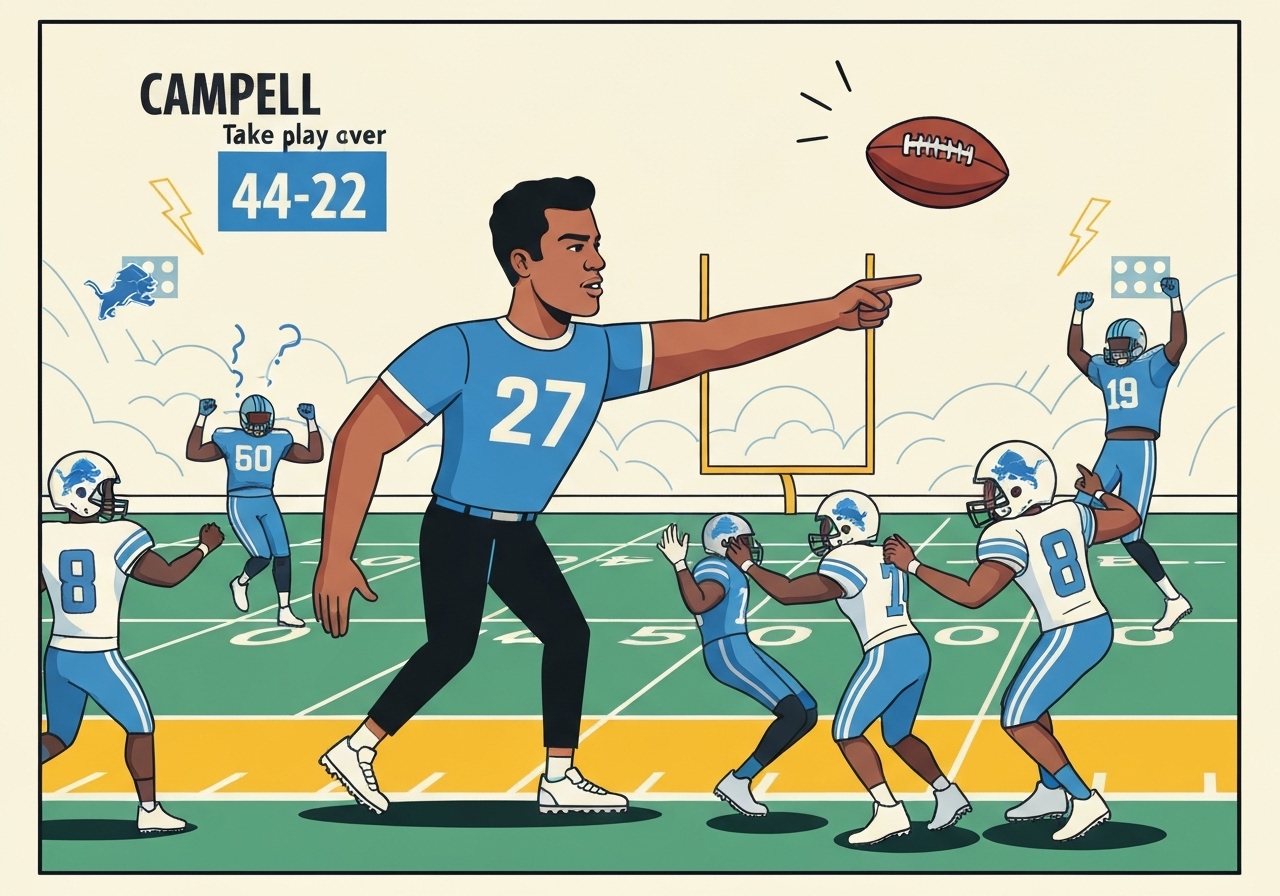
Head coach Dan Campbell assumed primary offensive play-calling duties in today’s 44-22 victory over the Washington Commanders, saying he wanted to “try something a little different” to jump-start the unit. Campbell told reporters he made the change because the offense needed a spark but stressed that offensive coordinator John Morton remained an active contributor to play selection. The shift coincided with wide receiver Jameson Williams posting a season-high performance — six catches for 119 yards — helping the Lions sustain drives and finish with a comfortable margin. Coaches and players described the move as collaborative, not a unilateral demotion of Morton.
- Dan Campbell served as the Lions’ primary offensive play caller in the 44-22 win over the Commanders; he said the change was meant to inject urgency into the offense.
- Jameson Williams recorded six receptions for 119 yards, a season-high output and the most productive game of his campaign to date.
- Offensive coordinator John Morton continued to provide input on calls despite Campbell assuming play-calling duties.
- Morton had acknowledged two weeks earlier that the game plan had underutilized Williams; the adjustment was visible in this game.
- The scoring margin (44-22) reflected offensive balance in this contest, with improved passing efficiency and sustained drives.
Background
Dan Campbell, the Detroit Lions’ head coach, has long been known for a direct, hands-on leadership style that blurs traditional lines between coaching roles. Play calling in the NFL often sits with an offensive coordinator, but head coaches who assume that duty can change tempo and emphasis quickly. John Morton, the Lions’ offensive coordinator, has worked closely with Campbell on schematic implementation; team leadership described their relationship as collaborative before this game. Two weeks prior, Morton publicly acknowledged that the offense had not involved Jameson Williams enough, a recognition that set expectations for tactical adjustments.
The Lions entered the matchup seeking more consistent production from their receiving corps and clearer situational play-calling on third downs and in the red zone. Campbell’s decision to take over calls is part of a broader trend in the league where head coaches sometimes intervene when offensive output stalls. Those interventions can be temporary, strategic gambits or signals of longer-term philosophical shifts, depending on results. For Detroit, the immediate result was a high-scoring outing and a visible increase in tempo and formation variety.
Main Event
During the game, Campbell periodically relayed plays from the sideline and made in-game adjustments he said were intended to exploit defensive alignments. He noted after the contest that he “knew what I wanted to do” and described the approach as both intentional and consultative. Morton remained on the headset and offered schematic input; Campbell emphasized that calls were informed by a dialogue rather than a complete handoff. The offense responded with a more targeted use of Jameson Williams, who beat single coverage on multiple attempts and turned short throws into chunk gains.
Campbell’s choice to call plays coincided with a more aggressive approach on early downs, leading to longer possessions and fewer three-and-outs. The Lions mixed run and pass concepts in series to create favorable matchups, while using motion and pre-snap looks to clarify defensive coverage. Special teams and turnovers did not materially alter the outcome; the 44-22 scoreline reflected sustained offensive productivity rather than an anomalous return or defensive collapse. Coaches said the execution, not just play selection, was central to the day’s success.
Analysis & Implications
The immediate implication is tactical: a head coach calling plays can accelerate in-game adjustments and compress the decision loop from scouting report to play call. For Detroit, Campbell’s intervention addressed a short-term problem—getting Williams more involved—and produced measurable returns. Over the medium term, teams will watch whether Campbell repeats this role or returns play-calling duties to Morton; continuity matters for installation of a coherent offensive identity.
For John Morton, the situation is nuanced. Remaining part of the decision-making process preserves his schematic voice, but sharing or yielding play-calling responsibilities can be seen as a performance signal if it becomes recurrent. NFL organizations often balance accountability with collaborative problem-solving; how the Lions allocate responsibilities after this win may indicate whether this was a tactical experiment or the start of a pattern.
For Jameson Williams, the game offers concrete evidence that targeted play design and consistent opportunities can unlock his production. A season-high 119 yards validates prior concerns about underutilization and may shift defensive game-planning against Detroit in coming weeks. Opponents will likely adjust coverage and leverage personnel to limit his deep-threat snaps, so sustaining this output will require scheme variation and continued attention from coaches.
| Player | Catches | Yards |
|---|---|---|
| Jameson Williams | 6 | 119 |
The table isolates Williams’ box score for this matchup; coaches noted that play design and target distribution shifted to create his opportunities. While one game does not define a season, the performance corrects a specific critique Morton acknowledged two weeks earlier and provides a baseline for future planning.
Reactions & Quotes
“Let’s try something a little different. I know what I want to do, I know how I want to do it.”
Dan Campbell, Detroit Lions head coach
Campbell framed the move as a strategic adjustment rather than a rebuke, stressing collaboration with his staff in subsequent comments. Coaches and players described the sideline exchanges as cooperative, with Morton still informing sequencing and personnel choices.
“We needed to get Jameson more involved — that was on me two weeks ago.”
John Morton, Lions offensive coordinator (acknowledged earlier)
Morton’s prior admission set expectations that play-calling or alignment changes could follow. His acceptance of responsibility two weeks ago contextualized the adjustments seen when Campbell assumed play-calling responsibilities.
Unconfirmed
- Whether Campbell will retain primary play-calling responsibilities in future games is not confirmed and was not declared as a permanent change.
- Internal staff conversations about long-term changes to Morton’s role or title have not been publicly disclosed and remain unverified.
- Whether opponents will specifically game-plan to neutralize Williams based on this single performance is speculative at this stage.
Bottom Line
Dan Campbell’s decision to take over play calling produced an immediate offensive uptick, evidenced by a 44-22 victory and a season-best showing from Jameson Williams. The move addressed a previously identified usage issue and showcased how tactical changes can yield short-term gains. However, the long-term effect on staff roles and offensive identity remains unsettled; the Lions will need sustained results to justify a permanent reallocation of play-calling responsibilities.
For observers, the key items to watch are whether the Lions replicate this level of production with Campbell calling plays, how Morton’s role evolves, and whether Williams can sustain increased involvement against forthcoming opponents. This game offered a clear corrective action with measurable outcomes, but confirmation will come only with follow-up performance and official organizational decisions.
Sources