
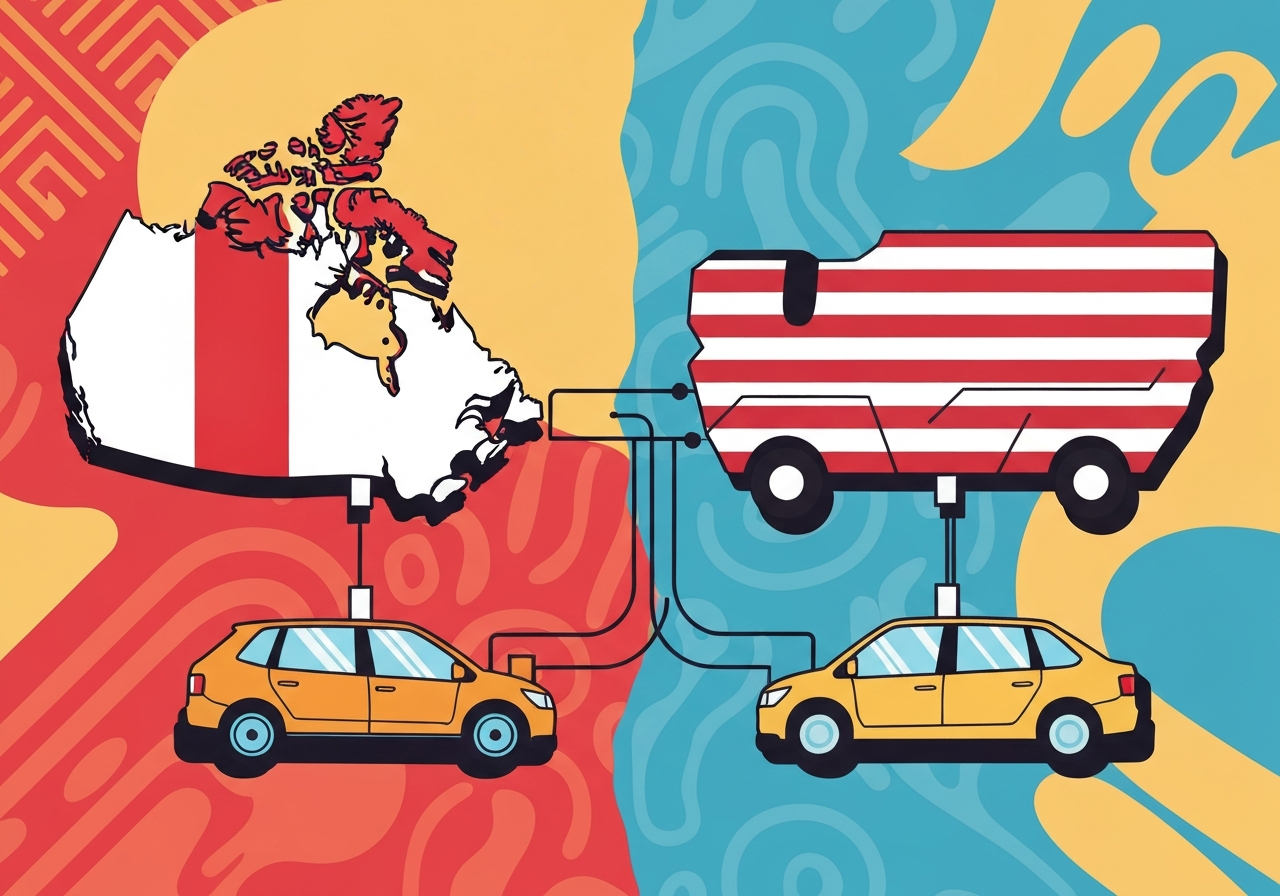
On Feb. 5, 2026, Prime Minister Mark Carney announced a package of multibillion-dollar incentives and tax breaks aimed at reshaping Canada’s auto sector around electric vehicles. The moves, unveiled at an auto parts plant in Woodbridge, Ontario, are positioned as a bid to make Canada a global EV manufacturing hub and to reduce dependence on a single export market. Carney framed the plan as a response to recent U.S. trade measures, including a 25 percent U.S. tariff on Canadian-made vehicles, and pledged government support to preserve jobs and attract investment. The announcement signals a deliberate economic pivot with immediate policy incentives and longer-term industrial strategy.
Key Takeaways
- On Feb. 5, 2026, Prime Minister Mark Carney announced multibillion-dollar incentives and tax breaks to accelerate electric-vehicle (E.V.) investment in Canada.
- Carney made the announcement at an auto parts factory in Woodbridge, Ontario, emphasizing national economic resilience.
- Canada’s auto sector employs about 125,000 workers and exports roughly 90 percent of its vehicles to the United States.
- The U.S. has imposed a 25 percent tariff on Canadian vehicles, a policy Carney cited as a driver of the new strategy.
- The package combines direct incentives and tax measures intended to lure manufacturers and supply-chain investment to Canada.
- Officials presented the plan as both an industrial policy and a geopolitical response to strained Canada–U.S. trade relations.
- Industry transformation toward batteries and electric drivetrains is central to the strategy, with a focus on domestic value capture.
Background
Canada’s auto industry has long been integrated with the United States through tightly woven supply chains and cross-border assembly operations. The sector directly employs about 125,000 people and supports many thousands more in parts, logistics and services; historically, roughly 90 percent of Canadian-made vehicles have been exported to the U.S. market. That dependence has left Canada vulnerable to shifts in U.S. policy, and recent measures in Washington have prompted Ottawa to rethink risk exposure and industrial priorities.
In late 2025 and early 2026 the bilateral relationship grew more fraught as the U.S. expanded trade pressure on goods including automobiles. The most disruptive measure for the auto sector has been a 25 percent tariff on vehicles originating in Canada, which industry groups say could sharply reduce demand for Canadian-built cars in their largest market. Policymakers in Ottawa have been exploring a mix of protective steps and proactive industrial policy options — including incentives for emerging technologies — to stabilize employment and reposition the supply chain.
Main Event
Prime Minister Carney delivered the policy package at an auto parts plant in Woodbridge, Ontario, flanked by provincial and industry officials. He described the measures as a concentrated effort to catalyze EV production, citing both immediate financial incentives and longer-term tax provisions designed to lower the cost of capital for manufacturers. Officials said the federal plan will target investment in battery manufacturing, electric drivetrains and advanced parts production, though they did not list every company that would receive support in the initial announcement.
The government characterized the program as a direct response to trade pressure from the United States, arguing that a stronger domestic EV ecosystem will reduce exposure to single-market shocks. Carney framed the move in national terms, telling reporters that Canada must “take care of ourselves” and adapt where external policy choices have created economic risk. He said the package aims to preserve jobs and attract new industrial activity, positioning Canada as a competitive alternative for global automakers considering EV investments.
Officials provided few immediate implementation details on timelines or precise disbursement amounts beyond the overall “billions” description, saying program guidelines and eligibility would be published in coming weeks. Industry groups and some provincial leaders welcomed the headline commitment but immediately sought clarity on how funds would be allocated across assembly, parts, battery production and workforce training. The announcement closed a political loop in which industrial strategy and trade policy intersected, setting up negotiations with manufacturers and unions over guarantees and conditions tied to subsidies.
Analysis & Implications
The policy shift marks a clear industrial pivot: Ottawa is using state incentives to accelerate structural change toward electric mobility. By channeling funds and tax breaks to battery and EV supply chains, the government intends to capture more of the value created in vehicle production, rather than remaining primarily an assembly base for vehicles designed and financed elsewhere. If the incentives succeed, Canada could deepen domestic manufacturing of higher-value components and reduce vulnerability to tariff-driven demand shocks.
However, the strategy faces material hurdles. Global automakers are weighing many factors when locating EV investments, including proximity to markets, costs, labor relations, and access to raw materials for batteries. Canada’s ability to compete will depend on the scale and predictability of incentives, regulatory clarity, and its ability to secure inputs such as battery minerals and skilled labor. The 25 percent U.S. tariff remains a significant headwind for exports to the U.S. unless mitigated by new trade arrangements or reciprocal policy changes.
There are also fiscal trade-offs. Multibillion-dollar subsidies and tax breaks require long-term budgetary commitments, and policymakers will be judged on whether investments translate into durable jobs and domestic value capture. Economists note that poorly targeted subsidies can distort location decisions; conversely, carefully calibrated incentives that tie support to local investment and employment outcomes can stimulate meaningful industrial transformation. The next phase will test Ottawa’s capacity to translate headline commitments into concrete, measurable results.
Comparison & Data
| Metric | Canada (noted) | Context / Notes |
|---|---|---|
| Auto industry employment | ~125,000 | Direct jobs in manufacturing and assembly, per government reporting cited |
| Share of vehicles exported to U.S. | ~90% | Proportion of Canadian-made vehicles sent to U.S. market |
| U.S. tariff on Canadian vehicles | 25% | Applied by the United States and cited by Ottawa as a key pressure |
| Federal investment pledged | “Billions” (broadly described) | Precise totals and program breakdown to be published by the government |
The table summarizes the core numeric anchors discussed by officials: employment (about 125,000), export dependence (about 90 percent to the U.S.) and a 25 percent U.S. tariff. Officials have described the financial package only at a high level, so program-level allocations and performance metrics remain pending. These figures frame the challenge Ottawa faces in converting financial commitments into jobs and supply-chain resilience.
Reactions & Quotes
Government statements and early commentary show a mix of political messaging and guarded industry optimism. Officials pitched the plan as both a defensive and strategic step; industry stakeholders are publicly receptive but are seeking detail on implementation.
“We must take care of ourselves. We cannot control what others do.”
Prime Minister Mark Carney
“Canada is an auto nation; the auto industry is central to our story,”
Prime Minister Mark Carney
“This package could reshape where automakers place battery and parts investments in North America, if the rules and scale are right,”
Industry analyst (comment)
Each quote above was offered in the context of the Woodbridge announcement. Carney’s remarks framed the move as national economic self-protection and industrial ambition. Analyst commentary underscores that outcomes will hinge on program design, scale, and follow-through by both government and private firms.
Unconfirmed
- Precise total of the federal multibillion-dollar package has not been published in full; detailed fiscal commitments are pending official program documents.
- Which specific automakers or battery suppliers will receive funding remains unclear and is subject to agencies’ future announcements.
- Whether the U.S. tariff policy will change in response to the Canadian plan is not confirmed and depends on future diplomatic and trade negotiations.
Bottom Line
Prime Minister Carney’s announcement on Feb. 5, 2026, signals a decisive Canadian effort to pivot the auto industry toward electric vehicles and to blunt the economic impact of strained U.S. trade policy. The combination of incentives and tax breaks aims to attract higher-value manufacturing and reduce reliance on a single export market that accounts for roughly 90 percent of Canadian vehicle shipments. Implementation details and program scale will determine whether the package delivers durable jobs and deeper domestic supply chains or becomes a costly short-term response.
Observers should watch for the government’s forthcoming program guidelines, the list of beneficiary firms, and any conditionality tied to local content or employment. The interplay between Ottawa’s industrial policy and Washington’s tariff posture will shape North American auto investment flows in the coming years, with implications for workers, suppliers and national competitiveness.
Sources
- The New York Times — news report (article covering Carney’s Feb. 5, 2026 announcement)