
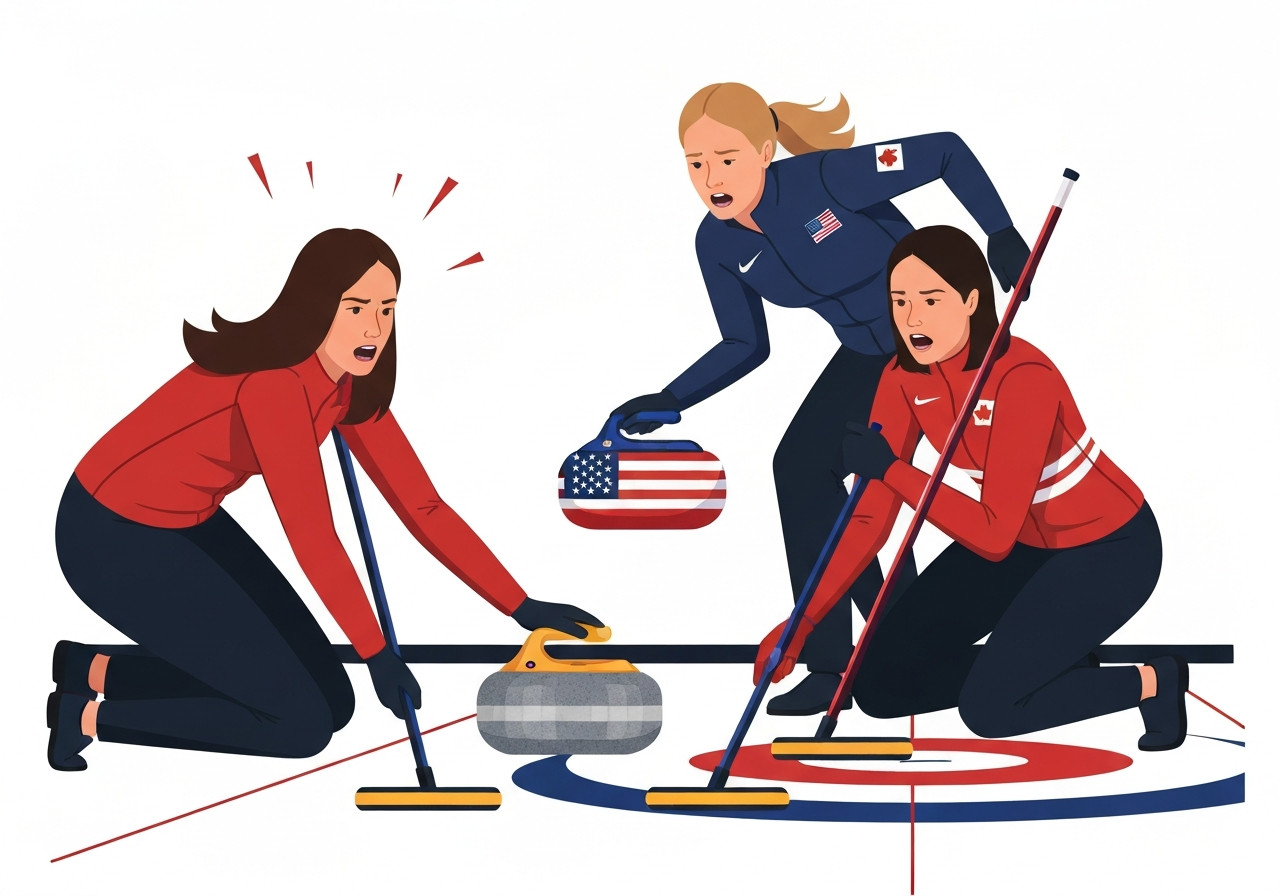
Lead: At the Milan Cortina Games on Feb. 20, 2026 in Cortina d’Ampezzo, top-ranked Canada and the United States were eliminated in the women’s Olympic curling semifinals. Sweden, led by Anna Hasselborg, defeated Canada 6-3 to reach Sunday’s gold-medal match. Switzerland, skipped by Silvana Tirinzoni, beat the U.S. 7-4 and will contest gold against Sweden. Canada and the United States will meet Saturday for the bronze medal.
Key Takeaways
- Sweden (ranked No. 12) upset top-ranked Canada 6-3 in the women’s semifinal on Feb. 20, 2026, securing a place in the gold-medal game.
- Silvana Tirinzoni’s Switzerland defeated the United States 7-4 to advance to the final and pursue its first Olympic women’s gold.
- Sweden has now reached the Olympic women’s final with three overall Olympic titles since curling returned in 1998.
- Canada, already shut out of mixed-team medals at these Games, will play the U.S. for bronze on Saturday in Cortina d’Ampezzo.
- In the men’s tournament, Canada will face Britain for gold on Saturday; Norway and Switzerland played for bronze later on Feb. 20, 2026.
- The Canadian men’s squad has been under scrutiny after accusations that several players double-touched the rock, a rules infraction attracting attention beyond curling circles.
Background
Curling returned to the Olympic program in 1998, and the sport’s landscape has often been defined by a handful of nations: Canada, Sweden and Switzerland among them. Canada has been the dominant force at world championships and Olympics historically, but recent years have seen Sweden and Switzerland close the gap with consistent podium finishes. Switzerland earned silver at the last two world championships behind Canada after four consecutive world titles prior to that streak, illustrating the depth of the Swiss program. The Milan Cortina Games have brought familiar rivalries into sharper focus, with medal rounds concentrated in Cortina d’Ampezzo and high-stakes matchups scheduled over a compact final-week timetable.
Off-ice issues have also become part of the tournament narrative. The Canadian men’s team faced allegations of double-touching the rock — a technical breach under the World Curling Federation rules — prompting debate about officiating and possible penalties. While that controversy concerns the men’s event, it has affected wider attention on curling at these Games. National federations, broadcasters and the sport’s governing body have all been monitoring both competitive and regulatory developments closely. That scrutiny contributes to a tense environment as teams approach medal matches.
Main Event
The women’s semifinal between Sweden and Canada unfolded with steady strategic play from both sides, but Sweden converted key opportunities to build and protect a lead. Anna Hasselborg’s rink produced the decisive scoring ends, limiting Canada to single points and capitalizing on open-house situations to finish 6-3. On the other side of the draw, Silvana Tirinzoni’s Swiss team managed a 7-4 victory over the United States through measured takeouts and strong hammer control late in the game. Both semifinals demonstrated the importance of end-by-end discipline: missed double-takes and a handful of misses proved costly for the North American teams.
With their semifinal wins, Sweden and Switzerland advance to the women’s gold-medal match set for Sunday; the bronze fixture between Canada and the U.S. is scheduled for Saturday. The Swiss rink arrives with recent international momentum—silver at the past two world championships—while Sweden’s Olympic pedigree includes three previous women’s titles since 1998. The venue in Cortina d’Ampezzo has hosted packed sessions and heightened media attention as the schedule reached its climax. Athletes and coaches began adjusting tactical plans for the medal games immediately after play concluded Thursday and Friday evening.
Analysis & Implications
Sweden’s win over Canada reinforces how Olympic curling outcomes can pivot on a few precise shots and momentum swings; a lower-ranked team can prevail by forcing errors and managing the scoreboard. For Canada, a semifinal loss represents a setback for a nation long viewed as the sport’s benchmark, sharpening internal questions about selection, strategy and performance under Olympic pressure. The U.S. defeat to Switzerland highlights the growth of European programs that now routinely challenge North American dominance at major events.
Switzerland reaching the final signals the effectiveness of its development pathway, which has produced consistent world-level results—including a run of golds at world championships followed by two silvers. A first Olympic women’s gold for Switzerland would mark a milestone for that program and could reframe funding and training priorities at home. For Sweden, another Olympic final appearance underscores sustained elite performance and could further validate its coaching and athlete-rotation models.
Beyond national programs, these results may influence how teams approach the Olympic format in future cycles: emphasis on end-game strategy, ice-reading consistency and mental resilience will likely be reinforced. Broadcast and sponsor interest tends to grow when traditional powers are challenged, potentially broadening curling’s audience in markets beyond Canada and the U.S. Finally, the men’s-team controversy over alleged double-touch infractions may prompt the World Curling Federation and national bodies to examine rule enforcement and education before Paris 2028 and other major championships.
Comparison & Data
| Team | Olympic Rank | Semifinal Score (Feb. 20, 2026) | Recent Worlds (2024–25) |
|---|---|---|---|
| Sweden | 12 | 6–3 vs. Canada | Top-tier finishes, multiple medals historically |
| Switzerland | N/A | 7–4 vs. USA | Silver at 2024 & 2025 Worlds |
| Canada | 1 | 3–6 vs. Sweden | Multiple recent podiums and world titles |
| United States | N/A | 4–7 vs. Switzerland | Competitive with intermittent podiums |
The table above summarizes semifinal outcomes and recent world championship context. While Olympic seeding does not always predict medal outcomes, world-championship performance offers a useful barometer of program depth. Switzerland’s consecutive world silvers (2024–25) underline their readiness to challenge for top Olympic honors despite not having claimed a women’s Olympic gold. Sweden’s history of Olympic success contrasts with its lower seeding at these Games, illustrating the episodic nature of tournament rankings.
Reactions & Quotes
Team and federation responses arrived quickly after the semifinals, underscoring both local pride and broader program concerns. Team Sweden and Team Switzerland framed their wins as the result of disciplined shots and tactical clarity, while Canadian and U.S. spokespeople acknowledged missed opportunities and vowed to regroup for the bronze match.
“We’re thrilled to be in the final and we’ll focus on executing our plan on Sunday.”
Team Sweden (post-match statement)
That succinct post-match message from Sweden emphasized focus rather than celebration, a common posture ahead of championship finals. Swedish team officials highlighted ice reading and shot-making as decisive factors in the victory, pointing to preparation routines that helped their squad adapt to Cortina’s playing surface.
“We left shots on the table today and will come back stronger for the bronze contest.”
Team Canada (coach statement)
Canada’s reaction centered on accountability and immediate recovery, with coaching staff stressing reset and tactical adjustments for the bronze-medal game against the U.S. Canadian curling administrators said they would review performance metrics from the semifinal to inform short-term fixes.
Unconfirmed
- Specific disciplinary outcomes or sanctions related to the Canadian men’s double-touch allegations have not been publicly finalized as of Feb. 20, 2026.
- Any internal roster or selection changes for national teams ahead of future championships remain subject to federation decisions and have not been confirmed.
Bottom Line
The women’s semifinals at the Milan Cortina Games produced a clear message: Olympic curling remains unpredictable, and historical ranking does not guarantee medal success. Sweden and Switzerland now contest gold on Sunday, while Canada and the United States must refocus quickly for a battle over bronze on Saturday.
Longer term, these results highlight a continuing shift toward greater parity in international curling, with European programs consistently challenging North American favorites. Federations and stakeholders will likely scrutinize technical preparation, rule enforcement and mental-game support as teams look to close small margins that decide Olympic medals.