
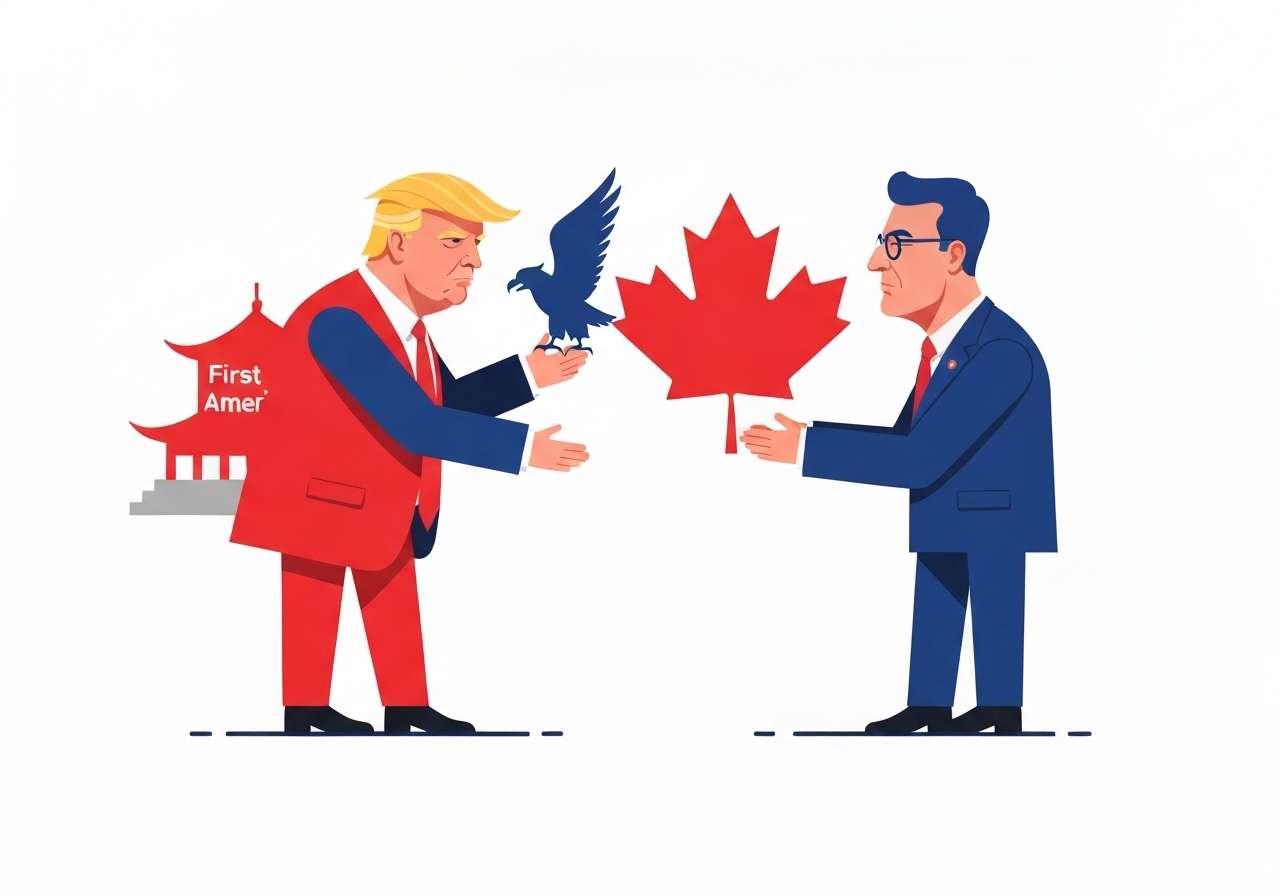
Lead
Canadian prime minister Mark Carney arrives in Beijing in January for a state visit aimed at repairing a relationship strained over the past decade. The trip is the first time a Canadian leader has been welcomed in Beijing in nearly ten years and comes amid rupturing global alliances and escalating economic pressure from the United States. Ottawa frames the visit as an effort to build a “stable” channel with Xi Jinping’s government while seeking new markets to offset U.S.-driven trade pain. The visit could yield near-term trade accords but also requires careful diplomacy around human rights and strategic-sector risks.
Key Takeaways
- Mark Carney’s January state visit is the first Canadian prime ministerial welcome in Beijing in nearly a decade, timed to reset bilateral ties.
- Canada still sells a large majority of exports to the U.S. — about 76% — while China accounts for roughly 4% of Canadian exports.
- Beijing has retaliated with punitive measures: 100% duties on Canadian canola oil and meal and an added 75.8% anti‑dumping tariff that effectively shut producers out of the market.
- Canada joined U.S. tariffs on Chinese electric vehicles in 2024, a move that helped trigger further Chinese trade penalties.
- Former diplomat Michael Kovrig and Michael Spavor were detained for more than 1,000 days after the 2018 Meng Wanzhou case, a rupture that stalled free‑trade prospects.
- Carney has pursued a “reliance to resilience” plan to diversify away from U.S.-centric trade while also advancing an Indo‑Pacific strategy for new partnerships.
- Analysts warn that China offers scale but limits on repatriating profits and risks in strategic sectors — especially AI, aerospace and critical minerals.
Background
Canada’s relationship with China has been a rollercoaster since 2018, when Beijing detained two Canadian citizens — Michael Kovrig and Michael Spavor — for more than 1,000 days in apparent retaliation for Canada’s arrest of Huawei executive Meng Wanzhou. The diplomatic standoff scuttled momentum toward a bilateral free‑trade agreement and hardened Ottawa’s view of Beijing as a complex partner: commercially important but politically adversarial. In parallel, allegations of Chinese electoral meddling and Arctic activity have added to Ottawa’s concerns about Beijing’s conduct.
Domestically, Ottawa has framed its economic policy around reducing vulnerability to external shocks. The United States bought about 76% of Canadian exports until recent policy shifts under an “America First” approach in Washington. Those U.S. moves — and the broader fracturing of supply chains — have pushed Carney to seek new markets and to accelerate Canada’s Indo‑Pacific outreach while also reopening channels in Beijing despite thorny political differences.
Main Event
Carney’s January state visit follows a series of incremental diplomatic steps. In September he met Chinese premier Li Qiang, and roughly a month later he held a short exchange with President Xi Jinping on the sidelines of an international summit in South Korea. Officials describe the visit as a deliberate, staged effort to move from guarded contact to more substantive discussions on trade, energy and security.
The agenda in Beijing is expected to focus on energy exports, agricultural market access and potential bilateral investment agreements. Ottawa is pressing for removal of punitive duties — notably the 100% canola duty and the 75.8% anti‑dumping additional levy — while Beijing seeks predictable resource supplies and new commercial ties. Canadian ministers have already engaged Chinese counterparts in a sequence of meetings that lay the groundwork for the state visit.
Behind the formal meetings, Ottawa’s briefers stress they have no illusions about the Chinese leadership. Michael Kovrig and other analysts say Beijing now markets competence and predictability rather than political benevolence, and that Ottawa must calibrate bargaining leverage against human‑rights and security concerns. Carney’s team intends to use commercial openings to secure diversification while pressing privately on detainee cases and other outstanding disputes.
Analysis & Implications
Economically, a successful visit could produce near‑term agreements that restore partial market access for commodities such as canola and timber — moves that would provide immediate relief to affected producers. Yet experts caution that many foreign firms face limits on repatriating earnings in China, and profit patterns in that market often favor state‑linked local partners. That reality tempers expectations that bigger exports to China will fully substitute for U.S. sales.
Strategically, the trip signals a pragmatic shift: Ottawa accepts that routine trade and diplomatic engagement with China are necessary for prosperity, even as it continues to scrutinize strategic risks. Carney’s “reliance to resilience” aim seeks to reduce single‑market dependency, but rapid diversification is difficult; supply chains, investment ties and regulatory regimes do not change overnight.
Politically, any rapprochement will face domestic scrutiny. Critics warn that reopenings must not grant Beijing access to sensitive sectors. Officials such as Margaret McCuaig‑Johnston explicitly urge caution for aerospace, artificial intelligence and critical minerals, pointing to instances where joint ventures left Canadian firms disadvantaged. Balancing commercial gains with national security safeguards will be a central policy challenge.
Comparison & Data
| Partner / Indicator | Share or Measure |
|---|---|
| United States — share of Canadian exports | ≈ 76% |
| China — share of Canadian exports | ≈ 4% |
| Chinese duties on Canadian canola | 100% + 75.8% anti‑dumping levy |
| Detention of Kovrig & Spavor | > 1,000 days (since 2018) |
The table underlines the asymmetry Canada faces: a heavy export concentration toward the United States and a relatively small share going to China, even though Beijing’s market power can inflict large sectoral shocks via tariffs and duties. Restoring partial access to Chinese markets could materially help specific industries without solving the broader structural reliance on the U.S. market.
Reactions & Quotes
Officials and analysts offered measured responses ahead of the visit, combining hope for commercial relief with caution about strategic exposure.
“There is a risk that China views Canada as weak…it sees an opportunity to present itself as the reasonable and stable adult in the room.”
Michael Kovrig, former diplomat and ICG Asia adviser
Kovrig framed the visit as both an opening for negotiation and a reminder of Beijing’s leverage. He urged Carney to press on rights and detainee issues even as he seeks trade concessions.
“It’s important to remember that China is not our friend…the geopolitical and transnational repression risks have not changed.”
Margaret McCuaig‑Johnston, senior fellow, University of Ottawa
McCuaig‑Johnston emphasized the need for strict guardrails on sensitive technology and warned against uncritical openings in sectors that affect national security.
“The logic was that it’s possible to trade with China while working on points of difference — you can walk and chew gum at the same time.”
Roland Paris, director, Graduate School of Public & International Affairs, University of Ottawa
Paris described the visit as part of a careful, incremental diplomatic dance designed to manage differences while pursuing mutual interests.
Unconfirmed
- Whether Beijing will remove the 100% canola duties and the 75.8% anti‑dumping tariff during or immediately after the visit remains unconfirmed.
- It is not yet confirmed whether the state visit will include concrete commitments on prisoner cases or only private representations on detainees.
- Any large‑scale Chinese investment pledge in Canadian clean‑energy technology or critical minerals has not been publicly announced and should be treated as tentative until formal agreements appear.
Bottom Line
Carney’s Beijing visit is a pragmatic attempt to expand Canada’s economic options after a period of acute U.S.‑driven friction. Expect modest, sector‑specific gains that can provide political breathing room for affected producers, but do not expect a rapid structural shift in export patterns — the dependence on U.S. markets is deep and will take years to change.
Diplomatically, Ottawa walks a narrow line: it must pursue commercial relief while protecting strategic sectors and defending core values. The success of the trip will be measured not only by tariff headlines but by the safeguards Ottawa secures for technology, investment screening and human‑rights advocacy carried out through private diplomacy and public pressure.