
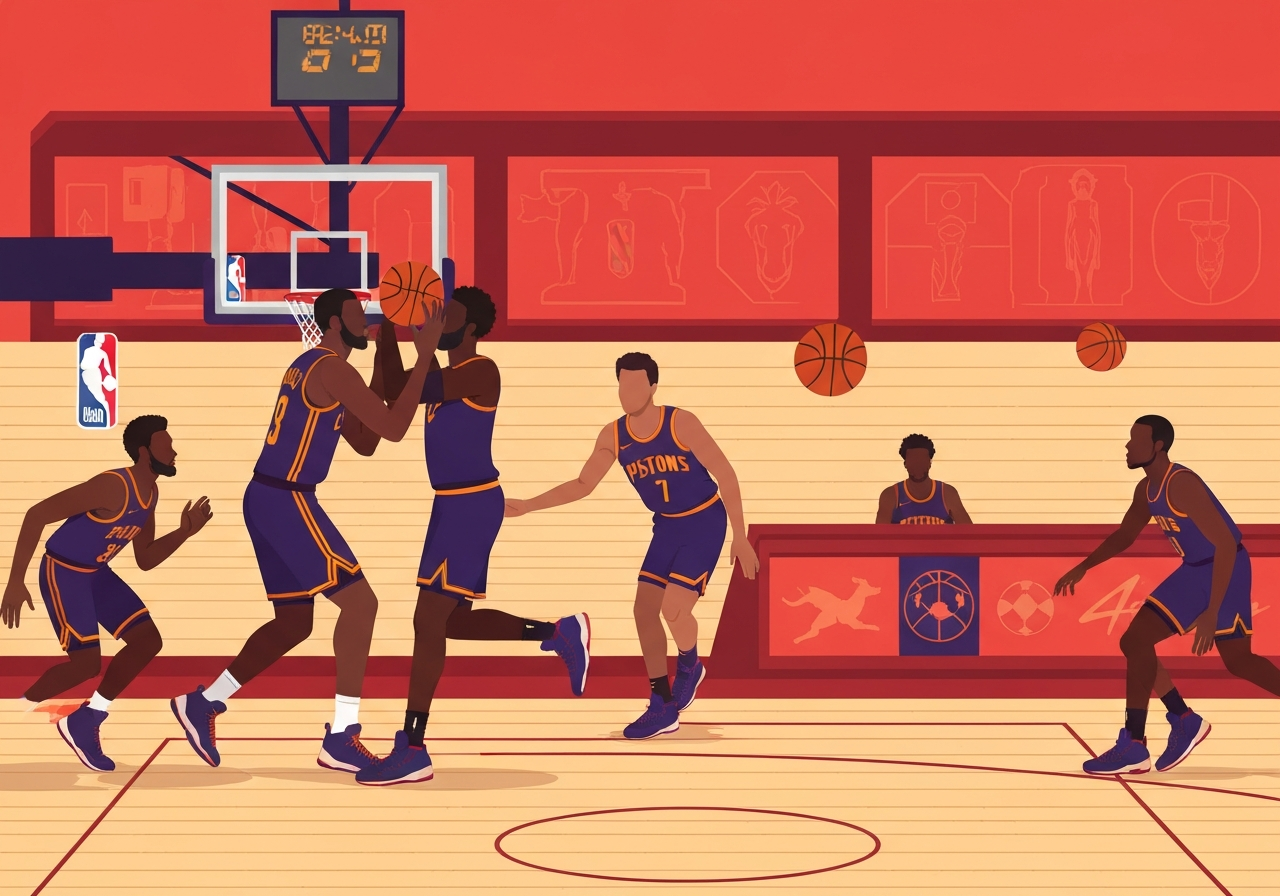
Lead: Cleveland’s defense throttled Detroit in a 113-109 victory Tuesday night, holding All-Star guard Cade Cunningham to 10 points and 4-for-16 shooting while forcing the Pistons to rely on low-percentage outside options. The Cavs repeatedly crowded Cunningham—using Jaylon Tyson, James Harden, Dennis Schröder and roamers Evan Mobley or Jarrett Allen—to shrink driving lanes and invite thin jumpers. Jalen Duren finished with opportunities that went begging amid the traffic, and Detroit’s role players seldom supplied reliable spacing. The result highlighted a structural weakness for the Pistons that could be decisive in a playoff meeting.
Key takeaways
- Cleveland defeated Detroit 113-109, limiting Cade Cunningham to 10 points (tied season low) on 4-for-16 shooting (25%) with 14 assists.
- The Cavs defended the rim aggressively; Detroit shot 36.4% at the rim in the first half and was blocked or altered frequently by Evan Mobley and Jarrett Allen.
- Against Cleveland this season Cunningham averages 19 points per game on 34% shooting in four meetings—six points below his season scoring average (25.0).
- Among Detroit’s top-10 players by minutes, only Duncan Robinson and Tobias Harris have career three-point percentages above 36%, limiting reliable spacing.
- Jalen Duren is the only non-Cunningham Piston with a usage rate above 20%, placing heavy playmaking burden on Cunningham.
- Cleveland’s strategy was deliberate: force Cunningham to make choices between contested finishes and pass-dependent, low-percentage shooters.
- Bench and role-player shooting variance (Javonte Green, Ron Holland) proved a gamble that could swing games but isn’t steady enough for a playoff series.
Background
The Pistons have surged this season behind Cade Cunningham, who ranks 12th in scoring and second in assists per game — a rare two-way creator and an MVP candidate. Detroit’s rise has been powered by Cunningham’s playmaking and the emergence of young pieces, but the roster still lacks consistent perimeter shooting beyond a couple of veterans. That mix has produced offensive wrinkles in the regular season but also a clear structural trade-off: when Cunningham is hunted, other options often do not punish help defenders from beyond the arc.
Cleveland entered the matchup with defensive assets built for that precise problem. Evan Mobley, last season’s Defensive Player of the Year candidate and a top rim protector, plus Jarrett Allen, give the Cavs freedom to hedge and rotate without surrendering the paint. Coach Kenny Atkinson has frequently invoked a ‘pick your poison’ framework — live with a particular spot-up threat or funnel playmakers into congested paint—and Tuesday’s game was a practical demonstration of that philosophy.
Main event
With 1:22 remaining, Cunningham drove through heavy traffic and improvised a behind-the-back assist to Jalen Duren. Duren missed the easy look in an emblematic moment that captured Detroit’s night: great creation, poor finishing from teammates. Cleveland’s defenders—Jaylon Tyson sticking on Cunningham, James Harden and Dennis Schröder stunting—left little clean space for the All-Star to operate on his own.
Evan Mobley’s paint roaming altered several Detroit possessions. By sagging when non-shooters like Ausar Thompson or Isaiah Stewart had the ball, Mobley could leave his base and clog driving lanes preemptively; the Cavs credited that tactic for holding Detroit to 36.4% at the rim in the opening half. The Pistons repeatedly found themselves choosing the high-risk option: drive into a wall or kick to low-percentage shooters.
Detroit’s supporting cast produced mixed results. Javonte Green (career 34.2% 3PT) and Ron Holland (career 23.7% 3PT) hit a few threes that would have been costly if Cleveland had lost, but both profiles are inconsistent enough that Atkinson and the Cavs were comfortable daring them to shoot. Sam Merrill summarized the defensive trade-off: protect the rim first, then contest threes when safe.
Analysis & implications
Cleveland’s plan exposed a core playoff question for Detroit: can the Pistons find dependable shooters and finishers to complement Cunningham? A round-two matchup between these teams would hinge on Detroit’s role players consistently converting open jumpers and finishing at the rim. If they fail to do so, the Cavs can continue to funnel play into Mobley or Allen and let help defense do the heavy lifting.
Statistically, forcing a pass-first star into more assists is less costly than allowing that star repeated high-efficiency finishes at the rim. Cleveland accepted 14 assists to Cunningham but kept his direct scoring to 10 points; in a seven-game series, limiting a star’s direct scoring while living with secondary shooting can flip outcomes. That said, a few anomalous shooting nights by Detroit shooters (Green, Holland) could tilt individual games, so the Cavs’ approach carries short-term variance even if it’s sound long-term.
For the Pistons, roster construction is the central challenge. Detroit’s top rotation includes only two reliable 36%+ three-point shooters (Duncan Robinson and Tobias Harris), and usage rates show minimal secondary playmaking beyond Duren. Without added shooting or a more diversified offensive load, defenses can prioritize Cunningham and make role players beat them. The front office faces a clear offseason remit: upgrade spacing and finishing to convert regular-season sparks into playoff viability.
Comparison & data
| Measure | Season / vs CLE |
|---|---|
| Cunningham scoring (season avg) | 25.0 ppg |
| Cunningham vs Cleveland (4 games) | 19.0 ppg, 34% FG |
| Tuesday game | 10 points, 4-16 FG (25%), 14 ast |
| Detroit rim FG% (1st half) | 36.4% |
The table clarifies how Cleveland suppressed Cunningham relative to his season norms and how Detroit’s rim effectiveness dropped in the early going. That floor protection and rim deterrence were decisive: when Cleveland’s bigs roam, driving lanes shrink and the offense tilts toward lower-percentage attempts.
Reactions & quotes
“It’s hard for coaches because you got to pick your poison,”
Kenny Atkinson, Cleveland coach
Atkinson summarized the defensive choice: identify the bigger threat and dare the rest to shoot. That philosophy informed rotations and who Cleveland elected to close out on.
“Me being able to roam the paint and just cover up a lot of different things. It’s very beneficial for us,”
Evan Mobley, Cavs center
Mobley framed his role as preemptive: by leaving his base against non-shooters he can prevent drives before they start, sacrificing traditional anchor positioning for disruptive reach.
“The main goal of every single team is still to put pressure on the rim first and foremost,”
Sam Merrill, Cavs guard
Merrill stressed that contested rim play remains a defensive priority even as three-point shooting dominates league conversation.
Unconfirmed
- A Cavs-Pistons playoff meeting is possible but not guaranteed; seeding and postseason outcomes remain uncertain.
- Whether Javonte Green’s or Ron Holland’s recent three-point makes represent a lasting improvement or short-term variance is unresolved.
- The Pistons’ ability to add dependable shooters before a potential playoff series is a projection, not a confirmed front-office plan.
Bottom line
The Cavs’ 113-109 win showcased a clear defensive counter to the Pistons’ current construction: make Cade Cunningham pass and let role players decide games. That tactic succeeded Tuesday, holding Cunningham well below his season scoring output while accepting his assist totals as an acceptable tradeoff.
If Detroit hopes to translate its regular-season rise into postseason success, it must upgrade spacing and finishing so defenses cannot consistently collapse on Cunningham without punishment. Until those supporting components improve, Cleveland’s blueprint—aggressive rim protection, roaming bigs, and selective closeouts—remains a practical roadmap for slowing Detroit in a playoff series.